Showing posts with label economy streams. Show all posts

Friday, January 6, 2012

An short explanation on Thai debt: FIDF


The Nation: Opinion, 

Charm needed to sway the central bank on debt burden

Thanong Khanthong
December 30, 2011 1:00 am
The former finance minister is heading a committee to rehabilitate Thai industry and infrastructure in the aftermath of the worst floods in 50 years. To reconstruct the economy, the government needs money. But, due to all the populist spending pledges, it is broke. Virabongsa's task is to help the government find the money - at least Bt350 billion for the time being.
The easy target is the Bank of Thailand, to which the government could pass on the burden of an old debt so that it can create a new debt for fresh spending.
The government needs a personality of Virabongsa's stature to battle against the central bank, whose governor, Dr Prasarn Trairatvorakul, is drawing up a strong defensive line. The battle now looks ugly, centring on the debt of the Financial Institution Development Fund (FIDF), an arm of the central bank.
The ghost of the FIDF will not be laid to rest easily. Every time a new government steps in, it wants to find a way not to service the debt of the FIDF, which used taxpayers' money to bail out the financial institutions in the 1997 Asian financial crisis to the tune of Bt1.4 trillion. The FIDF debt now stands at about Bt1.1 trillion.
The Yingluck government does not want to service the annual interest payment of Bt45 billion for the FIDF. It wants the central bank to assume all the Bt1.1 trillion of FIDF debt so that it has room to create new debt.
Thailand's public debt has exceeded Bt4 trillion, equivalent to 40 per cent of the gross domestic product. If the FIDF debt of Bt1.1 trillion is deducted from the overall public debt, the governmentwould be in a position to create new debt for massive spending. The government, prior to the floods, leaked a "New Thailand Project", through which it plans to invest Bt900 billion in the economy.
The Pheu Thai politicians live up to their repurtation as big-time spenders.
If my memory is correct, Dr Virabongsa used to oppose any attempt to pass the FIDF debt to the central bank, arguing that doing so would compromise the financial and monetary discipline of the country. He appears to have gone through a change of heart. He would like the central bank to dig into its foreign exchange reserves of more than US$180 billion to pay off the FIDF debt.
Governor Prasarn is protecting the central bank's turf. The FIDF debt was incurred by the previous government (led by General Chavalit Yongchaiyudh), which offered a 100 per cent blanket guarantee of the public deposits and creditors while the banks and finance companies were failing. No government in the world has hitherto issued a Cabinet resolution to protect creditors' rights like the Thai government, which did so under the directive of the International Monetary Fund.
Since it is the policy of the government to protect the public deposits and the foreign creditors' money, it must keep its promise. In this regard, Prasarn is correct to have insisted that the government continue to pay the debt of the FIDF.
The BOT's foreign exchange reserves are not totally secure. Foreign investors could withdraw their money out of the country any time in the event of financial shocks. If they were to flee the country (by converting the baht for the dollar before taking the money out) like they did in 1997, Thailand could lose its reserves in a hurry.
The position of Thirachai Phuvanat-naranubala, the finance minister, on the FIDF debt is not clear. Initially he wants the BOT to study a plan to help the government reduce the debt of the FIDF. He realises that the central bank is losing money from its monetary operations, resulting in a negative net worth of more than Bt400 billion. He wants the BOT to share the burden, but he opposes an outright monetisation of the FIDF debt, which would destroy the credibility of the central bank. By the way, Thirachai used to serve as BOT deputy governor.
If the BOT were to totally monetise the Bt1.1 trillion FIDF debt, it would increase its negative net worth to Bt1.5 trillion. In this case, confidence in the baht would wobble. That is the road Zimbabwe has taken.
Today, Kittiratt Na Ranong, the deputy prime minister, will call a meeting to set a plan for the Finance Ministry and the BOT to work out the FIDF debt. The details remain shrouded in mystery. But politically speaking, the Yingluck government has already sent an unequivocal message that the BOT must take the whole burden of the FIDF debt.

Wednesday, April 20, 2011

Weekly Anecdotes-International Organizations Acronyms: WB

1. WB: The World Bank

"Why is the World Bank called the World Bank when its Presidents have always been American since its inception in 1944?" I wondered. "Why don't they just simply call it the American Bank for International Development?" Then we'd not have any illusions about its true agenda.

"Spoils of war"...(WWII) is how I would prefer to refer the Bretton Woods Organizations. Yes, yes, I acknowledge, these organizations did contribute a great deal to the development of our modern global economy as it is today...but... I think after six decades we can start to ask, "How long are we still going to live in the shadows of one of humanity's darkest moments?" I'm all for learning from history, but really, do we want to eternally keep tying the way we think of ourselves to our worst moments? 

Then there's also the question, "To whom do the benefits accrue? To the so-called developed countries or to the developing countries whose help it was to be committed to?" Or I could even be more to the point and say, "To the country that doesn't even attempt to search around for its best and brightest to appoint as this organization's head?"

These questions came up to me when I started looking closely at the World Bank's declared raison d'être and changing realities of the global economy. It's been only 10 years since China joined the club (WTO) as a world trading partner that agrees to follow the sanctioned rules of international trade. In 2011, she surpasses the US as world manufacturer. In her 2nd decade after joining the club, she is expected to overtake the US to become the world's largest economy. Even if things go bust, and she doesn't make it by 2020, there's still 2030, according to our esteemed World Bank. By 2040, the citizens of China could well be richer than the citizens of Europe at the present moment.

So if the World Bank is supposed to represent its member countries by their sizes of economies, I couldn't help but wonder, "Can we expect a Chinese national as President of the World Bank in five years?" Not realistically.  Even if the World Bank would adjust its voting rights again so soon, along the lines of its 2010 WB voting rights adjustment, China could m-a-y-b-e earn around 8% of voting rights compared to US's 15%. Hmm, still not the decision makers there obviously. Don't even mention that China could influence international politics hard enough to have the US and EU change its de facto agreement concerning the appointment of WB's presidency. Well, I suppose I can still hope that the World Bank will continue its internal reform and search for the best and brightest, even among Americans, for the next World Bank President. 

Monday, December 27, 2010

Sufficiency economy pondered upon

"Sufficiency economy" can be better understood if it is seen as something quite uniquely Thai, with all its cultural nuances and non-translatable terms. It could be better understood if one is able to speak Thai and has followed its debate, discourse, promotion and implementation in the Thai language. When one tries to explain it in English, there are frustrating confusions, such as, is it an economic thought? Or is it a Buddhist philosophy? Is it the same as sustainable development or environmental sustainability? Most importantly, is it worth discussing or can it be applied anywhere else but in Thailand?

The person explaining from the Thai point of view can't explain it sufficiently, first, because of that frustrating incompatibility of the English language for explaining many Thai concepts. On top of that he/she is also challenged to apply western economic concepts to something that is more an expression of Buddhist philosophical thought than an economic thought. One speaks about the mind and its effects on the quality of life while the other speaks about quantitative monetary concepts. One calls for a middle way that considers family and community relationships and environmental responsibility, while the other is just looking for cost efficiency or the best price that expresses the right balance between supply and demand. How do you quantify the diverse levels of how each unique individual defines what is "sufficient" for him or his community? Price, demand, supply, efficiency, etc. becomes hopelessly inadequate as measurements. How does one quantify generosity or charity or a 'right' mind? Because sufficiency economy fails to answer these questions, its critics declare that it is not an economic thought nor a viable economic model.

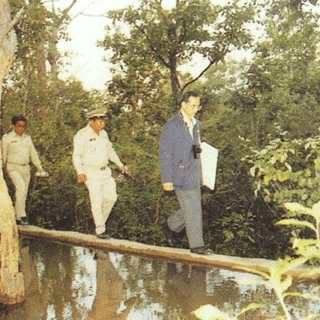
The story of sufficiency economy developed in Thailand nearly along the same timeline as the story of how sustainability caught on as desired developmental goal recognized by the UN in 1972 at the UN Conference on the Human Environment held in Stockholm, popularized 15 years later with the Brundtland report (1987) and adopted as a major wold challenge at the Rio Earth Summit (1992). In Thailand, sufficiency economy was being shaped and implemented as an economic thought since the late fifties/early sixties when a young king travelled laboriously around his country initiating development projects where he could to better the lives of people in remote areas.

Despite its current popularity, sufficiency economy is not a mainstream economic model in Thailand. It is more like a supplementary prescription for the shaping of economic activities to counteract the ills of a dominantly capitalistic model. Sufficiency economy as an alternative economic thinking is one that is gaining ground one poor village by one poor village converted, as individuals who were inspired by its principals implemented and demonstrated successful local action again and again. In many cases, villages that could not feed themselves started growing their own food as an alternative to growing cash crops that had only caused them to become increasingly indebted. Instead of buying expensive fertilizers, they have expanded the supply of organic food, some even becoming successful with an export niche market.  At the same time, depleted forests are being regenerated and a future in which environmental and community awareness where values such as love, friendship, and generosity gain triumph over profit and greed are being re-enforced.

A recent article, "Sufficiency Economy" was published by PETER JANSSEN on The Manila Bulletin (http://www.mb.com/, December 27, 2010:  http://www.mb.com.ph/articles/295104/sufficiency-economy ), focused on a Thai abbot at Doi Pha Som forest temple (วัดธาตุดอยผาส้ม) in Chiang Mai, Sorayut Chayapanyo (พระสรยุทธ ชยปัญโญ), who had rebuilt an old temple, regenerated the surrounding forest, and helped villages grow out of debt. Stanford educated, but rejecting that privileged knowledge, he explains sufficiency economy as not being 'anti-capitalist' nor 'anti-Western', but as something between market economy and socialism. Sufficiency economy was shown as being meaningful in impoverished rural areas where access to the market economy was difficult. Money or greed were no longer the main locomotive of local economic activities once people learnt how to search for ways to become dependant on what they had.

This was not a new story for me. I have heard many very interesting local stories of how poverty was transformed into resourcefulness over the years adopting those principals proposed by the Thai King, proposed in his annual speech of 1972. What this story gave to me, this time, was the realization that it was the availability and strength of a localized social network or social structures, very particular to Thailand or maybe a Buddhist society, that plays an important role in nurturing the emergence of leadership or inspired action by individuals in the successful implementation of a sufficiency economic model.

Before Thailand became a modern economy with its building blocks in the late fifties/early sixties, much of its rural economy, community life or social fabric was structured around the temple. The temple was not simply a religious institution, it was also the place where education was being given, funds being raised for community development, and where the binds of society were formed and strengthened. In many cases, it was the ground where many non-monetary activities were supplementing the economic livelihood of its communities, with its festivals and fairs, funerals, alms giving and donations.

This was a social network that encouraged individuals to make a difference, usually with very small means.  As the modern economy grew, the state and modern markets took over much of the role that the temple played. Festivals are now just commercial events hosted on government grounds. They don't do much for that very personal tie that binds. As a modern Thai, I don't remind myself the value of giving each single day as my mother does, just by consistently getting up every morning to cook rice for a group of passing monks.

When I read yet another story of how one person transforms a community, it dawned on me that poverty is not converted by economic intervention, but by changing the emphasis on our values. When we review what we want of the world by starting a review of  our minds, not from the point of view of what objects or things we need, but from a point of view of what qualities in life we really need to make us contented, we can come to realize that we really don't need all those consumerist products and services the markets try to push on us. We then realize that we don't need to focus on chasing money so much when we can focus on just trying to define what makes us contented.

Monday, December 6, 2010

Climate Change Negotiations: An example of Public Diplomacy

Shah, Anup. “Reactions to Climate Change Negotiations and Action.” Global Issues, Updated: 04 Oct. 2009. Accessed: 06 Dec. 2010.

UNITAR's training program:
http://www.unitar.org/ny/environmental_negotiations

Monday, October 18, 2010

"Stop calling them 'developing countries'" from Gapminder

The term "Developing Countries" might have made sense once.

Today it's impossible to make a clear distinction between "developing" and "developed" countries.

In 1950, most of the so-called "developing countries" had more than 5 children per women and less than 50 years of life expectancy.

Today, in most of the world, women have less than 3 and life expectancy is over 65 years.

Any attempt to divide the countries of the world into two groups, such as "developing and developed countries" will be an over-simplification.

Click play on the graph in the link below to see how the world has changed since 1950.

www.bit.ly/9DwNBE

Tuesday, September 21, 2010

The middle income trap

The Nation on Sep. 12, published an article announcing ADB's approval of a $300mn loan to Thailand to develop its capital market. The 15 year period loan is to be used in support of the Thai government's Capital Market Development Master Plan for 2009-13 for the development of the equity market, bond market and money market in four areas: regulatory environment; market efficiency, liquidity and transparency; market infrastructure; and new products and investors. 

The government has made substantial headway in developing Thailand's capital market. Recent measures included establishing a timetable for the demutualisation of the Stock Exchange of Thailand, strengthening the surveillance and enforcement capabilities of the Securities and Exchange Commission, moves to develop the domestic bond market, and simplifying taxes on financial transactions. There has also been activities organised to improve public financial literacy.

What caught my interest was the mention of the capital market development plan's goal to help the country "transform from a middle-income to high-income economy through increased contribution of the domestic capital market to financing domestic investment and economic growth".

"The middle income trap" seems to be a recent development agenda that is being 'pushed around' at the moment. I remembered having recently read an article at Time about Malaysia's dilemma with this interesting concept. I had felt then that the writer didn't do much justice for Malaysia. However, it seems that this economic criticism is gaining some weight among policy makers. Here are a couple of related articles:

From an economist's blog, "Getting out of the middle income trap"

Of course, moving towards a higher income economy is a desired goal, but I can't help wondering. Is the simple focus on "income" levels obscuring other desired developmental goals? Like income distribution for one? Does higher income come with skewered income distribution? If it does, well, maybe it's okay to be "stuck" for a while, until those higher income countries can show us that people with lower income in their countries are receiving desired benefits of higher income, let's say... a good welfare service system for one, no?

Some recommendations of how to escape the middle income trap:
  • a managed growth program with higher income, stronger currency, while maintaining a flexible foreign exchange regime and inflation control targets
  • a more efficient capital market, availability of capital for sme and local firms to grow
  • R&D spending
  • tax reform (capital gain tax)
  • investment in human resources
  • developing an ability to produce and contribute to the global economy via home grown innovations
Economics aside, I think there are other socio-political issues that can cause a country to be stuck, my own list:
  • political instability, stunted political development
  • corruption
  • a polarized society
  • debt
  • lack of investment in infrastructure and human capital
  • energy self-sufficiency
To cap off, I found this interesting and useful guide, from You can read the Bangkok Post, by Jon Fernquest, "Avoiding the middle income trap: The challenges ahead for Thailand"

Monday, November 9, 2009

The promise of ASEAN regional economy

ASEAN economic indicators
source:  http://www.aseansec.org/19230.htm

To see the above table, please use your browser's zoom in function.  I have organized the data from largest population size to smallest because I believe that second to a country's economic policy, it is population size which is an important key to assessing a country's economic potential.

ASEAN has matured surprising well over the past 10 years or so, considering the skepticism of many in the international community.  President Obama's signal to strengthen ties with ASEAN is a clear indication of this. Below are two sources of information (via google, of course) I found interesting whose words I could quote rather than write a whole blog about the promise of ASEAN's regional economy myself.


"Asean has a total population of 582 million people, nearly half the size of China. Market size is not only based on Asean but also the Asian region as a whole as Asean is connected to every country through its integration. Asean has a combined GDP of US$1.5 trillion and a total trade of $1.7 trillion with the world market. Of that 27 per cent of trade came from six Asean countries—Brunei, Indonesia, Malaysia, the Philippines, Singapore and Thailand. Last year, Asean attracted $60 billion foreign direct investment."

and from The Heritage Foundation's policy paper:

"ASEAN countries have a combined population of more than 500 million people--larger than the population of the European Union. Their combined gross domestic product (GDP) exceeds $1 trillion, which is the 11th largest in the world, ahead of Russia and India."
...

"The measure of ASEAN's integration is not only intraregional trade and investment flows, but also its attractiveness as an investment destination. From the 1992 launch of the ASEAN Free Trade Area (AFTA) to the signing of its Economic Community Blueprint in November 2007, achieving economy of scale in ASEAN has always meant attracting greater levels of foreign investment. Yet even as it has sought ever new ways to stay competitive as a region, it has lagged behind market-leader China-- particularly since the 1997 Asian financial crisis. (A few years prior to the crisis, ASEAN actually led China as an investment destination.)"

Towards the end of the above quoted policy paper is a section titled "Why ASEAN's Economic Integration Matters to America", which I will not copy-paste here since it deserves to be read in full at the Heritages website:
http://www.heritage.org/Research/asiaandthepacific/bg2101.cfm

Wednesday, November 4, 2009

Don't let Saxena die

Second part of Khun Thanong's report, published on The Nation, November 3, 2009.

Deliberate leak of bank documents triggered BBC and Thai economy's collapse but will financier spill the beans on dodgy deals in '96? 

In his second part of the series on the Bangkok Bank of Commerce scandal, Thanong Khanthong asks who ordered the closure of the bank in 1996 that triggered off the 1997 financial crisis.


In his fight against being extradited from Canada over the past 13 years, Rakesh argued that if he were to be sent back to Bangkok, his life could be at risk. He also said prison conditions in Thailand were horrible - compared, of course, to his luxury home where he was stuck under house arrest in Vancouver.

Indeed Rakesh Saxena's life may be in danger. But Korbsak Sabhavasu, the deputy prime minister, wrote in his web blog that Rakesh could not die as that would throw the political mess out of control.
Saxena lost the dramatic extradition case when the Supreme Court of Canada rejected any further appeal and sent him back to Bangkok last Friday. It gave no reason for rejecting his appeal.

However, Saxena has a full list of the politicians involved in the Bangkok Bank of Commerce scandal in 1996. Before leaving Vancouver, he issued a threat that he would tell all. Krirkkiat Jalichandra, the former president of BBC, also kept all documents to him?self.

If Saxena were to strike a pre-trial bargain plea with the Abhisit government by implicating politicians benefiting from BBC, he could compromise his safety in spite of the authorities' full assurance to protect him.

Saxena is now detained under 24-hour surveillance in the Bangkok Remand Prison hospital. His food is carefully screened. The Abhisit government has a full obligation to provide full and fair justice within the law to Saxena because it has won the extradition case. If the Saxena case is not handled with due process, chances are Thailand would have a difficult time winning extradition cases with other countries in the future.

Justice Minister Phiraphand Salirathawiphak said yesterday he had instructed the director general of the Corrections Department and the head of the Bangkok Remand Prison to look after Saxena, whose health is fragile. Saxena, 57, suffered minor paralysis on his left side after a stroke in March.

"I would like to stress that Rakesh is not receiving any privileges more than other inmates," Phiraphand said. "Since he is sick, he needs to be looked after. We have the same standard practice as applied to other inmates. Now Rakesh is being held in the hospital within the compound of the prison, with a surrounding wall and tight security. He is not getting any privileges."

The Democrat government has a lot of incentives to provide top security and safety to Saxena, because he could provide a link to politicians involved in the BBC scandal. Many of them are in the coalition government. Having Saxena in their control could help the Democrats hold their coalition partners in check. The Democrats want the coalition to survive till at least June 2010.

The politicians who benefited from the BBC are now not having a good night's sleep. They definitely do not want Saxena to open his mouth.

The man at the centre of the BBC affair was Ekachai Athikomnantha, then the bank's senior executive vice president.

He was politically connected to Sanan Kachornprasat, then the Democrat whip, and the PM Banharn Silapa-archa. Through Sanan, Saxena was introduced to the bank as Saxena impressed Sanan and others with his financial prowess. He practiced swaps, futures and options well before Thai bankers knew about these strange financial products. Thai financial laws did not cover these products, which allowed Saxena to test the law to the limit.

Although he was centrally involved in BBC, the name Ekachai quickly disappeared from public view after the bank collapsed. Sanan also quickly stepped out of the shadow of BBC before the financial scandal broke out.

Banking authorities sent Krirkkiat Jalichandra to be BBC president and rescue the bank. BBC was in big trouble with huge bad loans on its books. But the task of salvaging the bank was formidable. When Saxena came aboard as the bank's financial adviser, it was agreed the bank would shift away from normal practice to high finance - to try to strike gold on the stock market. If the bank could make quick profits, it would be able to clear all its bad debts in a swoop.

Saxena's unique position as financial adviser within BBC would not have been possible without strong political backup.

BBC tested the first drama script with a takeover bid from Song Watcharasriroj, alias Sia Song. More takeovers and acrobatic financial dealings would follow while money from the bank was drained overseas, first through Lebuan and the British Virgins Island and other financial centres of the globe. At the same time, the politicians, who tolerated this practice, got benefits from a series of questionable loans.

But this high finance ran against the tide. The stock market slumped by 40 per cent in 1996, as the real estate bubble was set to go bust. If the stock market was rally, Krirkkiat and Saxena would have emerged as heroes.

Vijit Supinit, then governor of the Bank of Thailand, kept the bank under his radar. He wanted a soft approach. The financial supervisors had asked him to take harsh action against BBC, but Vijit sat on it. He was doing everything to save BBC through a bail-out. He brought in the Financial Institutions and Development Fund and the Government Savings Bank to rescue BBC with a Bt60 billion capital increase. But it was too little.

Vijit had a good relationship with Krirkkiat. Vijit realised that closing down BBC would bring about a run of the financial system. But the politicians were all over his head.

At the time, the economy was severely overheated. The current account deficit hit 8 per cent of gross domestic product. The inflow from the Bangkok International Banking Fund (BIBF) made things worse as cheap money from offshore moved here enjoy the interest rate differential.

Later on, many questioned the sustainability of the Bank of Thailand's fixed exchange rate regime. The situation was aggravated by political conflict between Banharn Silapa-archa, the PM, and the Group of 16, who were trying to consolidate their own power. They included Suchart Tancharoen, Newin Chidchob, Varathep Ratanakorn, Sora-at Klinpathum, Thanee Yisarn, Wittaya and Sonthaya Khunplume. Their political ambition was boundless.

Suchart Tancharoen was deputy Interior minister in control of the police, while Newin Chidchob was deputy finance minister.

A minister belonging to the government leaked confidential bank documents to Suthep Thaugsuban, in the Democrat Party, then in opposition. The ulterior motive was to destroy the Group of 16. If anything were to happen to the bank, BBC could be shut down.

Suthep took the bait. Based on the documents, he launched a no-confidence debate in Parliament on May 9, 1996, and exposed how the Group of 16 benefited from a loan scandal at the bank. The world was shocked. Many Thais rushed to withdraw deposits from the bank.

On an order from Prime Minister Banharn, Surakiart Sathirathai told Vijit to close the bank. The implications were: 1/ The Group of 16 would be destroyed; 2/ The bank scandal would be covered up; 3/ blame could be shifted to Krirkkiat, Saxena, Vijit, and Surakiart.

Taxpayers had to foot initial losses at BBC of Bt200 billion. But the implications were much larger. The scandal triggered a loss confidence in the Thai financial system and the baht exchange rate, which subsequently turned into a loss of Bt4 trillion for Thailand as the economy collapsed like a house of cards in 1997-1998.

The road to scandal

Published by Khun Thanong, on the Nation, on October 31, 2009.

Thanong Khanthong examines the Bangkok Bank of Commerce saga, which emerged as the ailing symptoms of the 1996.

A turning point at the Bank of Thailand in mid-1996 revolved around the Bangkok Bank of Commerce (BBC).

With the credibility of the BOT hit hard, governor Vijit Supinit was forced to resign on July 1, 1996, bringing an abrupt, but hardly surprising, end to his six-year reign.


Vijit had become embroiled in the BBC scandal. The BOT had looked the other way while the rogue bank got itself into trouble dabbling in high finance. Most of its loans went towards stock-market speculation and takeover deals, as well as to politicians (at cheap rates). As the stock market headed downward, BBC quickly lost its capital.

But the central bank assisted BBC in its recapitalisation. Vijit did not think BBC had a big problem at the time. The problem, he argued, had more to do with Thai politics. If there were confidence in political stability, the financial markets would soon nurse BBC back to its normal health.
That was Vijit's view of the BBC affair.

The Banharn Silapa-Archa government was having a tough time managing the economic downturn. The Thai bubble economy was losing its steam, and asset quality of the banks was fast deteriorating. Indeed, the Thai crisis actually started in 1996 with an infection, which then burst in July 1997.
In the end, BBC could not survive. The Democrats exposed the BBC scandal in Parliament, telling the whole world that politicians had been dining at a BBC buffet.

The central bank ended up losing Bt120 billion in the bail-out for BBC, whose non-performing loans stood at almost 100 per cent. The episode dealt a serious blow to the BOT's credibility. If BBC was in this big a mess, how about other banks and finance companies?

Prime minister Banharn wanted to remove Vijit, and it fell to finance minister Bodi Chunnananda to do the dirty work. He instructed Vijit to lodge criminal charges against BBC president Krirk-kiat Jalichandra and his accomplice, Indian-born financier Rakesh Saxena, for causing such huge damage to the bank.

Both Krirk-kiat and Saxena were responsible from shifting the bank from routine banking operations to high finance, stock-market speculation and takeover deals. Several dozen dummy companies had been involved, with bank deposits shuffled around in deals involving both local and international banks.

Politicians belonging to the Chart Thai Party had benefited from the sweetheart deals with BBC, and Saxena was furious that Chart Thai had betrayed him.

Bodi threatened to fire Vijit if he failed to bring the case to court, so Vijit scrambled to put the case together. He filed charges against Krirk-kiat and Saxena with the police, but they did not carry much weight, because they were put together in too much of a hurry.

Saxena had the last laugh, as he had already left Thailand quietly, leaving Krirk-kiat holding the bag.
Still, Vijit was unable to keep his job. He did not stay in office long enough to witness the baht attack in November and December 1996.

Rerngchai Marakanond succeeded Vijit as governor and promised to launch a full in-house inquiry into the BOT's inept handling of the BBC scandal. Nevertheless, he hinted the inquiry would not begin until after the central bank had concluded talks with the Industrial Finance Corp of Thailand over the prospects of assuming management of the failed bank. That deal would never happen.

Rerngchai was aware if he did not attend to this scandal that had done so much damage to the BOT's reputation, someone else would. The opposition, led by the Democrat Party, had threatened to launch a House inquiry.

How was a bail-out of BBC with Bt90 billion in public funds allowed to proceed with such poorly outlined details?

Rerngchai had been frozen out by his predecessor, Vijit, confined for six years to running the obscure note-printing house. He was not even the first choice for the governorship when Vijit was sacked in July 1996.

Immediately upon assuming office, Rerngchai faced a series of crises, from an economic crash-landing, a financial meltdown and a currency war to the BBC scandal. Yet, as governor he had to act to restore the integrity of the BOT, which had previously been held as one of Thailand's finest institutions.

The central bank was a gathering of top-notched technocrats. Of its 5,185 employees, 180 work in the Supervision and Development of Financial Institutions Department, 40 in Legal Affairs, 285 in the Commercial Bank Examination Department and 200 in Finance Company Examination Department.
A source familiar with the BOT vouched for the integrity of both the central bank's examination and the legal officials handling the BBC case.

"The problem was that when their BBC reports were submitted to their superiors, no action was taken," the source said.

Phenwan Thongdithae, the BOT's top examiner and assistant governor, called on Vijit to take action against BBC management. Vijit replied to Phenwan's recommendations by reassigning him to a dead-end post under Chaiyawat Wibulswasdi, another assistant governor.

The reassignment marked the first time in the history of the BOT that a senior assistant governor was placed under another assistant governor.

Honest though he was, deputy governor Jaroong Ngukuan must have been aware of the rot at BBC. He worked closely with Vijit and read every report, yet he could not bring himself to warn the governor of the danger of letting BBC continue to play. Jaroong was simply a passive onlooker as the BBC collapsed at his feet.

BOT reports made public in May 1996 by Suthep Thaugsuban, at the time a Democrat MP from Surat Thani, indicated central-bank officials must have detected wrongdoing inside BBC as early as 1992, when its bad loans soared to Bt11.11 billion.

Despite warnings from the central bank, the management, led by Krirk-kiat, continued to flout banking regulations by lending money to cronies and other high-risk borrowers.

By the end of 1995, BBC's bad debts had skyrocketed to almost Bt80 billion.
Instead of taking drastic action against BBC's management, Vijit sought to bail out the bank with money from the Fund for Rehabilitation and Development of the Financial Institutes and the Government Savings Bank (GSB).

The GSB, under the chairmanship of Nibhat Bhukkanasut, approved a deal to buy a 3.125-per-cent stake in BBC for more than Bt400 million. This ill-advised investment ended up with a huge loss.
At that point, about Bt60 billion had been injected into the bank - but Bt30 billion more was needed just to keep it on its feet.

Asked by finance minister Surakiart Sathirathai for details of the BBC affair, due to its political implications, Vijit duly submitted confidential reports.

A letter written by Surachai Phruekbamrung, the BOT's director for supervision and examination of commercial banks, summarised alleged defrauding of the bank by Krirk-kiat, Saxena and Ekachai Athikomnantha. The letter, dated January 23, 1996, was submitted to Jaroong.

Yet it was not until that June that Vijit was forced to file charges against BBC executives for violating banking law. Actually, Vijit had no intention of bringing Krirk-kiat and his cohorts to justice in the first place, which explains the delay.

When the case was forwarded to the Economic Crime Investigation Division, it was handled in an extremely sloppy manner. Neither BOT officials nor the police knew for sure the exact date the one-year statute of limitations in the case would expire, from either not talking to each other or simply not wanting to follow up on the case.

When Rerngchai learned the attorney-general had decided to drop the case against the three suspects in the BBC scandal, he was shocked. By this time, BBC had become a full-blown political scandal, which gave interior minister Snoh Thienthong and his Rambo-style deputy, Chalerm Yoobamrung, the ammunition they needed to settle old scores with attorney-general Khanit na Nakhon.

Only after Khanit put up a strong fight by arguing the statutory period should have started with the BOT's January 23 letter - not February 12, when the BOT informed the BBC executives they were under investigation - did he escape Snoh and Chalerm's vendetta. By this time, prime minister Chavalit Yongchaiyudh and finance minister Amnuay Viravan, who had formed a new government in late 1996, had no choice but to look into the matter - as much as they preferred to distance themselves from this hot potato.

A special panel headed by Ackaratorn Chularat, secretary-general of the Office of the Council of State, was quickly formed to determine the flaws in the legal process that had resulted in failure to bring the notorious case to trial.

It was clear the central bank, after failing to supervise BBC adequately, could not afford to let a "technical mistake" further tarnish its reputation. Hence, Rerngchai's promise to launch an internal inquiry into the BOT's handling of the BBC scandal that would prove, not surprisingly, to go nowhere.

Sunday, July 26, 2009

Buffalo caravans that lasted until the early 20th century

My mother was born in 1925. She has vague recollections of a near mystical childhood that I love prompting her to recount. One of the stories that I found most interesting was about her first trip to Bangkok from Sakolnakorn when she was less than ten years old and allowed to accompany her mother to visit her mother’s family in Bangkok.

She had to travel with a buffalo caravan to Khon Khaen to board the train there. It must have been a long trip and it certainly left a lasting impression on her. For me, what was amazing was the recollection that not so long ago just one generation away travel by car on paved roads were not possible throughout the country.

Buffalo caravans were trading caravans whose trade routes crisscrossed North and Northeast Thailand, a trading route whose importance historians have overlooked with their focus on the more important sea routes that Ayudhya dominated. However, it was this land route that supplied Ayudhya with items that its trading partners valued, such as various natural dyes, forest products, and animal skin.

Some interesting things I found on the internet about the land trade routes are one, from a chapter on Chiang Mai from Joe Cummings’ "Lonely Planet Thailand".

An insert about the Chiangmai Night Bazaar reports that from the 15th century Chinese muslim traders from Yunnan brought down silk, opium, lacquerware, tea, dried fruit, musk, ponies and mules while northbound caravans brought gold, copper, cotton, edible bird’s nest, betel nut, tobacco and ivory. By the 19th century, artisans had settled along the route to produce craft for the trade. The Chinese traders preferred to use ponies and mules, while the Thais preferred oxen, water buffalo and elephants.

There were three main land trading routes in Northern Thailand: one from Sibsongpanna (Yunnan) to the Gulf of Martaban (Burma) via Mawlamyiang, this route extends westward from Simao to Chiang Roong-Keng Tung-Fang (Chiang Rai).

The middle route went south to Mengla to Luang Nam Ta in Laos, to Chiang Kong where it merges with the first route and continues further south through Chiang Mai to Mae Sariang continued along the Salaween River down to Mawlamyiang.

The third route went from Simao to Ponsali, Luang Prabang, Nan, Prae, Lampang, and Lampoon, to Chiang Mai.

Another interesting article I found on the internet relating to buffalo trade routes was an extensive wikipedia page about the Kula traders who travelled in small and large caravans.

“Some of these caravans would consist of more than 100 people traveling in ox carts, horses and elephants. Kula merchants would sell and buy items during their travels such as elephants, ivory, animal horns, antlers, silk, water buffalo, firearm, caskets, case etc. Smaller groups of Kula would travel in groups of at least 5,10 or 50 people and would be armed with knives, swords, firearms and scared magical charms for protection. The Kula engaged in commerce differently from the Chinese where they didn't establish themselves by setting up shops in communities but preferred to travel from destination to destination and rest along temples, jungle, prairie and forests along the way.”

Tung Kula Ronghai (the crying plains of the Kulas), the driest region of the Northeast, was called such, because the plain of grass and swamp was so sparsely populated during the early of 19th century that many caravans and individuals would enter the plain and find themselves lost. People living in the community had to erect wooden poles and plant trees to identify the safer route to make navigation possible.

There is also a research paper by Junko Kmsumi of Tokyo University, “Why the Kula wept”, that describes a historical dispute between the Kula traders and the officials of Siam during the reign of Rama the third.

Finally, from a book by Prince Dilok Nabarath, “Siam’s Rural Economy under King Chulalongkorn”, a picture from the past:

                          
Oxen carts bring produce to waiting river barges

Thursday, June 11, 2009

The financial crisis in 1932 that took down absolute monarchy

A long lost cousin of mine connected with me on Facebook today making me a little bit homesick and thinking about my family from Sakolnakorn. I originally wanted to write about the year 1910 and some events that had rippled from the center to my hometown close to the border of the Mekhong.

I was looking through a history book for ideas about how to shape my post on 1910 but got sidetracked by an account of a "financial war" in the year 1932. It’s curious how we tend to overlook small details in history when it is overshadowed by larger events like the end of absolute monarchy and the birth of Thailand’s first constitution.

This small detail of how bad public financial management can put a government in a tough spot seemed to be a more worthy subject to write a blog post about to relieve myself a bit (just a teeny, weeny bit) of my self-imposed theme of economics which doesn’t seem to gather much attention here (yet still a point of interest close to my dear subject), so 1910 got pushed aside and here’s an interesting anecdote from the year 1932 in Thai history:

Anyway, the connection between 1910 and 1932 was that 1910 was when one of Thailand’s greatest king past away, leaving the country in a bit of a shock and vacuum. From the short period of 1910-1932 we saw two kings come and go.

King Prajadhipok didn’t expect to reign but many unfortunate events left him with a legacy of chronic problems, one of which was the finances of the state. The budget was heavily in deficit and the royal accounts a nightmare of debts and questionable transactions.

Pages 235 to 239 of David K. Wyatt’s “Thailand: A Short History” makes an interesting reread. So many echos of the present found in the past. I hope my readers can find the book on some dusty bookshelf, I don’t want to be accused of plagiarism or infringement of copyright.

So the Great Depression hits Siam and the price of rice dropped by two-thirds, inducing a spiral of reduced cash income, less taxes, credit falling apart, inability to buy retail goods and government expenditure cut by a third.

If Wyatt’s publisher’s reads me, I am asking permission to quote some words here and now (I know I can get away with a limited number of words):

“To make matters worse, a financial crisis developed as, under the prodding of the British financial adviser, Siam doggedly maintained the gold standard as the basis of its currency, while Britain abandoned it. This came to mean that Siam’s rice was priced much higher than competing rice sold in currencies that had left the gold standard. It also brought about a significant outlfow of gold from Siam.”

“The crunch came as the government prepared the budget for B.E. 2475, the financial year that was to begin April 1, 1932. Battles raged.....”

Public dissatisfaction, prophecies, drafted constitutions, coup d’etat and “Promoters” (49 military and naval officers and 65 civilians) later, history was made.

Debt and monetary standards, I wonder who’s going to be in government when that nasty knot unravels our system again.

Part II (added)

King Prajadhipok inherited a bad account he couldn’t undo coupled with complex incidences happening in and outside of Thailand. His administration’s inability to split the pie properly could have been the crucial tipping point for that important political change in Thailand.

Here’s my summary of the internal and external events that contributed to political malaise during that time:

Internal:
  1. Huge budget deficits inherited from King Vajiravudh. Some of which were: 8% of 1910’s budget went to the new King’s coronation ceremonies costly nationalist to build Rama VI’s personal power base, such as, for a special palace guard and Wild Tiger Corp (a paramilitary group). Wild Tigers Corp was most expensive... nearly 20% of royal budget, 1.6 million out of the 96. million state budget-10% royal expenditure; 23% to military expenditure; Privy Purse and Ministry of the Palace were consuming nearly 10 percent of the annual budget
  2. Inability to find an accounting standard to control government expenditure causing power struggles within and between ministries and eventually laying off govt. work3. Financial mismanagement that aggravated the situation, such as borrowing from abroad, unpopular salary taxes, taxing land owned by peasants
  3. No policies for distribution of income, Thais becoming increasingly left out of economic activities dominated by Chinese and foreign merchants
  4. Lack of social investments, especially insufficient budget in support education, only 3 percent of the budget was allocated to education
  5. Rising affluence of Chinese minority accentuated by nationalistic sentiments, anti-Chinese and fear of communism among the Thais, anti-Japanese among the Chinese who had private schools and own press
  6. Only one dominant industry: rice export, controlled by Chinese merchants
External:
  1. The post war environment, rise of nationalism, fear of communism, perceived threat of China’s proximity
  2. The great depression, price of rice fell
  3. Delayed exiting of the gold standard exchange regime, silver and gold just bled out of the country

One of the first things Pridi Panomyong and the People’s Party did once they took over government in 1932 was to propose an economic development plan. The Plan was rejected as being too socialist. Industrialization, however, was set into motion with establishments of a number of state enterprises. First being the Fuel Division of the Ministry of Defense which later became the Fuel Organization (1953), the precursor of PTT (so my posts are more connected than I thought). Other key state enterprises set up that was the beginning of industrialization (much earlier than the 60s as I originally thought) were: a spinning and weaving factory, also under the Ministry of Defense, to produce military uniform, later to become Siam Cotton Mill (1953); a paper mill; and a sugar refinery.

Saturday, June 6, 2009

Tracing self-sufficiency back to energy security


From plastics to petrochemicals to oil and gas


I was recently hired to be an interpreter for a Thai technician who was sent to Mexico by a French company based in Thailand to re-adjust a serigraphy machinery built in Thailand and imported to Mexico last year. I was intrigued about why and how the machine came from Thailand and started doing some research about plastic packaging.

Mexico is a major oil producing country and plastics would seem to be a natural downstream industry. However, she imports many of her raw material because the petrochemical industry is not able to produce enough due to lack of new investments in the last 20 years. Oil production and its by-products is a government monopoly run by PEMEX, Mexico’s equivalent of PTT in Thailand. However, the energy sector in Thailand is more fortunate than Mexico’s since competition has been engineered into the sector since the beginning.

Having grown up in the Middle East, I’ve been fascinated by the story of oil and its power over the world economy. I presented a paper about foreign investment in the oil sector of Thailand for my Master’s thesis. So I find myself visiting the theme enthusiastically again prompted by this unexpected visit to a Mexican plastic factory.

The starting path of Thailand’s industrialization

I discovered that PTT is celebrating 30 years of achievement. Very short compared to PEMEX’s 70 years history. In contrast to Mexico’s faltering petrochemical industry Thailand is quite fortunate to have a thriving one. This is confirmed by the presence of a French company who was confident enough in the future of this sector to invest in building silk-screening machines for plastics in Thailand.

According to PTT’s website, this progressive company was founded in 1978 as a response to an energy crisis stemming from the 1973 Arab Oil Embargo. Achieving energy security was an imperative. Our bloggers’ comments about Thai people’s lack of planning is definitely proven wrong if we look hard enough for some hard evidence, as in the remarkable story of the dedication, persistence, and success achieved in building diverse and competitive upstream and downstream oil and gas industries in Thailand.

PTT was partially privatized in 2001 as a result of a process of liberalization and reform in the energy sector initiated during the premiership of Anand Panyarachun continued by Chuan Leekpai under the leading role of Sawat Bhodivihok. The Thai government has no plans to relinquish its 69% stake with the main enterprise, but gradual liberalization and reforms in the energy sector were set into motion since the 90s. Thailand had found a balance between public and private ownership of this important industry.

Fluctuating oil prices and financial crisis were taken in their stride and the company continues to flourish and is even confident enough to embark acquisitions locally and abroad.

What would this have to do with self-sufficiency? We need to produce what is needed. Energy is the main driving force of any economy. Thailand is still dependent on imported energy but I have hopes measured from how far we have come in 30 years, that PTT’s traditions and vision will guide us towards developing alternative energies and continue to generate other beneficial economic side activities.

Industry organizations and business clubs

Another unique character of business in Thailand and SE Asia is the curious organization of "Associations". These non-profit organizations bring together members of industries to promote dialogue among its members and help make sectors of industries more transparent. Businessmen have a forum to gather and brain storm in nearly a semi-bureacratic atmosphere. The public private cooperation in Thailand therefore is not top down with policies imposed upon businesses by governments. It actually can be a two sided process, depending on each industries' strengths and charismatic leaders as well as industry participants willing to work towards common goals. The role of these organization allow business partners and competitiors alike to know each other. Once confident and comfortable as a group. they are bold enough to approach or give feedback to the government with requests that can help industries grow.

One such organization is The Federation of Thai Industries, under which there is a Petrochemical Industry Club, as well as a Plastic Industry Club. Each club has sections listing directories of company (all members major participants of each sector), and sections explaining the structure or processes of each sector.

The Petrochemical Club (FTIPC) is actually organizing a three day training seminar entitled "Introduction to Petroleum & Petrochemical Business" from June 13-15. You can check the program at their website. (Too bad I cannot attend.)

They are also hosting a regional conference/exhibition, PRA 2010 later in the year during 16-18 November.

Apart from connecting businessmen within the country, the FTIPC is also dedicated to making connections with similar organizations across the region, such as, JPCA (Japan Petrochemical Industry), KPIA (Korea Petrochemical Industry Association) , MPA (Malyasian Petrochemicals Association), and SCIC (Singapore Chemical Industry Council).

The Plastic Industry Club of the Federtaion of Thai Industries was formed in 1982 and has 151 members. These companies are engaged in comprehensive integration of upstream, downstream investments. They range from petrochemical to plastic pellets, components and parts of cars, electrical and electronic appliances, packaging and wide-ranging consumer products including toys, machines and moulds. The state of the indsutry in 2000, reported by the Plastic Industry Club has primary and secondary industries operating at 80-100% of total capacity while plastic pellets exported to South and Southeast Asia rose by 53%. China also shifted polyethylene import from Korea to Thailand. Despite higher output, plastic pellet imports total US$ 1,217 million (+35 %) in 2000 as overseas buyers stepped up orders to forestall any impact from high crude oil prices.


Some comparative figures

PTT was ranked by as 207th largest companies on the Fortune 500 list for the year 2007 and climbed to 135 in 2008. It is also ranked as 17th fastest growing in 2008, with its revenue in 2008 was 51,192.5 million dollars having grown 59.7% from 2007. It’s profit increased by 33% from 2007.

A comparison with other global competitors in the petroleum refining industry can be looked up at:

http://money.cnn.com/magazines/fortune/global500/2008/snapshots/7174.html

According to FTIPC’s market overview, the petrochemical industry contributed a revenue that measured 5.8% of Thailand’s GDP in 2008, that is a value of 512,774 Million Baht or 15,539 Million US.

Exports of petrochemicals was 4.82% of total export at 253,294 Million Baht (2007). Its largest market is China.

**(Side note: For the sake of weaving stories, I would like to point out Khun Tawan’s blogpost of July 5, 2008 titled “Thailand’s Energy Solution”. The discussions raised about alternative energies are worth a visit.)

**** A recently published book in Thai, “PTT: The S-curve Story”, can be found at Putalay Bookshop.

Tuesday, March 17, 2009

Rice in Thailand

Some comments and strange ideas about rice are circulating the Nation blog space, so I'm doing some research. There's a lot of interesting things that can be said about the history of rice and it's connection with Thailand. I'm posting a list of links here as food for thought.

According to UNCTAD, Thailand produces only 4.4% of world's production of rice, but last year we exported a third of world rice exports. It was a bonus year because of the global food crisis earlier in the year, and Thailand didn't have production problems like other countries. The high prices is quite likely to come down in the near future once production picks up normally in that bigger 96% of world production.

The structure for exporting Thai rice was built over several decades with a strong government hand. We were lucky that it turned out well. There were once dark times of stock piling, corruption and price distortions and very little of the benefit from exports going to the farmers. With some remarkable people, determined to be fair and inclusive, it got worked out. I remember a very impressionable visit to Kamnan Song's central market for rice at Nakornsawan in the late 80s. Truck loads of rice arriving during the wee hours of the morning before sunrise, and farmers who drove those trucks in themselves auctioning their rice for the best price. The Nation could do service in writing a story about how that market has evolved if I may say so.

Thailand does have a reserve of rice, controlled by the Ministry of Commerce. It is used for stablilizing the domestic price of rice when prices go too high, also used for foreign aid to poor countries. I think it would be a grave mistake to morph the value of rice (a food crop) into something else, especially, something so closely linked to just monetary value, as proposed by Khun Tanong in his blog "When the UK prints money" . Look at what happened to the price of corn when the US decided to use it for biofuel. People down in Mexico were suffering because their staple food was corn (imported from US). (Thais can count their blessing that we never took the route of Mexico and completely believed WTO's and US free trade agenda and destroyed their agriculture sector to build a "industrial sector" for export in order to import food!)

Thailand also has an Agricultural Futures Exchange of Thailand where rice futures can be traded. This and technology have helped new players enter the market recently, all hopefully playing a role in increasing market efficiency and maybe production quality.

However, the idea of a rice bond, which "wch" posted as comment on an earlier post of mine had me intrigued. After some research on the net, I discovered that it is quite plausible. The Bank of Canada and some other academic institutions have funded researches about commodity-backed bonds as a way to help developing countries ease their debt problems. My protest against that would be that a rice bond is first of all a financial instrument and doesn't really help the farmer, it would only be useful as a hedge for government debt, which in my view the government should really be going easy on creating more public debt for future generations.

"Le Monde Diplomatique" in its March 2009, English editions printed "Fragrant Thai Rice" by Xavier Monthéard. He opens his article with a bit of drama, but I like how the article was started with a quote, ‘We need to find a balance between profit and holding the country back’.

Another noteworthy site is the Thai Rice Foundation (thairice.org), its list of webpages related to rice.

Tuesday, February 24, 2009

Asian Financial Chiefs Move to Fight Crisis

http://www.washingtonpost.com/wp-dyn/content/article/2009/02/22/AR2009022201964.html?hpid=topnews

Wednesday, December 10, 2008

Japanese Trading companies

Article from the Economist.  Japanese trading companies provide loans to their subsidiaries, a cushion in the financial crisis.

Wednesday, October 4, 2006

Self-sufficiency or sustainable development


The concept of what's being called "self-sufficient economy" in Thailand has been getting quite a bit of attention since the Thai coup leaders have declared that would be their economic policy. For people unfamiliar with Thailand's development, it might be a bit of a surprise and maybe difficult to understand. However, it's a concept that's been widely talked about and implemented as far back as in the late 70s-early 80s, even predating the Brundtland Report's definition of "sustainable development":
«Sustainable development is development that meets the needs of the present without compromising the ability of future generations to meet their own needs.»
Thailand's economic development has been guided by several 5 year period development plans of which there have been nine, summaries of the nine plans (1961-2006) provided here.

The first Western economist who had some understanding of how such a concept of development may work was E.F. Schumacher, and he wrote a famous book "Small is Beautiful: A study of economics as if people mattered". His concept has gained some ground in the world of conflicting economics and has been called Schumacher's Buddhist Economics.

However, don't mistake that for what the Thais are thinking about. Ven. P. A. Payutto's Buddhist Economics may be closer.

Among the economist in Thailand (at least my generation), the name "Father of Economics" in Thailand was given to Puey Ungpakorn, his simple piece "The quality of Life from Womb to Tomb" is a well quoted piece. He was among the key group of people thinking about the future of Thailand in the 30s. Puey was interested in development economics, however, economics taught in Thai universities had a very Keynesian tilt.

Theory explained, the actual implementation of such thinking was actually started in small scales through Projects Undertaken Through the Initiative of HM King Bhumibhol

Seventy years afterwards, this thinking crystalized and rises to the surface. It is printed in Chaipattana Foundation Journal HM's concept of self-sufficient economy:

His Majesty graciously granted his advice on self-sufficient economy in order for the people to lead their lives productively, peacefully and happily, with dharma to help steer the course and heart as an essential driving element. By Maintaining a Balance in the Five Following Aspects Describes the Principle of Being Self-reliant:

A balance in the state of mind: one needs to be strong, self-reliant, compassionate and flexible. Besides, one should possess a good conscience and place public interests on a higher priority, above one's own.

A balance in social affairs: people need to help each other, strengthen the community, maintain unity, and develop a learning process that stems from a stable and strong foundation.

A balance in managing natural resources and the environment: the country's resources need to be used efficiently and carefully, in order to create sustainable benefits and to develop the nation's stability progressively.

A balance in technology: technology should be used appropriately while encouraging new developments to come from the villagers' local wisdom.

A balance in economic affairs: one needs to increase earnings, to reduce expenses, and to pursue a decent life.
He proposed pratical method for farmers, the 30:30:30:10 ratio of land use which work under the three following phases.

Phase 1: To live at a self-sufficient level which allows farmers to become self-reliant and maintain their living on a frugal basis.
Phase 2: To cooperate as a group in order to handle the production, marketing, management, and educational welfare, as well as social development.
Phase 3: To build up connections within various occupation groups and to expand businesses through cooperation with the private sector, NGOs and the government, in order to assist the farmers in the areas of investment, marketing, production, management and information management.
Finally,
To Live in Accordance with the Principles of Self-sufficient Economy

1. One must adhere to a frugal style of living and try to cut down daily expenses especially for extravagant items as stated in the Royal speech, ". . .One should not live luxuriously and must cut down expenses in an appropriate manner. . ."

2. One must be true to oneself and work righteously as well as honestly, even under harsh living conditions according to the Royal speech, ". . .Success of all people comes from good conduct and proper work. . ."

3. One must stop selfish competition and the habit of taking advantage of others when doing business as commonly happened in the past. This is defined in the following excerpt from the Royal speech, ". . .The meaning of genuine happiness is the happiness derived from one's fair conduct, both of intention and action, and not from coincidence or taking advantage of others. . ."

4. One must not give up in finding ways to pull oneself out of hardship, by striving to learn more and more in order to earn sufficient income, as stated in the Royal speech, ". . .The reason for encouraging people to learn more and become stable in their life is for their own lasting happiness from, first, leading a sufficient lifestyle, and then from being proud of themselves for being able to stand on their own. . ."

5. One must behave with good morality and refrain from all greeds. Thai society collapsed with this adverse economic situation because a lot of people betrayed their own country without any shame. His Majesty the King graciously delivered a Royal speech that conveys a similar message, as follows: ". . .Avoid committing wrongdoings that will destroy oneself or others, eliminate one's inner greed, remain true to oneself, as well as preserve and enhance the good virtues within oneself. . ."

Chaipattana ends the article with, "His Majesty accentuated that the most important word is "sufficient". If we are satisfied with living at a sufficient level which is reasonable for our status, we will then learn the true meaning of happiness."

Migrant labor

BKK Post, Oct 4, 2006 reports "Thai workers 'cheated in Qatar'".

This is an issue that boils under the surface of everyday Thai politics and policy making, pops up once a while with a scandal such as the one above and eventually gets eclisped by other issues while its problems remains mostly unsolved.

A good brief about the problem is found here, it starts...
"Since 1973, Thai workers have migrated to Middle Eastern countries such as Saudi Arabia, Iraq, Kuwait, United Arab Emirates, Bahrain and Qatar. Saudi Arabia was once the largest labor market for Thai workers. In 1990, following a diplomatic break between the two countries, there was a sudden reduction in the demand for Thai labor. Thai migrant workers had to turn to the job markets in Southeast Asia (Singapore, Malaysia, Brunei) and East Asia (Japan, Taiwan, South Korea and Hong Kong). As of 1995, an estimated 627,815 documented and undocumented Thai migrant workers were scattered around the world."

Source: A White Paper from pacific.net

The first labor policy was initiated in 1932.

Sample of a "labor campagin" here)

Migrant labor policy is pretty closely related to Thai politics. (What a remarkable synchronicity that the BKK Post makes the above report at the dawn of this government.) It was part of a campaign introduced in the 70s by some power dealers, gained bureacratic support and henceforth grew. It was at the same time partly, an emergence from the periphery, as cash strapped Isaan workers tried whatever they could to find a living. This was easy money for them but it has put them in cycles of debt-ridden woe and loss of property rights. Even if a new Ministry of Labor has been set up in 1993, the issue has been eclipsed by other more politically volatile issues of the increasing import of poorer migrant workers into Thailand. So the poor people from the Thai countryside are still more or less left on their own wits to deal with the sharks and snakes of labor agents in their hopes of hitting the jackpot.

There's an interesting description here, where it gives an explaination about how migrant workers or "tourist consumers" are tied to "traditional forms of Buddhist ceremonial" where
"More than just a welcome respite from the drudgery and discipline of factory jobs, these excursions allow labor migrants to make important claims about their experiences as members of the Thai nation-state. As tourist-consumers, migrant workers appropriate powerful signs and symbols of modern Thai identity and status; in so doing they contest (and at least partly rework) their material and ideological marginalization within contemporary Thai society."

Lastly, a succinct blog post by David Frazier from Taiwan, in "Pots: "Thai Labor: Widgets or Workers"