Just wanted to note Philip J. Cunningham' excellent post on how it's not just simply red vs. yellow, government vs, people, or whatever. It's much, much more complex.
Please read in Phillip's own words at "The Long Winding Red Road to Ratchaprasong and Thailand’s Future" on his blog Frontier International.
Showing posts with label political streams. Show all posts
Showing posts with label political streams. Show all posts
Wednesday, May 26, 2010


Thursday, May 20, 2010
Thailand must step back from becoming a polarized society
I long for the days when I could pick up a yellow shirt or a red shirt without having to feel that if I wear one or the other, some stranger in the street is going to be making assumptions about my political standing. Yellow used to be a color of love, loyalty and friendship, the PAD totally corrupted the meaning of the color of yellow. Red used to be a color or passion, of love, of a call for attention, and now it's a color many fear and feel anger towards in Bangkok.
When you talk politics, you are expected to take sides. Common ground, moderate solutions get washed out in the emotional battle of who's right or wrong. Each side thinks only in black and white. Relationships become strained and society as a whole erodes. When we reach the point where burning buildings are pitted against lives taken out by guns and grenades, our society is on the verge of imploding.
How do we step back from the brink? Stop trying to insist on proving who's right or wrong. Let's look for the white in the black, the black in the white, like in the symbol of the Tao.
Thailand became the land of the free because we understood the concept of a buffer zone, an area designated to avoid conflict between two hostile power. Yes, it's more painful than when our ancient enemies the Burmese burned our capital to have our own people do it. However, it underscores the urgency of how important it is for us to reconcile our differences, to listen to what the other side wants.
Wednesday, May 19, 2010
Live reporting on May 19 Military Crackdown in Thailand
From Al Jazeera via livestation.com which offers streaming of live content from some TV stations that you can use with your iphone.
The quality of reporting of Al Jazeera on Thailand situation was excellent compared with BBC and CNN. CNN's correspondents came under attack by Thai FB users, a note written here, and further elaborated by Thai blogger here.
The quality of reporting of Al Jazeera on Thailand situation was excellent compared with BBC and CNN. CNN's correspondents came under attack by Thai FB users, a note written here, and further elaborated by Thai blogger here.
Tuesday, May 18, 2010
Friday, May 14, 2010
Facebook, Restaurant City, and political angst
If you know the game Restaurant City then you'd have no doubts about the connections between the two topics in the title of this blog post. If you're a player, you know how addictive it can be, especially once you've got your little restaurant to look just the way that pleases you and you're earning those virtual dollars real fast.

You're probably scratching your head about the third part, though.
For someone who connects her disparate parts on the internet... son in one city, daughter in another, herself halfway across the globe from familiar friends, family and food, Facebook gives a comforting...maybe illusionary, sense of connected identity. Two years now, in a country where they don't speak my language, where I'm still licking my wounds from having to depart some very good friends in another country. I shy away from making new friends knowing that I'm going to have to pack up and leave in a year or so. So what've I got? Facebook and Restaurant City. Pathetic, isnt' it? Even worse....
If you're reading this blog, you may have also noticed that there was a huge gap in my blogging. Where've I been? What have I been doing? Well, depressed. Uninspired by life. Angst...caused by politics.
Who would have thought that the state of one's country political falling apart can affect one's psychological health? How complex one's sense of identity is. Group belonging, so basic a need, so unaware of its central role in our sense of well-being until it's been challenged.
These past months have been spent flicking through The Nation and Bangkok Post pages in between Facebook news feed and feeding my workers in Restaurant City. Facebook news feed was also supplying me with tweets from Suthichai Yoon which kept me up to date on developments during critical nights faster than the newspaper could. I was also able to exchange and calm some of my angst with one or two more "friends" who were more vocal about their political feelings than others. Trying to explain it away gave some comfort, but we were all pretty much helpless and had to simply watch violence unravel itself.
At the start of 2010, it looked like things were going to move for the better, there were clear signs of economic recovery from the sub-prime financial crisis, Thaksin's Judgement Day trial was closing. Then Abhisit's government under-estimated the aggressiveness of the Red Shirts and an attempted clear up of the protestors botched up on April 10.
He should have known better, I thought. All those M79 grenades being lobbed around Bangkok since the demonstration started should have been fair warning.
To date there are 30 dead, plus a reported 7 more since last night. How many more during this weekend's second attempt to clear up the protestors?
Why do we have to resort to military action against the people? Why are such people constantly attracted like moths to camp out for a fight where everybody loses? Why do people feel that their life is worth giving up for a twisted, outdated notion of nationhood? Isn't there a better way to fight for democracy, for equality than to tear your country apart?
What is wrong with the Thai people?!!!!
Wednesday, November 4, 2009
Don't let Saxena die
Second part of Khun Thanong's report, published on The Nation, November 3, 2009.

Deliberate leak of bank documents triggered BBC and Thai economy's collapse but will financier spill the beans on dodgy deals in '96?
In his second part of the series on the Bangkok Bank of Commerce scandal, Thanong Khanthong asks who ordered the closure of the bank in 1996 that triggered off the 1997 financial crisis.
In his fight against being extradited from Canada over the past 13 years, Rakesh argued that if he were to be sent back to Bangkok, his life could be at risk. He also said prison conditions in Thailand were horrible - compared, of course, to his luxury home where he was stuck under house arrest in Vancouver.
Indeed Rakesh Saxena's life may be in danger. But Korbsak Sabhavasu, the deputy prime minister, wrote in his web blog that Rakesh could not die as that would throw the political mess out of control.
Saxena lost the dramatic extradition case when the Supreme Court of Canada rejected any further appeal and sent him back to Bangkok last Friday. It gave no reason for rejecting his appeal.
However, Saxena has a full list of the politicians involved in the Bangkok Bank of Commerce scandal in 1996. Before leaving Vancouver, he issued a threat that he would tell all. Krirkkiat Jalichandra, the former president of BBC, also kept all documents to him?self.
If Saxena were to strike a pre-trial bargain plea with the Abhisit government by implicating politicians benefiting from BBC, he could compromise his safety in spite of the authorities' full assurance to protect him.
Saxena is now detained under 24-hour surveillance in the Bangkok Remand Prison hospital. His food is carefully screened. The Abhisit government has a full obligation to provide full and fair justice within the law to Saxena because it has won the extradition case. If the Saxena case is not handled with due process, chances are Thailand would have a difficult time winning extradition cases with other countries in the future.
Justice Minister Phiraphand Salirathawiphak said yesterday he had instructed the director general of the Corrections Department and the head of the Bangkok Remand Prison to look after Saxena, whose health is fragile. Saxena, 57, suffered minor paralysis on his left side after a stroke in March.
"I would like to stress that Rakesh is not receiving any privileges more than other inmates," Phiraphand said. "Since he is sick, he needs to be looked after. We have the same standard practice as applied to other inmates. Now Rakesh is being held in the hospital within the compound of the prison, with a surrounding wall and tight security. He is not getting any privileges."
The Democrat government has a lot of incentives to provide top security and safety to Saxena, because he could provide a link to politicians involved in the BBC scandal. Many of them are in the coalition government. Having Saxena in their control could help the Democrats hold their coalition partners in check. The Democrats want the coalition to survive till at least June 2010.
The politicians who benefited from the BBC are now not having a good night's sleep. They definitely do not want Saxena to open his mouth.
The man at the centre of the BBC affair was Ekachai Athikomnantha, then the bank's senior executive vice president.
He was politically connected to Sanan Kachornprasat, then the Democrat whip, and the PM Banharn Silapa-archa. Through Sanan, Saxena was introduced to the bank as Saxena impressed Sanan and others with his financial prowess. He practiced swaps, futures and options well before Thai bankers knew about these strange financial products. Thai financial laws did not cover these products, which allowed Saxena to test the law to the limit.
Although he was centrally involved in BBC, the name Ekachai quickly disappeared from public view after the bank collapsed. Sanan also quickly stepped out of the shadow of BBC before the financial scandal broke out.
Banking authorities sent Krirkkiat Jalichandra to be BBC president and rescue the bank. BBC was in big trouble with huge bad loans on its books. But the task of salvaging the bank was formidable. When Saxena came aboard as the bank's financial adviser, it was agreed the bank would shift away from normal practice to high finance - to try to strike gold on the stock market. If the bank could make quick profits, it would be able to clear all its bad debts in a swoop.
Saxena's unique position as financial adviser within BBC would not have been possible without strong political backup.
BBC tested the first drama script with a takeover bid from Song Watcharasriroj, alias Sia Song. More takeovers and acrobatic financial dealings would follow while money from the bank was drained overseas, first through Lebuan and the British Virgins Island and other financial centres of the globe. At the same time, the politicians, who tolerated this practice, got benefits from a series of questionable loans.
But this high finance ran against the tide. The stock market slumped by 40 per cent in 1996, as the real estate bubble was set to go bust. If the stock market was rally, Krirkkiat and Saxena would have emerged as heroes.
Vijit Supinit, then governor of the Bank of Thailand, kept the bank under his radar. He wanted a soft approach. The financial supervisors had asked him to take harsh action against BBC, but Vijit sat on it. He was doing everything to save BBC through a bail-out. He brought in the Financial Institutions and Development Fund and the Government Savings Bank to rescue BBC with a Bt60 billion capital increase. But it was too little.
Vijit had a good relationship with Krirkkiat. Vijit realised that closing down BBC would bring about a run of the financial system. But the politicians were all over his head.
At the time, the economy was severely overheated. The current account deficit hit 8 per cent of gross domestic product. The inflow from the Bangkok International Banking Fund (BIBF) made things worse as cheap money from offshore moved here enjoy the interest rate differential.
Later on, many questioned the sustainability of the Bank of Thailand's fixed exchange rate regime. The situation was aggravated by political conflict between Banharn Silapa-archa, the PM, and the Group of 16, who were trying to consolidate their own power. They included Suchart Tancharoen, Newin Chidchob, Varathep Ratanakorn, Sora-at Klinpathum, Thanee Yisarn, Wittaya and Sonthaya Khunplume. Their political ambition was boundless.
Suchart Tancharoen was deputy Interior minister in control of the police, while Newin Chidchob was deputy finance minister.
A minister belonging to the government leaked confidential bank documents to Suthep Thaugsuban, in the Democrat Party, then in opposition. The ulterior motive was to destroy the Group of 16. If anything were to happen to the bank, BBC could be shut down.
Suthep took the bait. Based on the documents, he launched a no-confidence debate in Parliament on May 9, 1996, and exposed how the Group of 16 benefited from a loan scandal at the bank. The world was shocked. Many Thais rushed to withdraw deposits from the bank.
On an order from Prime Minister Banharn, Surakiart Sathirathai told Vijit to close the bank. The implications were: 1/ The Group of 16 would be destroyed; 2/ The bank scandal would be covered up; 3/ blame could be shifted to Krirkkiat, Saxena, Vijit, and Surakiart.
Taxpayers had to foot initial losses at BBC of Bt200 billion. But the implications were much larger. The scandal triggered a loss confidence in the Thai financial system and the baht exchange rate, which subsequently turned into a loss of Bt4 trillion for Thailand as the economy collapsed like a house of cards in 1997-1998.
Thursday, June 11, 2009
The financial crisis in 1932 that took down absolute monarchy
A long lost cousin of mine connected with me on Facebook today making me a little bit homesick and thinking about my family from Sakolnakorn. I originally wanted to write about the year 1910 and some events that had rippled from the center to my hometown close to the border of the Mekhong.
I was looking through a history book for ideas about how to shape my post on 1910 but got sidetracked by an account of a "financial war" in the year 1932. It’s curious how we tend to overlook small details in history when it is overshadowed by larger events like the end of absolute monarchy and the birth of Thailand’s first constitution.
This small detail of how bad public financial management can put a government in a tough spot seemed to be a more worthy subject to write a blog post about to relieve myself a bit (just a teeny, weeny bit) of my self-imposed theme of economics which doesn’t seem to gather much attention here (yet still a point of interest close to my dear subject), so 1910 got pushed aside and here’s an interesting anecdote from the year 1932 in Thai history:
Anyway, the connection between 1910 and 1932 was that 1910 was when one of Thailand’s greatest king past away, leaving the country in a bit of a shock and vacuum. From the short period of 1910-1932 we saw two kings come and go.
King Prajadhipok didn’t expect to reign but many unfortunate events left him with a legacy of chronic problems, one of which was the finances of the state. The budget was heavily in deficit and the royal accounts a nightmare of debts and questionable transactions.
Pages 235 to 239 of David K. Wyatt’s “Thailand: A Short History” makes an interesting reread. So many echos of the present found in the past. I hope my readers can find the book on some dusty bookshelf, I don’t want to be accused of plagiarism or infringement of copyright.
So the Great Depression hits Siam and the price of rice dropped by two-thirds, inducing a spiral of reduced cash income, less taxes, credit falling apart, inability to buy retail goods and government expenditure cut by a third.
If Wyatt’s publisher’s reads me, I am asking permission to quote some words here and now (I know I can get away with a limited number of words):
“To make matters worse, a financial crisis developed as, under the prodding of the British financial adviser, Siam doggedly maintained the gold standard as the basis of its currency, while Britain abandoned it. This came to mean that Siam’s rice was priced much higher than competing rice sold in currencies that had left the gold standard. It also brought about a significant outlfow of gold from Siam.”
“The crunch came as the government prepared the budget for B.E. 2475, the financial year that was to begin April 1, 1932. Battles raged.....”
Public dissatisfaction, prophecies, drafted constitutions, coup d’etat and “Promoters” (49 military and naval officers and 65 civilians) later, history was made.
Debt and monetary standards, I wonder who’s going to be in government when that nasty knot unravels our system again.
Part II (added)
King Prajadhipok inherited a bad account he couldn’t undo coupled with complex incidences happening in and outside of Thailand. His administration’s inability to split the pie properly could have been the crucial tipping point for that important political change in Thailand.
Here’s my summary of the internal and external events that contributed to political malaise during that time:
Internal:
One of the first things Pridi Panomyong and the People’s Party did once they took over government in 1932 was to propose an economic development plan. The Plan was rejected as being too socialist. Industrialization, however, was set into motion with establishments of a number of state enterprises. First being the Fuel Division of the Ministry of Defense which later became the Fuel Organization (1953), the precursor of PTT (so my posts are more connected than I thought). Other key state enterprises set up that was the beginning of industrialization (much earlier than the 60s as I originally thought) were: a spinning and weaving factory, also under the Ministry of Defense, to produce military uniform, later to become Siam Cotton Mill (1953); a paper mill; and a sugar refinery.
I was looking through a history book for ideas about how to shape my post on 1910 but got sidetracked by an account of a "financial war" in the year 1932. It’s curious how we tend to overlook small details in history when it is overshadowed by larger events like the end of absolute monarchy and the birth of Thailand’s first constitution.
This small detail of how bad public financial management can put a government in a tough spot seemed to be a more worthy subject to write a blog post about to relieve myself a bit (just a teeny, weeny bit) of my self-imposed theme of economics which doesn’t seem to gather much attention here (yet still a point of interest close to my dear subject), so 1910 got pushed aside and here’s an interesting anecdote from the year 1932 in Thai history:
Anyway, the connection between 1910 and 1932 was that 1910 was when one of Thailand’s greatest king past away, leaving the country in a bit of a shock and vacuum. From the short period of 1910-1932 we saw two kings come and go.
King Prajadhipok didn’t expect to reign but many unfortunate events left him with a legacy of chronic problems, one of which was the finances of the state. The budget was heavily in deficit and the royal accounts a nightmare of debts and questionable transactions.
Pages 235 to 239 of David K. Wyatt’s “Thailand: A Short History” makes an interesting reread. So many echos of the present found in the past. I hope my readers can find the book on some dusty bookshelf, I don’t want to be accused of plagiarism or infringement of copyright.
So the Great Depression hits Siam and the price of rice dropped by two-thirds, inducing a spiral of reduced cash income, less taxes, credit falling apart, inability to buy retail goods and government expenditure cut by a third.
If Wyatt’s publisher’s reads me, I am asking permission to quote some words here and now (I know I can get away with a limited number of words):
“To make matters worse, a financial crisis developed as, under the prodding of the British financial adviser, Siam doggedly maintained the gold standard as the basis of its currency, while Britain abandoned it. This came to mean that Siam’s rice was priced much higher than competing rice sold in currencies that had left the gold standard. It also brought about a significant outlfow of gold from Siam.”
“The crunch came as the government prepared the budget for B.E. 2475, the financial year that was to begin April 1, 1932. Battles raged.....”
Public dissatisfaction, prophecies, drafted constitutions, coup d’etat and “Promoters” (49 military and naval officers and 65 civilians) later, history was made.
Debt and monetary standards, I wonder who’s going to be in government when that nasty knot unravels our system again.
Part II (added)
King Prajadhipok inherited a bad account he couldn’t undo coupled with complex incidences happening in and outside of Thailand. His administration’s inability to split the pie properly could have been the crucial tipping point for that important political change in Thailand.
Here’s my summary of the internal and external events that contributed to political malaise during that time:
Internal:
- Huge budget deficits inherited from King Vajiravudh. Some of which were: 8% of 1910’s budget went to the new King’s coronation ceremonies costly nationalist to build Rama VI’s personal power base, such as, for a special palace guard and Wild Tiger Corp (a paramilitary group). Wild Tigers Corp was most expensive... nearly 20% of royal budget, 1.6 million out of the 96. million state budget-10% royal expenditure; 23% to military expenditure; Privy Purse and Ministry of the Palace were consuming nearly 10 percent of the annual budget
- Inability to find an accounting standard to control government expenditure causing power struggles within and between ministries and eventually laying off govt. work3. Financial mismanagement that aggravated the situation, such as borrowing from abroad, unpopular salary taxes, taxing land owned by peasants
- No policies for distribution of income, Thais becoming increasingly left out of economic activities dominated by Chinese and foreign merchants
- Lack of social investments, especially insufficient budget in support education, only 3 percent of the budget was allocated to education
- Rising affluence of Chinese minority accentuated by nationalistic sentiments, anti-Chinese and fear of communism among the Thais, anti-Japanese among the Chinese who had private schools and own press
- Only one dominant industry: rice export, controlled by Chinese merchants
- The post war environment, rise of nationalism, fear of communism, perceived threat of China’s proximity
- The great depression, price of rice fell
- Delayed exiting of the gold standard exchange regime, silver and gold just bled out of the country
One of the first things Pridi Panomyong and the People’s Party did once they took over government in 1932 was to propose an economic development plan. The Plan was rejected as being too socialist. Industrialization, however, was set into motion with establishments of a number of state enterprises. First being the Fuel Division of the Ministry of Defense which later became the Fuel Organization (1953), the precursor of PTT (so my posts are more connected than I thought). Other key state enterprises set up that was the beginning of industrialization (much earlier than the 60s as I originally thought) were: a spinning and weaving factory, also under the Ministry of Defense, to produce military uniform, later to become Siam Cotton Mill (1953); a paper mill; and a sugar refinery.
Friday, May 8, 2009
Why Generals have such a strong hold in Thai society
"Shadow play", my husband commented when I briefed him about the Sonthi assassination plot, "Thailand's politics has many levels of complexities not easily understood by outsiders."
I was explaining to him why Thanpuying Viriya can wield so much power in Thai politics. (BTW, can someone knowledgeable about Thai politics tell me: there was one "Khunying" or hi-so lady who was well known for being an arms dealer. Is this the same person, or what was her name?)
My husband once wrote a paper about the role of Generals in Thai politics in his NUS days when we had just first met. His classmate and good friend was a Thai General. So he knew something more than I did, or sometimes it's the fresh eyes of someone a bit removed from it all that can catch certain things we in the midst of can't see. (He's not a Thai national.)
Most people who have observed Thai politics for some time know about the vicous cycle we go through with coup d'état, appointed government, elections, corrupted politicians, and coup d'état once again. A naive conclusion would be that we have a tendancy to like dictators, strong men, etc. Not so....
If you really dig deep and follow the relationships of the Generals, you'd understand what makes a coup succesful or not are the relationships among certain cliques of Generals. The twists and turns of the aborted coup of 1981 would be a good example among others. "Cliques?", you may ask, "How's that?" Not so obvious is also the fact that in a country of only 60plus million with forces of about 300,000 we have around a hundred Generals. Isn't that absurd? Why do we have so many Generals?
You see, the military is like one of the oldest bureaucracies in Thailand older than the bureaucracy which is pretty old itself. People who enter the military service have paid for education, housing, guaranteed employment and job advancement for life, like a bureaucracy, but better (especially the housing and education part). The "modern" armed forces were set up in 1852 by King Mongkut but the heart that is intertwined with a military mind goes back several hundred years when Kings were also exceptional warriors, or exceptional warriors could become King, the most recent being the general that founded Bangkok and modern Thailand. Let's also not forget that it was the military that was behind Thailand's change from Absolute Monarch to Constitutional Monarchy. Their legitimacy to political power is engrained in the minds of military cadets from the first moments of their training.
The Military Academy is, however, the main culprit in why we can't rid ourselves of generals who feel they have political legitimacy. Class relationships are everything in a Thai student's life. It is why parents are willing to pay so much "additional" entrance fees to get their children in select school, because it ensures their kid's social circle for life. These circles are effective ways to get businesses moving, finding you that reliable doctor and lawyer and what not. The military class relationships tops all by being the forces that can define national government.
I had once thought, well, these Generals were all getting old and will eventually fade away, and maybe we can put hope in our new generation of soldiers who would be professionally trained to be just solders and not hope to be coup leaders. I was once optimistic that Thailand had evolved out of that vicious cycle of coups and elections but my hopes were obviously dashed by the coup of 2006. Then came the yellow shirt/red shirt face off, more power to the Generals.
The often not spoken about damage that Thaksin has done to Thailand, apart from a long list of unpardonable things, is that he had sparked hope and taught to the police cadets or other police strong men that maybe they too could become "One" in the country. I also wonder about the line of relationships that he has bought in the Thai bureaucracy that will try to trip good policies initiated by any well meaning government that will take time to wash out and hence make or politics fragile for some time to come.
Maybe I will write a blog about what makes the common mind of a Thai police.
Just some thoughts from one of the silent golden majority who abhors political demonstrations but have a strong opinion about the mess politics has done to our country. So please don't be too harsh in your comments.
I was explaining to him why Thanpuying Viriya can wield so much power in Thai politics. (BTW, can someone knowledgeable about Thai politics tell me: there was one "Khunying" or hi-so lady who was well known for being an arms dealer. Is this the same person, or what was her name?)
My husband once wrote a paper about the role of Generals in Thai politics in his NUS days when we had just first met. His classmate and good friend was a Thai General. So he knew something more than I did, or sometimes it's the fresh eyes of someone a bit removed from it all that can catch certain things we in the midst of can't see. (He's not a Thai national.)
Most people who have observed Thai politics for some time know about the vicous cycle we go through with coup d'état, appointed government, elections, corrupted politicians, and coup d'état once again. A naive conclusion would be that we have a tendancy to like dictators, strong men, etc. Not so....
If you really dig deep and follow the relationships of the Generals, you'd understand what makes a coup succesful or not are the relationships among certain cliques of Generals. The twists and turns of the aborted coup of 1981 would be a good example among others. "Cliques?", you may ask, "How's that?" Not so obvious is also the fact that in a country of only 60plus million with forces of about 300,000 we have around a hundred Generals. Isn't that absurd? Why do we have so many Generals?
You see, the military is like one of the oldest bureaucracies in Thailand older than the bureaucracy which is pretty old itself. People who enter the military service have paid for education, housing, guaranteed employment and job advancement for life, like a bureaucracy, but better (especially the housing and education part). The "modern" armed forces were set up in 1852 by King Mongkut but the heart that is intertwined with a military mind goes back several hundred years when Kings were also exceptional warriors, or exceptional warriors could become King, the most recent being the general that founded Bangkok and modern Thailand. Let's also not forget that it was the military that was behind Thailand's change from Absolute Monarch to Constitutional Monarchy. Their legitimacy to political power is engrained in the minds of military cadets from the first moments of their training.
The Military Academy is, however, the main culprit in why we can't rid ourselves of generals who feel they have political legitimacy. Class relationships are everything in a Thai student's life. It is why parents are willing to pay so much "additional" entrance fees to get their children in select school, because it ensures their kid's social circle for life. These circles are effective ways to get businesses moving, finding you that reliable doctor and lawyer and what not. The military class relationships tops all by being the forces that can define national government.
I had once thought, well, these Generals were all getting old and will eventually fade away, and maybe we can put hope in our new generation of soldiers who would be professionally trained to be just solders and not hope to be coup leaders. I was once optimistic that Thailand had evolved out of that vicious cycle of coups and elections but my hopes were obviously dashed by the coup of 2006. Then came the yellow shirt/red shirt face off, more power to the Generals.
The often not spoken about damage that Thaksin has done to Thailand, apart from a long list of unpardonable things, is that he had sparked hope and taught to the police cadets or other police strong men that maybe they too could become "One" in the country. I also wonder about the line of relationships that he has bought in the Thai bureaucracy that will try to trip good policies initiated by any well meaning government that will take time to wash out and hence make or politics fragile for some time to come.
Maybe I will write a blog about what makes the common mind of a Thai police.
Just some thoughts from one of the silent golden majority who abhors political demonstrations but have a strong opinion about the mess politics has done to our country. So please don't be too harsh in your comments.
Sunday, October 15, 2006
I like charts: the new Assembly

Friday, October 13, 2006
Names to remember: "Octoberists"
Names I need to remember, interestingly provided by The Nation's OCTOBERISTS' - 33 YEARS ON
A divided political ideology
Thirayuth Boonmi, his name I can remember, in fact I got an MA from ISS where he went for a fellowship after he came out of the jungle.
According to the article quoting Dr Kasian Tejapira, now Thammasat University's professor of political science., Thirayuth leads this camp:
Pibhob Thongchai, Prasarn Marukapitak, Chermsak Pinthong, Chaiwat Surawichai, Kaewsan Atibhodhi, Kamnoon Sithisamarn, Chatcharin Chaiwat, Tienchai Wongchaisuwan and Suwinai Poranawilai.
Octoberists who joined Thaksin's camp: Prommin Lertsuriyadej, Phumtham Vejayachai, Surapong Suebwonglee,
Chaturon Chaisang, (wasn't he just elected acting TRT's leader?)
Sutham Saengprathum, Pinij Charusombat, Adisorn Piengket and Kriengkamol Laohapairote.
Some Octoberists have been recruited to serve the new legislative body appointed by the Council for National Security. They are Gothom Areeya, Surichai Wankaeo, Sombat Thamrongthanyawong, Pinij Charusombat and Kamnoon Sittisamarn.
Nithinand Yorsaengrat, is also named an Octoberist and is a journalist.
I think Acharn Kasian paints a conflictive picture because he makes the common mistake trying to categorize these people. Limiting academic discipline also keeps one trapped in out of date vocabulary, like "ideology" and "leftist", even new generation political scientist Kanokrat can't see beyond her discipline, or was she misquoted?
Interesting also that Thongchai Winichakul, who wrote a really good book, "Siam Mapped", is Ass.Prof at University of Wisconsin, involved in the October events himself doesn't get named.
A divided political ideology
Thirayuth Boonmi, his name I can remember, in fact I got an MA from ISS where he went for a fellowship after he came out of the jungle.
According to the article quoting Dr Kasian Tejapira, now Thammasat University's professor of political science., Thirayuth leads this camp:
Pibhob Thongchai, Prasarn Marukapitak, Chermsak Pinthong, Chaiwat Surawichai, Kaewsan Atibhodhi, Kamnoon Sithisamarn, Chatcharin Chaiwat, Tienchai Wongchaisuwan and Suwinai Poranawilai.
Octoberists who joined Thaksin's camp: Prommin Lertsuriyadej, Phumtham Vejayachai, Surapong Suebwonglee,
Chaturon Chaisang, (wasn't he just elected acting TRT's leader?)
Sutham Saengprathum, Pinij Charusombat, Adisorn Piengket and Kriengkamol Laohapairote.
Some Octoberists have been recruited to serve the new legislative body appointed by the Council for National Security. They are Gothom Areeya, Surichai Wankaeo, Sombat Thamrongthanyawong, Pinij Charusombat and Kamnoon Sittisamarn.
Nithinand Yorsaengrat, is also named an Octoberist and is a journalist.
I think Acharn Kasian paints a conflictive picture because he makes the common mistake trying to categorize these people. Limiting academic discipline also keeps one trapped in out of date vocabulary, like "ideology" and "leftist", even new generation political scientist Kanokrat can't see beyond her discipline, or was she misquoted?
Interesting also that Thongchai Winichakul, who wrote a really good book, "Siam Mapped", is Ass.Prof at University of Wisconsin, involved in the October events himself doesn't get named.
Friday, October 6, 2006
6th October
A day many choose to forget. The recent military coup certainly helped refresh its memories. Here are some links about the anniversary of a very black day in Thai history.
Added Oct. 12, Chaiwat Satha-Anand's "Hurting, haunting, hoping", a deep articulation on how violence freezes time.
Former activists mark Oct 6 bloodbath
Democratic stance torn apart by coup
TRT figures fail to attend ceremony
Charoen honoured as an 'October 6 martyr'
Army 'never back in barracks'
And a page from "The Balancing Act: A History of Modern Thailand" by Joseph J. Wright Jr.
Added Oct. 12, Chaiwat Satha-Anand's "Hurting, haunting, hoping", a deep articulation on how violence freezes time.
Former activists mark Oct 6 bloodbath
Democratic stance torn apart by coup
TRT figures fail to attend ceremony
Charoen honoured as an 'October 6 martyr'
Army 'never back in barracks'
And a page from "The Balancing Act: A History of Modern Thailand" by Joseph J. Wright Jr.
...and so a round-the-clock vigil began on the Thammasat campus. Though the university had been closed down earlier, 4,000 determined students broke through the gates and took over the Bo Tree Courtyard and the football field. There were reports later that some of these students had smuggled in firearms which, if it were true, would seem a precaution, wisely taken or not, against the kind of violence used by Red Gaurs against defenseless marchers in the anti-American demonstrations six months earlier.
While the four thousand sat cross-legged in clusters around the campus grounds, singing their protest songs and making speeches, the capital braced itself for a reprise of Fourteen October, the anniversary of which was now just 10 days off. Counter-demonstrations began right away. A group of 400 rightists protested outside the prime minister's office, on the fourth, demanding he take a definitive stand. They stayed through the night, and their angry shouts intensified the following day, 5 October, when he announced his cabinet changes. Seni had dismissed the conservative Samak from his post as a deputy in the interior ministry, and had placed the apparently neutral Admiral Sa-ngad Chaloryu at the head of Defense.
Meanwhile, at Thammasat, a troupe of students actors staged a pivotal drama, a reenactment of the lynching two weeks before of the union men who had protested Thanom's return. On a make-shift stage in the campus courtyard, a young actor was strung up on a harness to stimulate the hanging, while others portrayed those responsible for the deed. One of the performers-the one dangling from the rope- was said by some to have borne a certain resemblance to the crown prince, an unpopular figure then among the members of the left. Soon, somehow, word got out that the play had been an act of lese majeste, an insult to the crown, in which radical leftists had hanged the king's heir apparent in effigy.
By evening a photo story about the skit had made Bangkok's front pages. Dao Sayam-a "rabid, right-wing newspaper," says Anderson -printed apparently retouched pictures of the performers, exaggerating the features of the one in question to make him look more like the prince. Then, in what seems to have been a coordinated effort, the armed forces radio network broadcast a similar version of the story and urged the citizenry to buy Dao Sayam and see for themselves.
Considering the theme of the student's skit-the murder of innocent citizen by corrupt authorities- it does not seem logical that the dramatists would have planned to make the victim, who was a sympathetic figure, look like the crown prince. In another photograph of the skit, one sees a young man in the guise of a monk - apparently Thanom- seated half-lotus style beneath the dangling "corpse". In the monk's lap is a human skull; standing guard beside him is a soldier with a Nazi arm band. Several students lay about, face-down, nearby, obviously mimicking more dead bodies, those who had fallen on fourteen October. A placard beside the tableau reads "Students, don't worry. I only want a few more corpses."
Plainly, then, the hanging figure would not have intentionally resembled the prince. It simply would not have fit in with the rest of the scene if it had.
Yet, even if this was an act of mockery against the sacred institution of the throne, it would not have justified what followed. Heeding the call of the army broadcast for "all true Thai patriots" to quash the supposed anti-monarchist demonstrations, thousands of militants, led by the Red Gaurs and other neo-fascist groups, flowed into the Thammasat area and surrounded the campus.
It was now the morning of Six October, another date which requires no mention of the year to distinguish its place in Thai history.
Perhaps sensing what was to come, the NSCT (National Student Center of Thailand) leadership left the campus, not in flight but to surrender themselves to the prime minister and try to explain the true meaning of the play before the misguided mob could carry out its intentions. The NSCT leaders left behind some two-thousand of their fellow demonstrations who had spent the night on campus as promised. By the time the students leaders arrived at Seni's office, however, it was too late.
Claiming they had been fired upon from inside the campus, police who had been shepherded the mob outside called for reinforcements. By 7:30 am the streets outside the university compound were lined by special units of the police and military, armed with machine guns, recoilless rifles, grenade and rocket launchers. The mob had by now swollen to ten thousand, and as if the police needed more help, had armed themselves with swords, clubs, and guns of their own. Suddenly police and soldiers opened fire, pouring as many as 1,000 rounds per minute in sporadic intervals into the compound. They used no tear gas. By comparison, shooting a fly with an elephant gun seemed reasonable.
They smashed through the campus gates with a dump truck and charged the cowering demonstrators inside. There must have been snipers within firing upon the invaders, as photographs do show armed soldiers and policemen hiding behind trees and walls as the civilian mob carelessly blundered through the compound. But whatever armament the students possessed could not have been enough to make a difference, for soon the demonstrators were overcome by the rabble, some trying to flee, leaping into the Chao phraya River, others trying to give themselves up. Reporter Richard Nations was there.
"I saw one university student emerge from the auditorium unarmed only to be swamped by the mob and kicked and beaten to death with bottles, mangled chairs and jagged bits of metal torn from the main gates. Other students who tried to escape were hanged from the trees outside the campus. Later, their bodies were doused in petrol and burned. At least one girl was reported to have drowned among the many who tried to swim across the river to safety."
The rampage went on for hours, as police went from building to building to flush out the students. Once outside, the demonstrators were rounded up and herded into the football field where onlookers cheered from the bleachers, waving flags, and laughing as boys and girls alike were made to strip to the waist and lie facedown on the playing field; any show of reluctance earned a rifle butt in the head. Among the sprawling mass of half-clad students, prone and paralyzed with fear, strolled policemen, kicking and beating the quivering forms as they went. At least one officer went about stripping students of any Buddha images, violently ripping chains from around their necks; he said he did so "because communists are not Buddhists," but he did not mention the amulet's gold content.
By midday, police arrested 1,700 students and carted them away to detention facilities, driving them along the way, past the mutilated corpses of their friends, strung from the trees around Sanam Luang. Their job at Thammasat done, the victorious patriots marched to government house to confront the premier.
"I did my best," a tearful Seni Pramoj told the crowd. "I tried to keep law and order in this kingdom, but if you wish, I will go."
Somehow the honor and prestige of governing the people of Thailand did not seem worth fighting over now. A dark and ugly side of a normally pleasant people had just been revealed, and the Thai elite seemed revolted by it. That evening it was announced that the military had taken over the government. No one else seemed to want it anymore.
Tuesday, October 3, 2006
More on pyramid of party politics
Posters and polling, two business that grew greatly with party politics.
BKK Post's COUP DEALS BIG BLOW TO POSTER MAKERS by SURASAK TUMCHAROEN
and this one (Bangkokians prefer being happy, The Nation), I thought was a silly way to use a poll. Party politics, polling = dualities that we need to escape from.
BKK Post's COUP DEALS BIG BLOW TO POSTER MAKERS by SURASAK TUMCHAROEN
and this one (Bangkokians prefer being happy, The Nation), I thought was a silly way to use a poll. Party politics, polling = dualities that we need to escape from.
Monday, October 2, 2006
Excerpts of Prime Ministerial Order No. 65/2525 "Plan for Political Offensive"
I found this is the appendix of Suchit Bunbongkarn's "The Military in Thai Politics, 1981-86", printed by ISEAS, 1987. This was a government paper signed by then Prime Minister Prem Tinasulanonda in 1982, so possibly a number of people were involved in its drafting. What I found interesting was how it categorized "pressure groups and interest groups" as "economic groups, the masses, progressive groups, and mass media". An extensive quote, but it needed all its elements together:
The source quoted for this plan wasISIS Bulletin.
1. Principles and Rationale
1.1. Pursuant to the Prime Ministerial order No. 66/2523 of 23 April 1980 pertaining to the policy "Struggle to Win Over Communism" which required that the "Struggle to Win Over Communism be completed within a short period of time by conducting a continuous political offensive", the Cabinet on 20 April 1982 endorsed the recommendations put forward by the Committee on the Policy to Struggle to Win Over Communism concerning a "Plan for Political Offensive", and hereby ordered by Government agencies concerned to follow the guidelines laid out in this plan as well as other plans which the Committee may add in the future to complement it.
1.2. The important factor in the struggle to win over communism and destroy all forms of authoritarianism (totalitarianism) is the development of democracy. The people desire that the nation becomes democratic under the leadership of the monarchy, but because the political development towards democracy has been delayed and is full of shortcomings, the communists have used these conditions as the basis for a propaganda campaign to compete for the people's loyalty. However, the "democracy" spoken of by the communists is only a tactic to win over the state so that eventually a conversion can be made to socialism and communism. Therefore, better and true democracy, both strategically and tactically speaking, must be developed within a short period of time. The personnel who will be the main instrument for achieving this task, are to be government officials in every agency as well as ordinary people with idealism who are prepared to co-operate to bring about a model democracy in our society.
2. Objectives and Policy
2.1 To promote true faith and understanding that sovereignty rests with the people.
2.2 To create a balance between individual freedom and this collective sovereignty.
2.3 To destroy all forms of authoritarianism and form a democratic society under the leadership of the monarchy and based on the guidelines of democratic beliefs.
3. Operational Framework
An organizational unit composed of government officials and idealistic ordinary people as core members is to be created to direct the campaign. This unit is to be responsible for safeguarding the people's interests, creating true democracy and fulfilling the basic needs and desires of the people by:
3.1 Enabling the people to live in happiness and security, both personal and material, free from exploitation and repressive influences.
3.2 Enabling the people to live with honor and dignity, and to participate in and lead political processes, for they are the owners of the country.
3.3 Enabling the people to live with hope and faith in their faith in their future and their nation's security.
4.Operational Guidelines
4.1 The task of developing democracy has two parts: one is to promote faith and understanding that sovereignty rests with the people by destroying authoritarian power and influences from the local to the national level, and the other is to promote individual freedom by making laws which are laws. Due to the existence of many constraints such as resources and laws which must be amended or annulled, this task cannot be accomplished completely in a short period of time, but should be done in continuous stages with a full awareness of the special characteristics of Thai society and contextual limitations...
4.2 In addition to the operational guidelines laid down by Order 66/2533 of 23 April 1980, the following operational guidelines are to be followed:
4.2.1 Faith in the value of democracy... must be promoted by disseminating and improving knowledge of democracy both in theory and in application; providing true information about the prevailing situation; educating the mass media which are to act as an instrument for transmitting correct knowledge and understanding of democracy to the public at large; and ensuring that governmental officials conduct themselves in an exemplary and democratic manner.
4.2.2 The discharging of their respective responsibilities according to democratic principles by all state mechanisms must be accelerated at two levels. At the highest level of decision-making which involves politicians, political parties and top administrators... policies must be laid down clearly, positively and coherently to solve the nation's fundamental problems... strong and decisive response must be made to cope with day-to-day problems as they develop in accordance with principles of justice and interests of the people as a whole; opportunity must be made open for others such as academics, mass media, interest groups and various experts or specialists to partake in solving of such problems... The bureaucracy as a whole must be improved to strengthen the conditions for creating and developing democracy, and bureaucrats must be made to develop a conscience and sense of duty together which idealism to be responsive to the people in a responsible way, strictly to enforce the law and bring justice for one and all... At the level of civil servants, improvements must be accelerated because all civil servants, have an important role in putting into practice the national policy but at the moment are still lacking in the sense of duty and idealism necessary to promote popular sovereignty and generate respect for the law. All civil servants are to ... search for sources of a remedy for corruption ... discharge their duties and responsibilities strictly ... and within limits ... prevent fellow civil servants from acting as lords and masters of the people and exploiting them, and at the same time bring to justice those who break rules... (In addition) the bureaucratic system must be reformed and decentralized, delegating power and responsibility towards regions and localities..., and sufficient salary and welfare must be provided for all civil servants, especially those at junior levels, so they can uphold their own honor and dignity.
4.2.3 Popular participation in political activities must be promoted to enable the people to have more practicle experience which can serve to strengthen their attachment to an understanding of the principles of popular sovereignty. This must be done by involving the people in activities near their places of residence such as in the tambol councils, village committees and co-operatives ...; encouraging the use of political parties as a means of promoting their own interests at the national or local level in accordance with the principles of democracy...
4.2.4 Activities of pressure groups and interest groups must be regulated. Pressure and interest groups can act either to reinforce or to obstruct the development of democracy. Therefore, to ensure that their role be a constructive one and to deter any such group from hindering this development, their activities must be regulated in the following ways:
Economic Groups Because Thailand has a liberal economic system but its state mechanisms for mobilizing resources and distributing benefits are still weak, some economic groups have been able to take advantage to build up monopolistic power which inflicts social injustice and material hardship on the people, creating conditions for war. Moreover, some of these monopolistic groups have been able to develop great political bargaining power which is an obstacle in the development of democracy. Although it is vital to regulate these groups, the process of regulating them should be taken step by step and in accordance with the law ... The guidelines for cutting down the monopolistic power of the economic groups are: accelerated enforcement of the law against any violation by business; use of strict legal measures to guard against any violation by business; use of strict legal measures to guard against and destroy monopolistic power; enhancing among traders and capitalists the feeling of social responsibility and commitment towards the collective interest of the nation, by commending those with a social conscience, education, and opening up opportunities for participation in solving problems caused by their peers, and use of appropriate monetary, fiscal, legal and administrative measures on business, industry and commerce to bring about a distribution of economic benefits among the people at large.
The Masses. Workers and farmers are important in that they form the crucial foundation for Thailand's revolution and are targets for competition among political groups including the communists. Therefore, to prevent opposition groups from winning over them, to save them from being victims of communist propaganda and to generate their support for the development of democracy, the following guidelines for action should be taken. Support should be given to mass organizations which are truly democratic to prevent their leadership from falling into the hands of opposition groups. Leadership of mass organizations should be won over to destroy the subversive power of the communists within these organizations. A political environment conducive to mass political activities based on the principles of democracy should be created and encouraged.
Students. Students are a special group which has high political awareness and seeks democracy and social justice. However, because their experience is limited, they are targets for communist groups and used as a part of the united front constructed by the latter. Therefore, to utilize students as a force for democracy and to prevent them from becoming tactical tools of communists as well as other authoritarian groups, the following guidelines for action should be taken. Freedom should be given to students to conduct all their activities, including political activities, which are within the law and the regulations laid down by their academic institutions. Students' activities geared towards the development of democracy be incorporated in the syllabus at every level of education and appropriate textbooks prepared by academics as standard of references for the future.
Progressive Groups. There are now many groups which have become more politically active in urban areas, including those who have returned from the "jungle", various progressives, communists, united fronts and other democratic groups. To ensure that their activities be kept within bounds imposed by national security considerations and contribute towards the development of democracy, the following guidelines for action should be taken. Opportunities should be given to all groups to put forward ideas and suggestions within the limits of the Constitution and law. Strong democratic movements should be encouraged in accordance with the Prime Ministerial Order No. 66/2523 dated 23 April, 1980. Leadership of Progressive ideas should be won over. Activities of those groups which constitute a threat to national security and the development of democracy should be closely and continuously observed and obstructed.
Mass Media. The media can act either to promote or to destroy democracy. Therefore, to ensure that they are constructive for democracy, the following guidelines of action should be taken. Members of the mass media who have democratic ideas should be commended and given support and special responsibility in providing new conducive to the development of democracy encouraged. Campaigns to use ideas as a means of promoting democracy by the mass media should be supported. The government's mass media organizations should be used to promote democracy and counteract news which cause its destruction. News which have adverse impact on the democratic system should be curtailed by executive as well as legal measures.
Armed Forces and Formation. They should have a correct understating of democracy and support and preserve this system.
27 May BE 2525
(27 May 1982)
(Signed) General Prem Tinsulanond
Prime Minister
The source quoted for this plan wasISIS Bulletin.
The First Constitution and the First Political Movie
The First Constitution and the First Political Movie
an essay in thaicinema.org
an essay in thaicinema.org
People's Assembly in Thailand
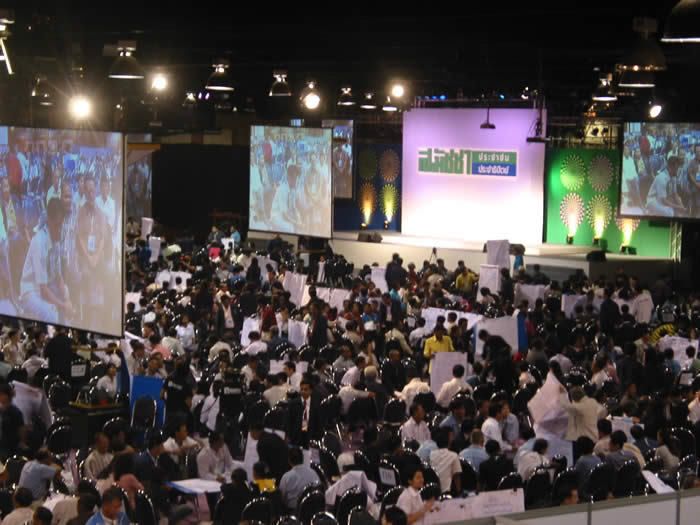
"As a member of 1960s generation, I grew up in the midst of the search for the meaning of life...."
Words from a soulmate I never met. Read more from this link:
Quest for a sustaining energy for societal change
from Chaiwat Thirapantu
Military coup of 1932
Here's a page from David K. Wyatt's "Thailand: A Short History", (Silk Worm Books, 1982/84) an account of the 1932 coup:
More about factions in the Thai military coming up later.
"It was accomplshed by a handful of conspirators with a few hundred troops and involved only one casualty. It succeeded initially on surprise and bluff, then on the Promoters' holding of princely hostages, and finally on the sanction conferred by royal approval - all of this taking only a few hours. The public was not even aware of what was happening until it was all over, and before noon on June 24, the life of Bangkok and Siam was proceeding normaly, but with new leaders at its top.
The 114 Promoters of the 1932 coup could not have succeeded as they did if they had not included in their ranks a small number of senior military men, whose membership in the group lent it credibility. It may perhaps also suggest the extent to which officials had begun to lose faith in the old order. These men, indeed, were relatively conservative, certainly compared with the youthful left-leaning civilians led by Pridi Phanomyong. It was they who dominated the first constitutional regimes until the late 1930s. The most important of these were Phraya Phahonphonphayuhasena (Phot Phahonyothin) and Phraya Songsuradet (Thep Panthumsen), both colonels by 1932. Phraya Song held a top post at the military academy in Bangkok, which gave the conspirators access to a broad range of contacts and an increasingly indoctrinated cadet corps. His tactical genius made it possible to neutralize a strong army and government with a handful of troops. Phraya Phahon was distinguised by a personal integrity that made him acceptable to all factions of the Promoters as the leader of the People's party.
Having induced the king to recognize and validate their actions, the Promoters undertook to organize a government under a provisional constitution of June 27. In order to minimize internal resistance and avoid the dangers of foriegn intervention that they thought civil strife might invite, the Promoters initially stayed in the background, though they were still firmly in control. The long-term political program drawn up at the time by Pridi envisaged a three-stage process of political development. The first stage had now begun, with the adoption of a provisional constitution establishing an Assembly of seventy members appointed by the Promoters and a smaller People's Committee drawn from and responsible to it. A second stage was to begin within six months under a constitution similar to that drafted for Prajadhipok in March, with a half appointed and half indirectly elected National Assembly. A third stage of full representative government was to be inaugurated when half the population had completed primary education or within ten years, whichever came first. The general framework was defined in terms of the political leadership and tutelage of the People's party.
This party had as yet no mass membership or following, nor had it even substantial control over the army, so the first government it constituted displayed at least the facade of wide support. The first National Assembly included in its membership numerous senior officials, including some chaophraya of the old regime, amounting to about one-third of the total membership. The president of the Assembly was Chaophraya Thammasakmontri (M.R.W. Sanan Thephastsadin), a former minister of education. On the People's Committee, which handled the day-to-day administration of the governement, there were eleven promoters, including the leaders of their four chief factions, and four senior officals. Of the latter, the most important were Phraya Maopakonnithithada (Kon Hutasing), a respected judge of the Court Appeals, and Phraya Sri Wisarn Waja, former undersecretary of the Ministry of Foreign Affairs and adviser to King Prajadhipok. Phray Sri Wisarn was the new foreign minister, and Phraya Mano became prime minister and minister of finance.
Meanwhile to consolidate their power while experienced hands ran the government, the People's party reorganized the army and navy to put their men in key positions and began trying to build a popular constituency. They quickly discovered that the first course was much easier than the latter, that people would not attend rallies and demonstrations unless ordered to do so, and that many now seeking to join their ranks were motivated by desire for jobs in the new government. The lack of dependable popular support clearly became evident within a few months. It left the young civilian faction within the People's party at a severe disadvantage in competing the influence with the military and with senior civilians with the bureacratic experience and networks of connections within the elite.
Once the permanent constitution of December 10, 1932, came into force the conflicts and competition latent within the ruling coalition began to erupt."
More about factions in the Thai military coming up later.
Tanks in the name of democracy
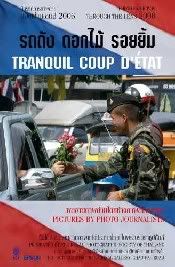
Why do the Thai military think they have a right in politics? They gave the people democracy with their coup of June 24, 1932. A constitution was drafted and we became a constitutional monarchy. "Protector of democracy" has been their slogan ever since.
I wonder how long it will take for people holding guns to realize that those guns will never be able to give equality and freedom. How can they be so deaf and blind to the fact that in our collective memories, when guns and people stood against each other lives were lost, always. The Thai people giving flowers and food to the soldiers? Isn't that how they appease powerful spirits?

Factions and politics
Aahhh...the familiar make and break of pyramids in Thailand:
Somsak leads 100 members to resign from Thai Rak Thai
Sonthaya and Chonburi faction resign from TRT
Suranand leaves Thai Rak Thai
Surakiart resigns from Thai Rak Thai Party
All in a rush to (pardon the language) save their asses.
Somsak leads 100 members to resign from Thai Rak Thai
Sonthaya and Chonburi faction resign from TRT
Suranand leaves Thai Rak Thai
Surakiart resigns from Thai Rak Thai Party
All in a rush to (pardon the language) save their asses.
Sunday, October 1, 2006
Last time we had a "good" general at the helm:
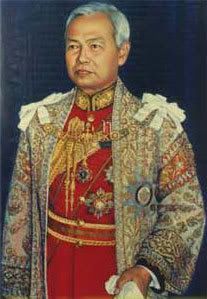
General Prem's coalition government lasted 6 years (1981-87), two elections and a couple of parliamentary dissolutions resulting in the five cabinets listed below.
1st Prem Cabinet (3 March, 1980-11 March, 1981)
Coalition partners: Social Action Party, Chart Thai, Democrat, Chart Prachachon and Siam Democrat
Major opposition: Prachakorn Thai
2nd Prem Cabinet (11 Mar 1981- 8 Dec 1981)
Coalition Partners: Democrat, Chart Thai and a number of smaller parties including Siam Democrat, Ruam Thai and Social Democrat
Major oppposition: Social Action and Prachakorn Thai
3rd Prem Cabinet (9 Dec 1981-30 Apr 1983)
Coalition Partners: Social Acion, Democrat, Chart thai and a number of smaller parties
Major opposition: Prachkorn Thai
4th Prem Cabinet (30 Apr 1983-11 Aug 1986)
Colatition partners: Social Action, Democrat, Prachakorn Thai and National Democrat (replaced by the Progressive party in Sep 1985)
Major opposition: Chart Thai
(In Jan 1986, there was a reshuffle within the Social Action Party for its allocated quota of cabinet seats)
5th Prem Cabinet (11 August, 1986-28 April, 1988)
Coalition partners: Democrat, Chart Thai, Social Action, Rasadorn
Major opposition: Prachakorn Thai, United Democratic, Ruam Thai, Community Action, Progressive
Source: "The Military in Thai Politics, 1981-1986", by Suchit Bunbongkarn, published by the Institute of Southeast Asian Studies, 1987.
Taksin's politics wiped out nearly all political party alternatives, co-opting them all into TRT. At this moment, we don't have strong enough groups of representative of diverse voices to enter the parliamentary system as we had back then. Without a constitution and with the ban on political gathering, it would be difficult for any alternative political groups to be built in time to run competitively in upcoming elections.
On censorship
Lots of talk about this now, here's an eye opener:
Censorship
There's a lot to read on that website, good for critics who love to criticize. Even shutdowns of antiwar websites. How's that for freedom of speech in the land of "democracy"?
Here's some good (rather extensive) reading on freedom of expression. FEPP
And lastly, this is what Thailand needs: Media Literacy: An Alternative to Censorship, and since we change constitutions and governments so often, we might have the capacity to jump into it naturally. Hah, hah, hah? :)
Censorship
"Censorship exists to some extent in all modern countries, including the U.S.A., the U.K., Germany, France, Singapore, Australia and New Zealand."
Serendiptiy
There's a lot to read on that website, good for critics who love to criticize. Even shutdowns of antiwar websites. How's that for freedom of speech in the land of "democracy"?
Here's some good (rather extensive) reading on freedom of expression. FEPP
And lastly, this is what Thailand needs: Media Literacy: An Alternative to Censorship, and since we change constitutions and governments so often, we might have the capacity to jump into it naturally. Hah, hah, hah? :)
Subscribe to:
Posts (Atom)