Thursday, October 29, 2015

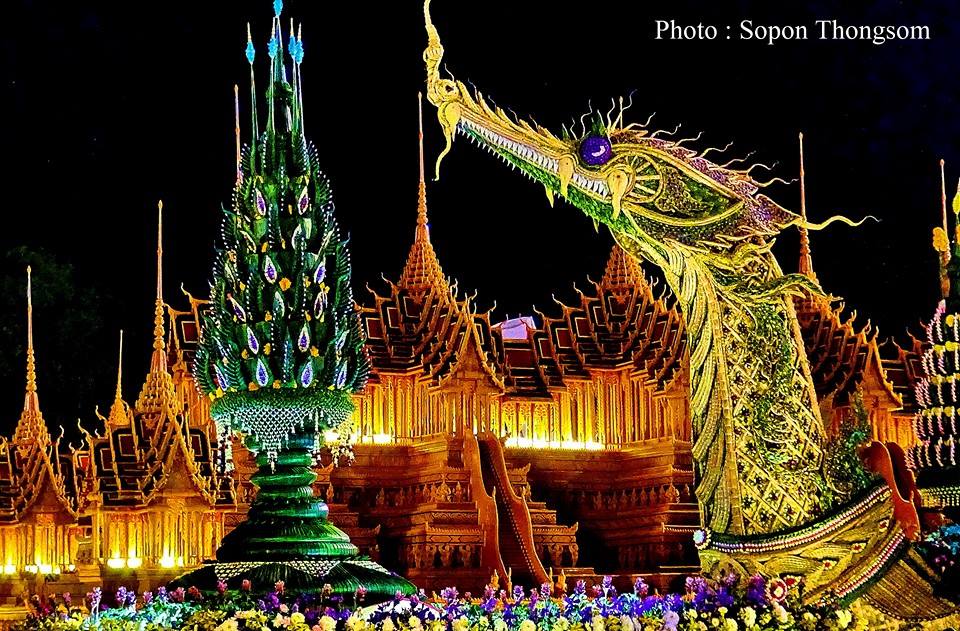
Wax Castle Festival, Sakon Nakhon

The Wax Castle Festival is held each year in Sakon Nakhon, on the full moon of October (15th day of 11th Lunar month), marking the end of Thai Buddhist’s Lent. 

The Buddhist Lent called “Kaw Phansa” in Thai, is a practice of Thervada Buddhism, when wandering monks seek retreat during the rainy season to avoid walking over rice fields. It ends after three months, at the end of the rainy season, celebrated as the “Ok Phansa”. 

It was recorded that when Phansa was first practiced during the time of Gotama Buddha, the monks took vows of silence to avoid potential conflict during their time of confinement. The Buddha criticised this practice and initiated the practice of atonement or “pavarana” instead.

Buddhist stories say that on his seventh phansa, Gotama Buddha went to heaven to give a sermon to his mother who had passed away without receiving Buddhist teachings. On his descent from heaven, the Buddha miraculously sent forth a light so bright it opened up the three realms of earth, heaven and hell, and all beings who awaited him on his descent from heaven were united in the marvel of enlightenment. 

Another story tied to the Ok Phansa tradition tells us that during one lent period, the Buddha had no company except for an elephant and a monkey. These animals offered him a honey comb and when the monkey and elephant died they were reborn in heaven. So when the Buddha went to visit heaven, he brought with him honey for the monkey and elephant angels.

In Sakon Nakhon, the Wax Candle Procession is a homage to their sacred temple, Phra That Choeng Chum Vorawiharn. During this celebration, the people wish for a happy live, with wealth, as symbolised by the castle. The 11th century Phra Thad Choeng Chum is scared not only for Sakon Nakhonians but for all people of Thailand because it is believed to hold the footprints of 4 Buddhas, representing a location that past Buddhas have passed through.

Communities from all over Sakon Nakhon province will join hands at their local temples two to three months in advance to build, mold, carve and decorate the magnificent beeswax castles. The wax castle is built from a wooden frame and then covered with wax patterns and carvings. The wax castle in its current form was first created about 60 years ago at Wat Chaeng, based on the model of the royal Bang-Pa-In Palace. While its current form reminds us of the palaces in heaven in which the Buddha visited, its older form, the bee’s tower, as it was called before, had two earlier forms.

The old wax tower forms were originally in the shape of a ‘Talum’. The Talum is a ten or twelve sided, layered, lacquered rattan, elevated bowl. The Talum form evolved out of an older tradition of a bee’s tower from banana trunk decorated with bee’s wax patterns. This bee tower was used in ceremonies for paying final respects to the deceased after a cremation. In its older form, bee’s wax patterns were created from carved papayas that were dipped into softened bee’s wax and  alternatively dipped into cold water to release the patterned forms. This was placed onto a round cut turmeric, to support the wax, pinned into place onto the banana trunk with rattan picks. At the base of the tower would be a three legged stand that was used for picking up the left over cremated parts. After which the tower would be placed over the ashes and blessed before the ashes are collected into urns.
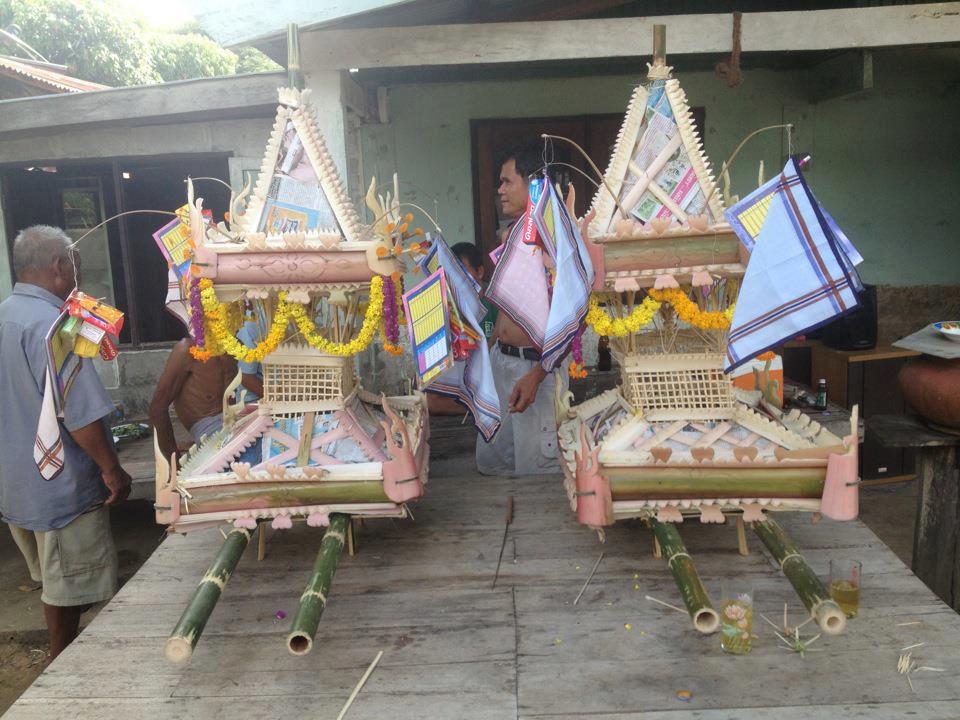


Ok Phansa is celebrated with Thod Kathin offerings, which would include, apart from saffron robes, food, toiletries, simple utensils, and a rattan tree with silver and gold branches in which donation money were tucked in as leaves. The Kathin procession used to be brought to a temple through the water, accompanied with music and dancers. As it arrived to the temple, it would have to circulate the temple three times while prayers were chanted. 

The present day procession is led by traditional local dancers on foot, from the Sakon Nakhon city gate to the temple and then carried to the old government plaza at Sanam Ming Muang where visitors can admire the castles, and take selfies.

On Kathin day, a ceremony of presenting the offering is held at the temple. At other temples all over the country, many other Kathins are presented. In Isan, crocodile flags are placed at a temple’s entrance to show that it has received the annual Kathin donations, so worshippers can find another temple to present their seasonal merit.

Pra Thad Choeng Chum had been maintained by generations of local communities whose forefathers had dedicated themselves as slaves to the temple. When King Rama 3 integrated Isaan into his kingdom, these caretakers were exempted from tax collection. The caretaker communities grew to include several other areas far from the temple. The Ok Phansa ceremony is also a leave taking from their duties to temple to return to their families’ rice fields for harvesting season.

The seasonal food for this period is steamed sticky rice cakes wrapped in banana leaves and Khao Mao, a delicacy of unripe green rice that is pounded close to a paste and served with shaved coconut.

Sakon Nakhon’s celebration of its Wax Castle Festival is a testimony to the binding power of culture. It has endured from time immemorial, transformed in multiple facets, and year by year has become a larger and more renowned celebration.


Friday, January 6, 2012

An short explanation on Thai debt: FIDF


The Nation: Opinion, 

Charm needed to sway the central bank on debt burden

Thanong Khanthong
December 30, 2011 1:00 am
The former finance minister is heading a committee to rehabilitate Thai industry and infrastructure in the aftermath of the worst floods in 50 years. To reconstruct the economy, the government needs money. But, due to all the populist spending pledges, it is broke. Virabongsa's task is to help the government find the money - at least Bt350 billion for the time being.
The easy target is the Bank of Thailand, to which the government could pass on the burden of an old debt so that it can create a new debt for fresh spending.
The government needs a personality of Virabongsa's stature to battle against the central bank, whose governor, Dr Prasarn Trairatvorakul, is drawing up a strong defensive line. The battle now looks ugly, centring on the debt of the Financial Institution Development Fund (FIDF), an arm of the central bank.
The ghost of the FIDF will not be laid to rest easily. Every time a new government steps in, it wants to find a way not to service the debt of the FIDF, which used taxpayers' money to bail out the financial institutions in the 1997 Asian financial crisis to the tune of Bt1.4 trillion. The FIDF debt now stands at about Bt1.1 trillion.
The Yingluck government does not want to service the annual interest payment of Bt45 billion for the FIDF. It wants the central bank to assume all the Bt1.1 trillion of FIDF debt so that it has room to create new debt.
Thailand's public debt has exceeded Bt4 trillion, equivalent to 40 per cent of the gross domestic product. If the FIDF debt of Bt1.1 trillion is deducted from the overall public debt, the governmentwould be in a position to create new debt for massive spending. The government, prior to the floods, leaked a "New Thailand Project", through which it plans to invest Bt900 billion in the economy.
The Pheu Thai politicians live up to their repurtation as big-time spenders.
If my memory is correct, Dr Virabongsa used to oppose any attempt to pass the FIDF debt to the central bank, arguing that doing so would compromise the financial and monetary discipline of the country. He appears to have gone through a change of heart. He would like the central bank to dig into its foreign exchange reserves of more than US$180 billion to pay off the FIDF debt.
Governor Prasarn is protecting the central bank's turf. The FIDF debt was incurred by the previous government (led by General Chavalit Yongchaiyudh), which offered a 100 per cent blanket guarantee of the public deposits and creditors while the banks and finance companies were failing. No government in the world has hitherto issued a Cabinet resolution to protect creditors' rights like the Thai government, which did so under the directive of the International Monetary Fund.
Since it is the policy of the government to protect the public deposits and the foreign creditors' money, it must keep its promise. In this regard, Prasarn is correct to have insisted that the government continue to pay the debt of the FIDF.
The BOT's foreign exchange reserves are not totally secure. Foreign investors could withdraw their money out of the country any time in the event of financial shocks. If they were to flee the country (by converting the baht for the dollar before taking the money out) like they did in 1997, Thailand could lose its reserves in a hurry.
The position of Thirachai Phuvanat-naranubala, the finance minister, on the FIDF debt is not clear. Initially he wants the BOT to study a plan to help the government reduce the debt of the FIDF. He realises that the central bank is losing money from its monetary operations, resulting in a negative net worth of more than Bt400 billion. He wants the BOT to share the burden, but he opposes an outright monetisation of the FIDF debt, which would destroy the credibility of the central bank. By the way, Thirachai used to serve as BOT deputy governor.
If the BOT were to totally monetise the Bt1.1 trillion FIDF debt, it would increase its negative net worth to Bt1.5 trillion. In this case, confidence in the baht would wobble. That is the road Zimbabwe has taken.
Today, Kittiratt Na Ranong, the deputy prime minister, will call a meeting to set a plan for the Finance Ministry and the BOT to work out the FIDF debt. The details remain shrouded in mystery. But politically speaking, the Yingluck government has already sent an unequivocal message that the BOT must take the whole burden of the FIDF debt.

Wednesday, April 20, 2011

Weekly Anecdotes-International Organizations Acronyms: WB

1. WB: The World Bank

"Why is the World Bank called the World Bank when its Presidents have always been American since its inception in 1944?" I wondered. "Why don't they just simply call it the American Bank for International Development?" Then we'd not have any illusions about its true agenda.

"Spoils of war"...(WWII) is how I would prefer to refer the Bretton Woods Organizations. Yes, yes, I acknowledge, these organizations did contribute a great deal to the development of our modern global economy as it is today...but... I think after six decades we can start to ask, "How long are we still going to live in the shadows of one of humanity's darkest moments?" I'm all for learning from history, but really, do we want to eternally keep tying the way we think of ourselves to our worst moments? 

Then there's also the question, "To whom do the benefits accrue? To the so-called developed countries or to the developing countries whose help it was to be committed to?" Or I could even be more to the point and say, "To the country that doesn't even attempt to search around for its best and brightest to appoint as this organization's head?"

These questions came up to me when I started looking closely at the World Bank's declared raison d'être and changing realities of the global economy. It's been only 10 years since China joined the club (WTO) as a world trading partner that agrees to follow the sanctioned rules of international trade. In 2011, she surpasses the US as world manufacturer. In her 2nd decade after joining the club, she is expected to overtake the US to become the world's largest economy. Even if things go bust, and she doesn't make it by 2020, there's still 2030, according to our esteemed World Bank. By 2040, the citizens of China could well be richer than the citizens of Europe at the present moment.

So if the World Bank is supposed to represent its member countries by their sizes of economies, I couldn't help but wonder, "Can we expect a Chinese national as President of the World Bank in five years?" Not realistically.  Even if the World Bank would adjust its voting rights again so soon, along the lines of its 2010 WB voting rights adjustment, China could m-a-y-b-e earn around 8% of voting rights compared to US's 15%. Hmm, still not the decision makers there obviously. Don't even mention that China could influence international politics hard enough to have the US and EU change its de facto agreement concerning the appointment of WB's presidency. Well, I suppose I can still hope that the World Bank will continue its internal reform and search for the best and brightest, even among Americans, for the next World Bank President. 

Monday, December 27, 2010

Sufficiency economy pondered upon

"Sufficiency economy" can be better understood if it is seen as something quite uniquely Thai, with all its cultural nuances and non-translatable terms. It could be better understood if one is able to speak Thai and has followed its debate, discourse, promotion and implementation in the Thai language. When one tries to explain it in English, there are frustrating confusions, such as, is it an economic thought? Or is it a Buddhist philosophy? Is it the same as sustainable development or environmental sustainability? Most importantly, is it worth discussing or can it be applied anywhere else but in Thailand?

The person explaining from the Thai point of view can't explain it sufficiently, first, because of that frustrating incompatibility of the English language for explaining many Thai concepts. On top of that he/she is also challenged to apply western economic concepts to something that is more an expression of Buddhist philosophical thought than an economic thought. One speaks about the mind and its effects on the quality of life while the other speaks about quantitative monetary concepts. One calls for a middle way that considers family and community relationships and environmental responsibility, while the other is just looking for cost efficiency or the best price that expresses the right balance between supply and demand. How do you quantify the diverse levels of how each unique individual defines what is "sufficient" for him or his community? Price, demand, supply, efficiency, etc. becomes hopelessly inadequate as measurements. How does one quantify generosity or charity or a 'right' mind? Because sufficiency economy fails to answer these questions, its critics declare that it is not an economic thought nor a viable economic model.

The story of sufficiency economy developed in Thailand nearly along the same timeline as the story of how sustainability caught on as desired developmental goal recognized by the UN in 1972 at the UN Conference on the Human Environment held in Stockholm, popularized 15 years later with the Brundtland report (1987) and adopted as a major wold challenge at the Rio Earth Summit (1992). In Thailand, sufficiency economy was being shaped and implemented as an economic thought since the late fifties/early sixties when a young king travelled laboriously around his country initiating development projects where he could to better the lives of people in remote areas.

Despite its current popularity, sufficiency economy is not a mainstream economic model in Thailand. It is more like a supplementary prescription for the shaping of economic activities to counteract the ills of a dominantly capitalistic model. Sufficiency economy as an alternative economic thinking is one that is gaining ground one poor village by one poor village converted, as individuals who were inspired by its principals implemented and demonstrated successful local action again and again. In many cases, villages that could not feed themselves started growing their own food as an alternative to growing cash crops that had only caused them to become increasingly indebted. Instead of buying expensive fertilizers, they have expanded the supply of organic food, some even becoming successful with an export niche market.  At the same time, depleted forests are being regenerated and a future in which environmental and community awareness where values such as love, friendship, and generosity gain triumph over profit and greed are being re-enforced.

A recent article, "Sufficiency Economy" was published by PETER JANSSEN on The Manila Bulletin (http://www.mb.com/, December 27, 2010:  http://www.mb.com.ph/articles/295104/sufficiency-economy ), focused on a Thai abbot at Doi Pha Som forest temple (วัดธาตุดอยผาส้ม) in Chiang Mai, Sorayut Chayapanyo (พระสรยุทธ ชยปัญโ), who had rebuilt an old temple, regenerated the surrounding forest, and helped villages grow out of debt. Stanford educated, but rejecting that privileged knowledge, he explains sufficiency economy as not being 'anti-capitalist' nor 'anti-Western', but as something between market economy and socialism. Sufficiency economy was shown as being meaningful in impoverished rural areas where access to the market economy was difficult. Money or greed were no longer the main locomotive of local economic activities once people learnt how to search for ways to become dependant on what they had.

This was not a new story for me. I have heard many very interesting local stories of how poverty was transformed into resourcefulness over the years adopting those principals proposed by the Thai King, proposed in his annual speech of 1972. What this story gave to me, this time, was the realization that it was the availability and strength of a localized social network or social structures, very particular to Thailand or maybe a Buddhist society, that plays an important role in nurturing the emergence of leadership or inspired action by individuals in the successful implementation of a sufficiency economic model.

Before Thailand became a modern economy with its building blocks in the late fifties/early sixties, much of its rural economy, community life or social fabric was structured around the temple. The temple was not simply a religious institution, it was also the place where education was being given, funds being raised for community development, and where the binds of society were formed and strengthened. In many cases, it was the ground where many non-monetary activities were supplementing the economic livelihood of its communities, with its festivals and fairs, funerals, alms giving and donations.

This was a social network that encouraged individuals to make a difference, usually with very small means.  As the modern economy grew, the state and modern markets took over much of the role that the temple played. Festivals are now just commercial events hosted on government grounds. They don't do much for that very personal tie that binds. As a modern Thai, I don't remind myself the value of giving each single day as my mother does, just by consistently getting up every morning to cook rice for a group of passing monks.

When I read yet another story of how one person transforms a community, it dawned on me that poverty is not converted by economic intervention, but by changing the emphasis on our values. When we review what we want of the world by starting a review of  our minds, not from the point of view of what objects or things we need, but from a point of view of what qualities in life we really need to make us contented, we can come to realize that we really don't need all those consumerist products and services the markets try to push on us. We then realize that we don't need to focus on chasing money so much when we can focus on just trying to define what makes us contented.

Monday, December 6, 2010

Climate Change Negotiations: An example of Public Diplomacy

Shah, Anup. “Reactions to Climate Change Negotiations and Action.” Global Issues, Updated: 04 Oct. 2009. Accessed: 06 Dec. 2010.

UNITAR's training program:
http://www.unitar.org/ny/environmental_negotiations

Wednesday, November 17, 2010

Thai cooking in Spanish

Recently inspired to find more simple solutions to making a video, finally got into editing on iMovie, and cut a DVD earlier produced into 4 minute shorts to upload to YouTube....


There's also more (cooking vdos in Spanish) to come at my YouTube channel:
http://www.youtube.com/user/netnapitasakorn?feature=mhum

Monday, October 18, 2010

"Stop calling them 'developing countries'" from Gapminder

The term "Developing Countries" might have made sense once.

Today it's impossible to make a clear distinction between "developing" and "developed" countries.

In 1950, most of the so-called "developing countries" had more than 5 children per women and less than 50 years of life expectancy.

Today, in most of the world, women have less than 3 and life expectancy is over 65 years.

Any attempt to divide the countries of the world into two groups, such as "developing and developed countries" will be an over-simplification.

Click play on the graph in the link below to see how the world has changed since 1950.

www.bit.ly/9DwNBE

Tuesday, September 21, 2010

The middle income trap

The Nation on Sep. 12, published an article announcing ADB's approval of a $300mn loan to Thailand to develop its capital market. The 15 year period loan is to be used in support of the Thai government's Capital Market Development Master Plan for 2009-13 for the development of the equity market, bond market and money market in four areas: regulatory environment; market efficiency, liquidity and transparency; market infrastructure; and new products and investors. 

The government has made substantial headway in developing Thailand's capital market. Recent measures included establishing a timetable for the demutualisation of the Stock Exchange of Thailand, strengthening the surveillance and enforcement capabilities of the Securities and Exchange Commission, moves to develop the domestic bond market, and simplifying taxes on financial transactions. There has also been activities organised to improve public financial literacy.

What caught my interest was the mention of the capital market development plan's goal to help the country "transform from a middle-income to high-income economy through increased contribution of the domestic capital market to financing domestic investment and economic growth".

"The middle income trap" seems to be a recent development agenda that is being 'pushed around' at the moment. I remembered having recently read an article at Time about Malaysia's dilemma with this interesting concept. I had felt then that the writer didn't do much justice for Malaysia. However, it seems that this economic criticism is gaining some weight among policy makers. Here are a couple of related articles:

From an economist's blog, "Getting out of the middle income trap"

Of course, moving towards a higher income economy is a desired goal, but I can't help wondering. Is the simple focus on "income" levels obscuring other desired developmental goals? Like income distribution for one? Does higher income come with skewered income distribution? If it does, well, maybe it's okay to be "stuck" for a while, until those higher income countries can show us that people with lower income in their countries are receiving desired benefits of higher income, let's say... a good welfare service system for one, no?

Some recommendations of how to escape the middle income trap:
  • a managed growth program with higher income, stronger currency, while maintaining a flexible foreign exchange regime and inflation control targets
  • a more efficient capital market, availability of capital for sme and local firms to grow
  • R&D spending
  • tax reform (capital gain tax)
  • investment in human resources
  • developing an ability to produce and contribute to the global economy via home grown innovations
Economics aside, I think there are other socio-political issues that can cause a country to be stuck, my own list:
  • political instability, stunted political development
  • corruption
  • a polarized society
  • debt
  • lack of investment in infrastructure and human capital
  • energy self-sufficiency
To cap off, I found this interesting and useful guide, from You can read the Bangkok Post, by Jon Fernquest, "Avoiding the middle income trap: The challenges ahead for Thailand"

Tuesday, September 7, 2010

Linguistic diversity in Thailand

Recently meeting a linguistic student the other day, I surprised him by declaring that Kmer and Thai did not belong to the same family group. He thought they belonged to the same linguistic family.  I had a vague memory of a classification of the three large linguistic families of Southeast Asian languages I had read in Joachim Schiiesinger's "Ethnic Groups of Thailand: Non-Tai Speaking Peoples of Thailand" (published by White Lotus Press, 2000.)  I looked up this book as soon as I got home, just to make sure I hadn't made a rash declaration. Sure enough, page 8, a diagram, adapted from James A. Matisoff, "Linguistic Diversity and Language Contact", in John MacKinnon and Wanat Bhruksasri, eds, Highlanders of Thailand (Oxford University Press, 1983): The three linguistic superstocks of Southeast Asia:
  1. Austro-Asiatic, to which belongs the languages of Munda (India), Nicobarese, Mon-Kmer (Vietnam, Laos, Cambodia, Burma, Thailand, China, Assam), and Aslian (Malaysia).
  2. Austro-Thai, to which belongs the sub-family languages called Austronesian, Tai-Kadai, and Mioa-Yao.
  3. Sino-Tibetan, subdivided into Chinese and Tibeto-Burman.
Now if you're not a linguist (which I'm not, but I'm an extremely curious person), it's easy and forgivable to make a simple and common conclusion that people of same geographic region will be speaking similar and related languages. However, it turns out that Southeast Asia is one of the most diverse and linguistic regions of the world. My new linguist friend, who specialized in Spanish and is more interested in learning about prehispanic languages, of course, was not expected to know this.

How would you explain to people who don't have a clue, the minefield of linguistics? What exactly do linguists do? Well, my husband's niece who had decided to go into that field of study, is now working on the construction of a dictionary of Spanglish, of all things. I met another, who worked with a computer software company, using her speciality in Latin, putting a natural order to computer programming. Then, there's a blogger I avidly follow who doesn't write so much about linguistics as much as she writes about Thai cooking!

Wikipedia says, "linguistics is the scientific study of natural language". It also goes on to say that there are several sub-fields (ie, grammar and semantics), and sub-disciplines (ie, evolutionary liguistics, historical linguistics, sociolinguistics, neurolinguistics, language acquisition, discourse analysis, and pragmatics), and even relate fields (like phonetics). Interestingly, "outside the field, this term is commonly used to refer to people who speak many languages fluently".

So from the understanding derived from reading the above wiki article, the classification of family languages falls under historical linguistics, branching out from philology, the study of ancient texts.  Well, if you're in interested in what linguistics is all about just keep following those numerous links provided by wikipedia. I hope it will inspire you to develop a keener interest in what linguistics is about, if not to be fascinated enough to become one yourself.  Meanwhile, I'm looking at the topic heading that I put up and sees that it's saying "Linguistic diversity in Thailand"!

What then is the distinction between Austro-Asiatic and Austro-Thai? "Austro" means south, so therefore, Austro-Asiatic is basically South Asia. That is an interesting revelation, because only a small group of people are left that speak Austro-Asiatic (Munda) in India which geographically is considered South Asia. Instead, the language of the Indians are mainly of the Indo-European and Dravidian language groups. Another quirk of linguistics.

The grouping of the language family of Austro-Tai is based on a hypothesis that the Tai-Kadai and Austronesian language families of southern China and the Pacific are genealogically related. There are a number of possible cognates in the core vocabulary.  The word for rice, for example.

While what is seen on the surface is that the Thai language is THE one and only official language of Thailand, in reality a multitude of languages and dialects are spoken in Thailand. I enjoy being able to point out the differences of Isaan dialects spoken in Northeastern Thailand. Sakon Nakhon, where my family is from, has a special kind of sing song lilt (influenced by Puthai) that in my opinion makes it sound softer than for example the dialect of its neighboring province of Kalasin. Nobody will deny that the dialect of the North is different from the dialect of the Northeast, even if we can quite easily understand each other, but have a Southerner speak his dialect to me and I'm lost, but not as lost as having a Karen hilltribe speak to me.

The book, "Linguistic Diversity and National Unity", by William A. Smalley (1994), singularizes the success of Thailand's official language policy. Unlike other multi-ethnic nations, such as Myanmar and India, where official language policy has sparked bloody clashes, Thailand has maintained relative stability despite its eighty languages. 

Another notch on the belt for Thailand, it seems.


Friday, August 13, 2010

IPad moves us forward

I was skeptical, at the beginning, whether I could adapt and actually enjoy reading on a touch screen tablet...until the iPad officially hit the Mexican market. My family and I turned out to be among the first to check it out at Reforma 222's iShop. The main reason for scuttling across the city to hunt for and happily dishing out 8,000 pesos for the smallest 16G-wifi iPad, which was selling like hot cakes that first week, was justified with the thought of all the savings I would receive from not having to pay the average 20 dollars for shipping that always topped each order of books I made with Amazon. (English language bookshops being a rarity in Mexico.) The various Mexican stores that were carrying the iPads all offered the increased incentive of long-term payments, interest free, from 6-18 months. 

It's been about three weeks now and I'm still being surprised on a daily basis, by how I can adapt the iPad to helping me better enjoy the things I like.  Primarily, the adjustment to reading ebooks came pretty easily. Not only do I agree with a Macworld's writer account of "How the IPad changed my reading habits": yes, to the liberating experience of being able to control font size; yes, to the mobility of carrying several 'books' with you in one package; YES, to going back to reading comics again, and finally-yes, to a totally new way of reading magazines and news. I managed to read a novel more leisurely with the bookmark function, and the temptation to look at the final pages is somehow removed by this less physcial format. While reading Chris Kuzneki's The Lost Throne, his descriptions of fabulous places like   Meteora and Mt. Athos, had me checking them out immediately online, just a click away on the iPad.

I also discovered the pleasures of being rewarded by the creative powers of application makers. By asking google to deliver the lastest news related to the iPad, I caught Flipboard on its launching day. What a novel way of experiencing Facebook and Twitter it was! I'm actually using my Twitter account more because of Flipboard. I even like the way Wired is presented on Flipboard more than on its original, too fancy, Wired app. It's a genius of having many options put into one place. I deleted some newspaper apps that I felt were cluttering my opening screen and opted for Flipnews instead. The coolest is being able to use the iPad as a really expensive photo frame that I can switch on as I listen to music from iTunes (which never really caught up with me until now). Apart from the app Photo Frame Lite which delivers me interesting and recently loaded photos from Flickr, I can watch stream of photos shared by my social groups from Facebook, Twitter, and other Flip items I've chosen on Flipboard in its 'unopened' flip screen. Just these photo streams alone make me feel more connected with the world, and with absolutely no regrets that I didn't hesitate to buy this new tech gadget. I am offered glimpses into the beautiful lives, the so talented eyes of a larger bit of humanity than I could possibly experience personally.

The iPad is much more than an oversized iPod, and much more than a common e-reader. The apps Virtuoso, Note Goal Lite, and Etude is encouraging me to try learning how to play the piano again. I doodle on Draw Free when I'm bored. I'm expecting the acquisition of my Spanish vocabulary to speed up with Spanish Dict's word game, my grammar to improve with free spanish lessons podcasts, my ability to manage the complexity of the language by internalizing the downloaded audiobook, Don Quixote.

All in all, I can't help sympathizing with the angst of the publishing industry in their scramble to figure out how to keep in the game in a digitized world. However, at the same time, I can't help cheering all these new game changing paradigm, when I read articles about learning disabled kids and old people coming out enchanted and having a richer learning experience, all thanks to the iPad, ....and all the industrious people creating fabulous apps!

Tuesday, August 10, 2010

Mor Lam and Monks

Mor lam, is a northeastern Thai tradition that is slowly dying due to the influence of pop music. It would be wonderful if a new generation of Isaan youngster with talent could revive this lyrical art.

An unforgetable talent that had helped keep this artform current was Pumpuang Duangjan, R.I.P. While there are current artists like Jintara Poonlarp, Siriporn Ampaipong, and even a Dutch singer Christy Gibson, these studio-produced mor lam pales in comparison to the excitement and appreciation of a spontaneous talent shown in the live sparing of a mor lam contest or performance among the Isaan people.

I was fortunate enough to witness one such performance at a young age.  Maybe multimillion Thai pop music studio businessmen can be tipped to fund these contests in the Isaan country side, in the way that Nelson Mandela did for South African rugby, as shown in the movie, Invictusnot only to promote the goodwill of Luk Tung, a local musical genre not imported from abroad, but to give a sense of pride in cultural identity of the young, as well as to discover new natural talent.

I had always thought that this musical form is in some ways similar to modern rap, only much more traditional. It challenges its performers to dig up the best use of language and rythm on the spot. The best perform from a memory or repertoire of word play, rythm, rhyme and metaphors. It's what I would call a neobaroque form of entertainment because the musical accompaniment is simple and repetitive yet intuitive and spontaneous. It's a whole performance that engages and pulls in its viewers or in this case audience and listeners.


So what does mor lam performances have to do with monks?

I just recently read the history of Phra Ajaan Mun Bhuridatta Thera (1870-1949), the most venerable founder of Thailand's famous forest monk tradition. Here's what http://www.accesstoinsight.org/ says,
The unusual style of Phra Ajaan Mun's sermons may be explained in part by the fact that in the days before his ordination he was skilled in a popular form of informal village entertainment called maw lam. Maw lam is a contest in extemporaneous rhyming, usually reproducing the war between the sexes, in which the battle of wits can become quite fierce. Much use is made of word play: riddles, puns, innuendoes, metaphors, and simple playing with the sounds of words. The sense of language that Ajaan Mun developed in maw lam he carried over into his teachings after becoming a monk. Often he would teach his students in extemporaneous puns and rhymes. This sort of word play he even applied to the Pali language, ...

The best of buddhist teachings comes from oral traditions, in the forms of rhetorics, whether in the Tibetan debating or in this case the teachings of humble monks of Isaan origins, that towers above the more conventional Thervada style of Thailand's center. The language of mor lam and the language of forest monk tradition is Lao, which is (central Thais would probably love to deny) the true origin of the Thai language. Acharn Mun and other forest tradition monks had so internalized the teaching of the Buddha, which they had learnt in Pali, but it was practice and practice (of meditation) that allowed them to master the knowledge and thereby able to transmit in simple yet enlightening forms (in Lao) to their students and the common people. 

An interesting note to leave, pondering on oral tradition, links to languages, and preservations of cultures.

Acharn Mun passed away in 1940 at Wat Pa Suthawat, Sakon Nakhon. A small museum was built in his honor where there is an exhibit of his personal belongings and a brief account of his life.

Wax image of Pra Acharn Mun Bhuridatto, 
at Wat Pa Suthawat, Sakon Nakhon

Sunday, August 8, 2010

Noteworthy places to visit recommended by a noteworthy blog

To take note of some places I would like to visit in Thailand.  Musuem Siam, and BMA Local Museum of Yannawa District, both have special memories for me, both recommended by a blog I like, My Unseen Thailand.

Thursday, June 10, 2010

Thai ceramics: an ancient, yet living tradition

Living under the shadow of a greater neighbor such as China has its disadvantages as recounted in my previous post relating the Haw Wars.  It also has many advantages. One boon was the boosting of a prosperous international trade in ceramics in the 13-14th century Sukhothai.

King Mengrai of Chiang Mai, King Ramkamhaeng of Sukhothai, and the Kingdom of Lopburi all sent several diplomatic missions to Chinese courts. Some Chinese potters were probably brought back to Thailand during 13th century as a result of these friendly and profitable visits.  Later around late 14th century, the ban on exports of early Ming Dynasty most likely encouraged frustrated Chinese potters to relocate to several pottery cities around Southeast Asia.

The famous Sangkhalok ceramics of Si Satchanalai flowered around the 14th century. These beautiful green glazed celandon and fish painted stoneware ruled the seas for some 300 years before blue and white porcelain from China took over international Eastern maritime markets. Recent discoveries of numerous shipwrecks, such as the Turiang shipwreck discovered by Sten Sjostrand in the South China Sea, have provided more detailed information about Sukhothai ceramic production than historical records could have provided.

Hundreds of ancient kilns have also been archeologically excavated in several locations all over Thailand.  Most of them were centered around Si Satchanalai, Sukhothai, Suphanburi, and Tak. The Chao Praya  River system obviously had been a key artery of distribution.  Eventually it seemed that the deterioration of river access to Si Satchanalai could have been a major cause for the decline of ceramic trade from Si Satchanalai and subsequent geopolitics shifted the center of power from Sukhothai to Ayudhya, where other products of trade gradually gained more importance over ceramics.


Southeast Asia has an old tradition of pottery that dates back even before the times of Sukhothai.  There were ancient Mon, Kmer, and Vietnamese 8-11th century traditions.  Pots have been excavated from burials dating 6,00BC to 4,000BC. Buried red earthenware were so abundant in Ban Chiang that thousands of years later, a teenager kicks up its shards leading to the discovery of an extensive Bronze Age pottery production.  


Looking around present day common life in Thailand, you'll find evidence abound that such pottery traditions continue to be an important element of Thai culture. From fine high cultured, five-coloured  Benjarong porcelain and imitations of antiqued ceramics sold to tourists and collectors, to commercial modern dining wares for exports and day to day items of household use such as, Ratchaburi dragon water jars, ubiquitous red-tiled roofs and sculptured terra cotta motifs in temples.  


For those who have such as a pottery craze as I do, a tour of just pottery sites in Thailand alone can easily fill up any touring plans.  A day trip out of Bangkok to Ratchaburi is as good a place to start as a river trip down the Chao Praya river to Ko Kret.

There are 42 factories of dragon jar makers in Ratchaburi, all of them descended from early 20th century Chinese pot makers who were brought in to make to pots during the World War when imports of these important jars were not allowed.  You can find a description of how these dragon jars are made in this page of Sea East Asia Pottery.


One can also visit production villages that had evolved out of old pottery communities. Dan Kwian, in Nakorn Rajasima (Korat), about  three hours out of Bangkok is a good detour on a trip to the Pimai Kmer style archeological site.

If you plan a trip up North towards Chiang Mai, drop by to support the Muang Kung Pottery Village.

However, if you have to save your plans of travel for sometime in the future, don't despair. You can just visit online this exquisitely produced Shaw collection website, where you will be able find descriptions of dated ceramic traditions, as well as rare pictures of ancient kilns that dot the geography of Thailand.  You can use the map provided to mark out places you must try to visit when you eventually make it to Thailand.


Admiring the variety and genius of ceramic traditions around the world, old and new, never fails to touch me with the ebb and flow, the persistence of humanity's creative spirit to shape, out of so humble a material such as earth, to produce such venerable objects as these enduring pots and jars... that, even after several hundreds of years buried under sea salt... can still shine their lustrous beauty.

Don't miss checking out the extensively, resourceful Maritime Asia website for detailed information about Sukhothai and Si Satchanalai pottery.

Friday, May 28, 2010

The Haw Wars, 1865-1890 (สงครามปราบฮ่อ)

Around the time that Louis Napoleon Bonaparte's regime was ending in France, the Taiping rebellion having failed in China, King Mongkut (Rama IV)had just gained an acceptance for Siam as a rightful nation in world diplomacy. Between the years 1865 and 1890, the Thai Kingdom's northern parts which was then bordering with the French protectorate Tonkin, were being raided by Chinese rebels that had fled southwards after their defeat in Nanking and other rebellions.

Rama IV

Armed, organized and trained but outlawed warriors banded together under different leaderships who distinguished their different groups by using colored flags. There were red, black, yellow and stripped groups of flagged bandits roaming the country side. The Black Flag group, led by Lui Yongfu was the most legitimate of the colored flags and fought for both the Viet and Chinese rulers against the French.

The Yellow Flags, led by Huang Chongying, were modeled after, but rivalled the Black Flags, failed to gain legitimacy and were pursued by both Qing and Vietnamese armies, as well as their original contenders, the Black Flags.  They were broken and on the run, raiding, looting, and harassing defenseless towns.

Many of those rebels roaming the countryside in the South of China towards the ending of the 19th century were Muslim Chinese, known as Hui in China and Panthay to the Burmese, while in Siam and Laos they were known as Haw.  

By 1872, bandit groups had drifted across the frontier of Laos and were occupying a large part of Laos which was then a tributary state of Thailand. In 1873, the Red Flags sacked Dien Bien Phu (a place where, at that time, French opium dens were making fortunes), and the Stripped Flags gained control of the Plain of Jars and the area of the Phuan (Xieng Khouang).

Several unsuccessful attempts to subdue the rebels were pressed upon by Viet, Laos and Thai kings.  A prince of Phuan was killed in one attempt and a Thai Praya was shot at in another. Each time that the Siamese army retreated, the rebels came back to raid towns. The rebels had equipped themselves with modern repeating rifles and Birminghan-manufactured ammunition and were skilled in guerilla warfare.

The Thai army was mostly made up of untrained men recruited from the North and Northeastern farmlands.  The commanders sent by King Chulalongkorn were unfamiliar with the terrain and logistics.  In one campaign, supplies were lost to the rebels, in another campaign an outpost was lost because its captain fell ill with malaria.  The Thai army's offensive to subdue the Haw bandits took so many years because it was also difficult to fight during rainy seasons.  Without success in one year, the army would have to regroup again the next year to push for another offensive.

In the end, the Thai army was supplied and trained with foreign weapons to match the fighting power of the Haw rebels. A British surveyor, James McCarthy, under hire by the Thai king to map Thai terrain during that period, was an observer of the Haw Wars.  He had noted that on one occasion some of those weapons carried by Thai recruits weren't even loaded!

A successful strategy was finally planned and the Thai army moved in a more coordinated offense, and managed to squeeze the perimeters of the bandits into a smaller territory. After some key towns the Yellow Flags had taken were freed, the Haw bandits were pushed out of the Northeastern borders of Siam and Laos back into China. 


The observation of this particular historical moment is very interesting for me personally due to an unquenchable curiosity to know more about a hometown and family that I hadn't grown up with.  In answer to my constant pestering questions about the past,  my Mom once recounted to me that the Promasakha Na Sakon Nakhon family was related to ours, the Singhakul family (a story that I will tell later in another blogpost).

Sakon Nakhon is a province in the Northeast of Thailand, about two hours from the Mekhong River border with Laos.  When I unearthed, in the scantily recorded history of this town, an interesting record of how the name Promasakha Na Sakon Nakhon was given to a highly esteemed governor of the Muang, relating his role for recruiting and leading people in support of the offensive against the Haw bandits, the Haw Wars became for me an important reference point to find out more about events that had shaped the times of my mother's grandparents.

Since I am now able to use the internet to access sources in English and increasingly more in Thai, I am seeing a clearer picture of how a sleepy town on the edge of empires is, in fact, not as insignificant as one had perceived. Several connections to many other important world events could be drawn from this single event.

The little details recounted by McCarthy of repeating rifles and Birmingham manufactured ammunition opened my eyes to how British imperial ambitions, whether intentional or not, were entwined in that moment.  The name "Haw", before just a name of an ethnic group, led me to discover that they were the same as Hui, Muslim Chinese who were, at that moment in history, leading a serious rebellion against the Qing dynasty.  Those rebels weren't just mindless raiders, they were pretty likely sent to that specific area. Whether as part of mercenaries simply following a campaign to harass French powers in the area, or as part of the Panthay Rebellion's leader's plan to occupy as much area as possible in readiness for his planned move into Burma, I will have to investigate further.

The lengthy campaign against the Haw also revealed in finer details the growing pains and mistakes of then a still evolving administration of the fourth, fifth, and sixth reign of the Chakri dynasty, learning, modernizing bit by bit, on the ground, less than 150 years ago.

The picture of elephants standing in formation with the Thai army above recalled to mind a funny anecdote of how King Rama V had once offered to send elephants to aid the US during its Civil War.

A revelation more relevant to the present, was the idea invoked of how, in actuality, not so far away China is, from the frontiers of Thailand. Our modern maps show that the space between the center of Thailand and the heart of China is quite immense, but if in the 19th century, all that space was takable by rebels, refugees moving over land, in a matter of months, fighting prolonged for decades, the illusion of that safe distance seems rather foolish indeed.  If anything such as a serious political unrest were to happen in that great land up North, Thailand would be receiving the brunt of an unimaginable deluge of refugees. We've never really overcome problems generated by refugee situations of the Vietnam wars, and even now, we are having increasing difficulties managing illegal immigrants in a million or two, escaping the oppression of the Burmese Junta. 

The different colored flags was also an odd reflection on the yellow and red colored political polarization happening currently in Thailand.

Recommended further reading:

Islam and Commerce in Old Yunnan
http://en.wikipedia.org/wiki/Haw_wars
สงครามปราบฮ่อ
Surveying and exploring in Siam, by James McCarthy

Wednesday, May 26, 2010

The winding road to Rachaprasong

Just wanted to note Philip J. Cunningham' excellent post on how it's not just simply red vs. yellow, government vs, people, or whatever.  It's much, much more complex.

Please read in Phillip's own words at "The Long Winding Red Road to Ratchaprasong and Thailand’s Futureon his blog Frontier International.

Tuesday, May 25, 2010

A different auteur: Apichartpong Weerasethakul

Congratulations to Thai film director, Apichartpong Weerasethakul, for winning the Palme d'Or at the Cannes Film Festival 2010 for his film "Uncle Boonmee Who Can Recall His Past Life".


I remember that as I was watching one of Apichart's film, "Tropical Malady" at TIFF, after it had won the Cannes' Jury Price in 2004, in the dark trying to understand what he had wanted to say with his movie, I'd noticed quite a number of viewers who'd just simply given up and walked out. Of course, they were under the pressure of a film festival where one only wanted to see as many films that attracted one as time could permit. I toughed out quite a number of cringes and perplexities... to be surprisingly rewarded by a few really subliminal forest and country scenes. I was transported across time and space to moments in my own past when I, myself had commuted with Thailand's many beautiful nature scenes. One memorable beautifully shot scene of a huge tree swaying in the moonlight had made the whole movie worth watching. I left the cinema that night wondering if a viewer who had never been in such an atmosphere before would have felt something similar to what I'd felt. The story he was trying to tell itself, though, made no sense at all. Apichart's skill was not in narrative.

A year later, I made an even greater effort to understand Apichart's films by watching "Syndromes and a Century" and even bought a DVD one of his first movies, "Mysterious Object at Noon", from Bay Street VDO, one of Toronto's blessing for those who are intrigued by different kinds of film. 

Apichart is skilled at evoking memories of a time past.  His movies aren't about contemporary Thailand, but he portrays a Thailand that informs many of our present moments in such an intriguing way that you end his movies asking questions about your own perceptions of those times, or even asking about your perception about perception. 

I think what the jury at Cannes this year voted for was a "yes"; the world of cinema is ready for  surrealism from a Thai point of view.  Apichart's win and the timing of his win was as surreal as his movies. Under the fall of volcanic ashes, his themes of death and dying, belief in reincarnation, belief in a world where other forces besides human's co-existed amongst us, were like a sad mystical echo for those lives lost in the streets of Bangkok.  His memories expressed in Uncle Boonmee's story came from another time in Thailand's history when ideals also fell under conventional forces of repression. Ideals that were eventually proven false but still its loss painfully felt for those who had experienced it. I suppose this is an artist's way of putting out that big question, "Why?"

I hope to see more of Apichart's work. Even if I will be left full of questions, and his work is likely not going to so well-accepted in Thailand. I hope it is the inspiration needed for many more younger generation Thai filmmakers to have the courage, drive and commitment to one's conviction to come out and do something different, and bring more of Thai cinema to international attention.

PS.  For those who would like to read an extensive account of Apichart's win at Cannes, please read Wise Kwai's Thai Film Journal.

Monday, May 24, 2010

Himmapan Forest-3: The world of the Nagas

Nagas, morphing rain-giving majestic serpents, are probably one of the most revered mythical creatures in Thailand.  I was born on a Saturday and my protective Buddha figurine is that of the Buddha sitting on and under the protective shade of the 7-headed Naga, Muchalinda.


Wat Pho

In Buddhist stories about the life of the Buddha, it was told that not long after the Buddha had gained enlightenment, he travelled through many towns and villages to teach the people about his path towards enlightenment.  On the outskirts of one village, he settled into deep meditation under a tree for seven days, oblivious of the heavy storm that was raging about him during that time.  Muchalinda, the King of the Nagas, called Phya Nak by the Thai people of the North, Northeast Thailand and Laos, protected the meditating Buddha by morphing his body into a big shade over and around him.  When the Buddha came out of meditation, Phya Nak transformed himself into a human form to bow before the Buddha and returned to his crystal palace in joy.

In another Buddhist story, the Buddha went to teach the angels and gods in celestial heavens, his descent was aided by seven jeweled rainbow steps laid by the gods between the bodies of two nagas.

Naga sculptures can be found in many Thai, Northern or Laotian temples, at entrances, adorning stairways, or on rooftops, as gaurdians of these sacred places, or as a metaphor for the rainbow bridge that connects the human world with heaven. 

Prasat Hin Pimai


The original dwelling place of the Nagas is in the mythical forest of Himmapan, a place where the most beloved Buddhist tales took place. 

In King Lithai's Traibhumikatha, a description of the Naga and their dwelling place is given:

"After a kalpa is brought to an end by the great fire, a new earth is born.  Nothing is the way it was before.  The land had been flattened and is then a glittering white, as beautiful as a sheet of pure silver. Beautiful green grass grew.  The entire land radiates glory and splendor.  Everywhere is beautiful.

There are several lakes that are generally covered with five kinds of exquisite lotuses. There are trees with beautiful trunks untouched by insects or disease. They bear fruit and flowers that are a wonder and delight to behold. There are tough mountain vines, some with red floweres, some with yellow flowers. The whole place is a glorious spectacle as if someone had carefully planned it. This is the homeland of the Nagas.  It is their native dwelling place. Here there are crystal mansions, silver mansions and gold mansions beautiful beyond description. However, there are also some areas where nothing could live.  They are hollow and empty.

Under the Himmapan range, there is a cavity of some 200 yoth wide. It is the city of the Nagas where there are seven kind of gems: gold, silver, lapis lazuri, crystal, agate, ruby and cornelian. It is as beautiful as Traitrimsha, the abode of Lord Indra. Several large lakes are found where the Nagas live and play. The water is beautifully clear and smooth, like a large piece of glass polished a number of times. In fording places, Nagas bathe and play, large fishes gliding along together snapping at smaller fishes. Patches of water-lettuce and five kinds of lotus bloom spectacularly. The flowers of the sacred lotus are as large as a cart wheel. When the water ripples, these blooms sway back and forth looking delightfully pretty, as if they had been consciously arranged.

There is one kind of Naga that dwells in the ocean. When the female of this Naga is well advanced in preganancy, she thinks to herself: "What if the newborn were delivered in mid-ocean? The ocean churns and foams violently; great sea birds agitate the waters; the winds from the wings of the Garuda beat the waves into foam."  Thus reasoning, the pregnant Naga dives deep and long and emerges where one of the five great rivers run into the ocean.  The Naga then swims up river until she reaches the great Himmapan forest.  In this forest there are golden caves beyond the reach of the Garudas. 

She delivers her young in one of these caves and remains to nurture him until he grows strong. When he is ready she takes him to a place where the water is only knee deep to teach him how to swim first in circles. After it is clear to her that he can swim well, she takes him back and forth across one of the great rivers. When he can cross the river with due swiftness, she induces a heavy rainfall which floods the Himmapan forest until it looks like an ocean. She then creates a spired mansion of gold, ornamented with the seven gems that gleam in glorious splendor. This palatial mansion is rich with decoration and good food.  It is as magical as those that are the dwelling of the devatas. The mother Naga places her child in the spired mansion and floats it down the river to the mouth, and out into the deep ocean where they dive to dwell under in the ocean bed.

There are two different kinds of Naga: the water-born and the land-born. The latter can change their form only when they are on land, they cannot do so in water. The water-born Naga can transform themselves in the water, but not on land. Neither kind can change its form in its place of birth, its death or where it sleeps. Nor can they do so when they assemble, nor when they are sloughing off their skins. The Nagas have the power to transform themselves only in places other than those just mentioned.  When they so wish, they can take forms as angelic as the devatas, their females as graceful as the female inhabitants of the celestial heavens. When the Naga seeks its prey, it will take the form in which it can most easily hunt its victim. In such a form they roam the land in search of food.  Sometimes they appear as common water snakes, sometimes as the Sai, or the Krasa, cobras, vipers, and sometimes as forest beasts. It is thus so because the Naga properly belongs to the Animal Kingdom."