Showing posts with label cultural streams. Show all posts

Thursday, October 29, 2015

Wax Castle Festival, Sakon Nakhon

The Wax Castle Festival is held each year in Sakon Nakhon, on the full moon of October (15th day of 11th Lunar month), marking the end of Thai Buddhist’s Lent. 
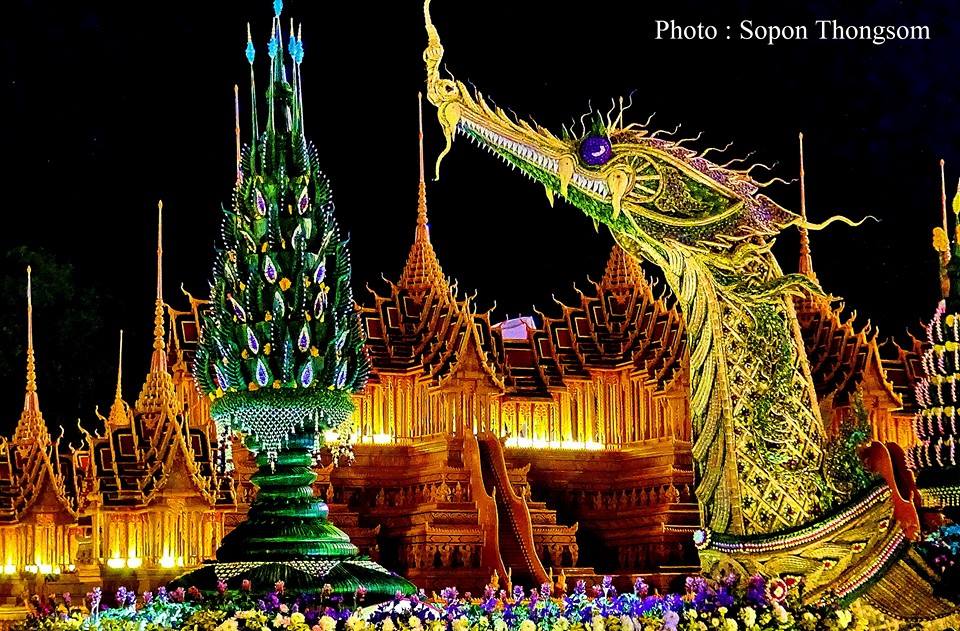

The Buddhist Lent called “Kaw Phansa” in Thai, is a practice of Thervada Buddhism, when wandering monks seek retreat during the rainy season to avoid walking over rice fields. It ends after three months, at the end of the rainy season, celebrated as the “Ok Phansa”. 

It was recorded that when Phansa was first practiced during the time of Gotama Buddha, the monks took vows of silence to avoid potential conflict during their time of confinement. The Buddha criticised this practice and initiated the practice of atonement or “pavarana” instead.

Buddhist stories say that on his seventh phansa, Gotama Buddha went to heaven to give a sermon to his mother who had passed away without receiving Buddhist teachings. On his descent from heaven, the Buddha miraculously sent forth a light so bright it opened up the three realms of earth, heaven and hell, and all beings who awaited him on his descent from heaven were united in the marvel of enlightenment. 

Another story tied to the Ok Phansa tradition tells us that during one lent period, the Buddha had no company except for an elephant and a monkey. These animals offered him a honey comb and when the monkey and elephant died they were reborn in heaven. So when the Buddha went to visit heaven, he brought with him honey for the monkey and elephant angels.

In Sakon Nakhon, the Wax Candle Procession is a homage to their sacred temple, Phra That Choeng Chum Vorawiharn. During this celebration, the people wish for a happy live, with wealth, as symbolised by the castle. The 11th century Phra Thad Choeng Chum is scared not only for Sakon Nakhonians but for all people of Thailand because it is believed to hold the footprints of 4 Buddhas, representing a location that past Buddhas have passed through.

Communities from all over Sakon Nakhon province will join hands at their local temples two to three months in advance to build, mold, carve and decorate the magnificent beeswax castles. The wax castle is built from a wooden frame and then covered with wax patterns and carvings. The wax castle in its current form was first created about 60 years ago at Wat Chaeng, based on the model of the royal Bang-Pa-In Palace. While its current form reminds us of the palaces in heaven in which the Buddha visited, its older form, the bee’s tower, as it was called before, had two earlier forms.

The old wax tower forms were originally in the shape of a ‘Talum’. The Talum is a ten or twelve sided, layered, lacquered rattan, elevated bowl. The Talum form evolved out of an older tradition of a bee’s tower from banana trunk decorated with bee’s wax patterns. This bee tower was used in ceremonies for paying final respects to the deceased after a cremation. In its older form, bee’s wax patterns were created from carved papayas that were dipped into softened bee’s wax and  alternatively dipped into cold water to release the patterned forms. This was placed onto a round cut turmeric, to support the wax, pinned into place onto the banana trunk with rattan picks. At the base of the tower would be a three legged stand that was used for picking up the left over cremated parts. After which the tower would be placed over the ashes and blessed before the ashes are collected into urns.
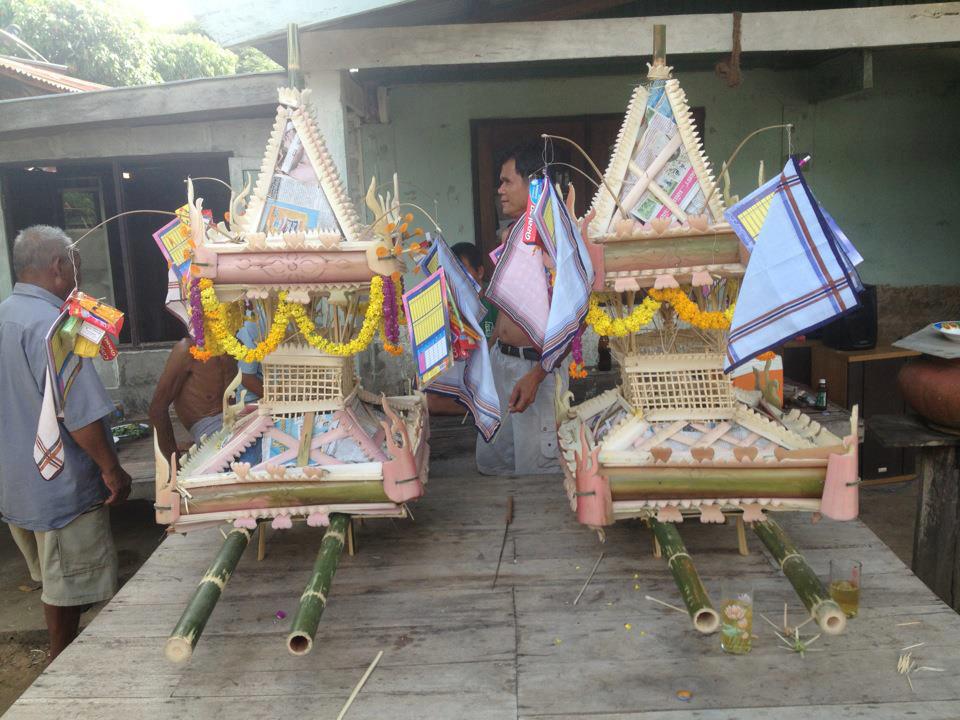


Ok Phansa is celebrated with Thod Kathin offerings, which would include, apart from saffron robes, food, toiletries, simple utensils, and a rattan tree with silver and gold branches in which donation money were tucked in as leaves. The Kathin procession used to be brought to a temple through the water, accompanied with music and dancers. As it arrived to the temple, it would have to circulate the temple three times while prayers were chanted. 

The present day procession is led by traditional local dancers on foot, from the Sakon Nakhon city gate to the temple and then carried to the old government plaza at Sanam Ming Muang where visitors can admire the castles, and take selfies.

On Kathin day, a ceremony of presenting the offering is held at the temple. At other temples all over the country, many other Kathins are presented. In Isan, crocodile flags are placed at a temple’s entrance to show that it has received the annual Kathin donations, so worshippers can find another temple to present their seasonal merit.

Pra Thad Choeng Chum had been maintained by generations of local communities whose forefathers had dedicated themselves as slaves to the temple. When King Rama 3 integrated Isaan into his kingdom, these caretakers were exempted from tax collection. The caretaker communities grew to include several other areas far from the temple. The Ok Phansa ceremony is also a leave taking from their duties to temple to return to their families’ rice fields for harvesting season.

The seasonal food for this period is steamed sticky rice cakes wrapped in banana leaves and Khao Mao, a delicacy of unripe green rice that is pounded close to a paste and served with shaved coconut.

Sakon Nakhon’s celebration of its Wax Castle Festival is a testimony to the binding power of culture. It has endured from time immemorial, transformed in multiple facets, and year by year has become a larger and more renowned celebration.


Tuesday, August 10, 2010

Mor Lam and Monks

Mor lam, is a northeastern Thai tradition that is slowly dying due to the influence of pop music. It would be wonderful if a new generation of Isaan youngster with talent could revive this lyrical art.

An unforgetable talent that had helped keep this artform current was Pumpuang Duangjan, R.I.P. While there are current artists like Jintara Poonlarp, Siriporn Ampaipong, and even a Dutch singer Christy Gibson, these studio-produced mor lam pales in comparison to the excitement and appreciation of a spontaneous talent shown in the live sparing of a mor lam contest or performance among the Isaan people.

I was fortunate enough to witness one such performance at a young age.  Maybe multimillion Thai pop music studio businessmen can be tipped to fund these contests in the Isaan country side, in the way that Nelson Mandela did for South African rugby, as shown in the movie, Invictus, not only to promote the goodwill of Luk Tung, a local musical genre not imported from abroad, but to give a sense of pride in cultural identity of the young, as well as to discover new natural talent.

I had always thought that this musical form is in some ways similar to modern rap, only much more traditional. It challenges its performers to dig up the best use of language and rythm on the spot. The best perform from a memory or repertoire of word play, rythm, rhyme and metaphors. It's what I would call a neobaroque form of entertainment because the musical accompaniment is simple and repetitive yet intuitive and spontaneous. It's a whole performance that engages and pulls in its viewers or in this case audience and listeners.


So what does mor lam performances have to do with monks?

I just recently read the history of Phra Ajaan Mun Bhuridatta Thera (1870-1949), the most venerable founder of Thailand's famous forest monk tradition. Here's what http://www.accesstoinsight.org/ says,
The unusual style of Phra Ajaan Mun's sermons may be explained in part by the fact that in the days before his ordination he was skilled in a popular form of informal village entertainment called maw lam. Maw lam is a contest in extemporaneous rhyming, usually reproducing the war between the sexes, in which the battle of wits can become quite fierce. Much use is made of word play: riddles, puns, innuendoes, metaphors, and simple playing with the sounds of words. The sense of language that Ajaan Mun developed in maw lam he carried over into his teachings after becoming a monk. Often he would teach his students in extemporaneous puns and rhymes. This sort of word play he even applied to the Pali language, ...

The best of buddhist teachings comes from oral traditions, in the forms of rhetorics, whether in the Tibetan debating or in this case the teachings of humble monks of Isaan origins, that towers above the more conventional Thervada style of Thailand's center. The language of mor lam and the language of forest monk tradition is Lao, which is (central Thais would probably love to deny) the true origin of the Thai language. Acharn Mun and other forest tradition monks had so internalized the teaching of the Buddha, which they had learnt in Pali, but it was practice and practice (of meditation) that allowed them to master the knowledge and thereby able to transmit in simple yet enlightening forms (in Lao) to their students and the common people. 

An interesting note to leave, pondering on oral tradition, links to languages, and preservations of cultures.

Acharn Mun passed away in 1940 at Wat Pa Suthawat, Sakon Nakhon. A small museum was built in his honor where there is an exhibit of his personal belongings and a brief account of his life.

Wax image of Pra Acharn Mun Bhuridatto, 
at Wat Pa Suthawat, Sakon Nakhon

Tuesday, May 25, 2010

A different auteur: Apichartpong Weerasethakul

Congratulations to Thai film director, Apichartpong Weerasethakul, for winning the Palme d'Or at the Cannes Film Festival 2010 for his film "Uncle Boonmee Who Can Recall His Past Life".


I remember that as I was watching one of Apichart's film, "Tropical Malady" at TIFF, after it had won the Cannes' Jury Price in 2004, in the dark trying to understand what he had wanted to say with his movie, I'd noticed quite a number of viewers who'd just simply given up and walked out. Of course, they were under the pressure of a film festival where one only wanted to see as many films that attracted one as time could permit. I toughed out quite a number of cringes and perplexities... to be surprisingly rewarded by a few really subliminal forest and country scenes. I was transported across time and space to moments in my own past when I, myself had commuted with Thailand's many beautiful nature scenes. One memorable beautifully shot scene of a huge tree swaying in the moonlight had made the whole movie worth watching. I left the cinema that night wondering if a viewer who had never been in such an atmosphere before would have felt something similar to what I'd felt. The story he was trying to tell itself, though, made no sense at all. Apichart's skill was not in narrative.

A year later, I made an even greater effort to understand Apichart's films by watching "Syndromes and a Century" and even bought a DVD one of his first movies, "Mysterious Object at Noon", from Bay Street VDO, one of Toronto's blessing for those who are intrigued by different kinds of film. 

Apichart is skilled at evoking memories of a time past.  His movies aren't about contemporary Thailand, but he portrays a Thailand that informs many of our present moments in such an intriguing way that you end his movies asking questions about your own perceptions of those times, or even asking about your perception about perception. 

I think what the jury at Cannes this year voted for was a "yes"; the world of cinema is ready for  surrealism from a Thai point of view.  Apichart's win and the timing of his win was as surreal as his movies. Under the fall of volcanic ashes, his themes of death and dying, belief in reincarnation, belief in a world where other forces besides human's co-existed amongst us, were like a sad mystical echo for those lives lost in the streets of Bangkok.  His memories expressed in Uncle Boonmee's story came from another time in Thailand's history when ideals also fell under conventional forces of repression. Ideals that were eventually proven false but still its loss painfully felt for those who had experienced it. I suppose this is an artist's way of putting out that big question, "Why?"

I hope to see more of Apichart's work. Even if I will be left full of questions, and his work is likely not going to so well-accepted in Thailand. I hope it is the inspiration needed for many more younger generation Thai filmmakers to have the courage, drive and commitment to one's conviction to come out and do something different, and bring more of Thai cinema to international attention.

PS.  For those who would like to read an extensive account of Apichart's win at Cannes, please read Wise Kwai's Thai Film Journal.

Monday, May 24, 2010

Himmapan Forest-3: The world of the Nagas

Nagas, morphing rain-giving majestic serpents, are probably one of the most revered mythical creatures in Thailand.  I was born on a Saturday and my protective Buddha figurine is that of the Buddha sitting on and under the protective shade of the 7-headed Naga, Muchalinda.


Wat Pho

In Buddhist stories about the life of the Buddha, it was told that not long after the Buddha had gained enlightenment, he travelled through many towns and villages to teach the people about his path towards enlightenment.  On the outskirts of one village, he settled into deep meditation under a tree for seven days, oblivious of the heavy storm that was raging about him during that time.  Muchalinda, the King of the Nagas, called Phya Nak by the Thai people of the North, Northeast Thailand and Laos, protected the meditating Buddha by morphing his body into a big shade over and around him.  When the Buddha came out of meditation, Phya Nak transformed himself into a human form to bow before the Buddha and returned to his crystal palace in joy.

In another Buddhist story, the Buddha went to teach the angels and gods in celestial heavens, his descent was aided by seven jeweled rainbow steps laid by the gods between the bodies of two nagas.

Naga sculptures can be found in many Thai, Northern or Laotian temples, at entrances, adorning stairways, or on rooftops, as gaurdians of these sacred places, or as a metaphor for the rainbow bridge that connects the human world with heaven. 

Prasat Hin Pimai


The original dwelling place of the Nagas is in the mythical forest of Himmapan, a place where the most beloved Buddhist tales took place. 

In King Lithai's Traibhumikatha, a description of the Naga and their dwelling place is given:

"After a kalpa is brought to an end by the great fire, a new earth is born.  Nothing is the way it was before.  The land had been flattened and is then a glittering white, as beautiful as a sheet of pure silver. Beautiful green grass grew.  The entire land radiates glory and splendor.  Everywhere is beautiful.

There are several lakes that are generally covered with five kinds of exquisite lotuses. There are trees with beautiful trunks untouched by insects or disease. They bear fruit and flowers that are a wonder and delight to behold. There are tough mountain vines, some with red floweres, some with yellow flowers. The whole place is a glorious spectacle as if someone had carefully planned it. This is the homeland of the Nagas.  It is their native dwelling place. Here there are crystal mansions, silver mansions and gold mansions beautiful beyond description. However, there are also some areas where nothing could live.  They are hollow and empty.

Under the Himmapan range, there is a cavity of some 200 yoth wide. It is the city of the Nagas where there are seven kind of gems: gold, silver, lapis lazuri, crystal, agate, ruby and cornelian. It is as beautiful as Traitrimsha, the abode of Lord Indra. Several large lakes are found where the Nagas live and play. The water is beautifully clear and smooth, like a large piece of glass polished a number of times. In fording places, Nagas bathe and play, large fishes gliding along together snapping at smaller fishes. Patches of water-lettuce and five kinds of lotus bloom spectacularly. The flowers of the sacred lotus are as large as a cart wheel. When the water ripples, these blooms sway back and forth looking delightfully pretty, as if they had been consciously arranged.

There is one kind of Naga that dwells in the ocean. When the female of this Naga is well advanced in preganancy, she thinks to herself: "What if the newborn were delivered in mid-ocean? The ocean churns and foams violently; great sea birds agitate the waters; the winds from the wings of the Garuda beat the waves into foam."  Thus reasoning, the pregnant Naga dives deep and long and emerges where one of the five great rivers run into the ocean.  The Naga then swims up river until she reaches the great Himmapan forest.  In this forest there are golden caves beyond the reach of the Garudas. 

She delivers her young in one of these caves and remains to nurture him until he grows strong. When he is ready she takes him to a place where the water is only knee deep to teach him how to swim first in circles. After it is clear to her that he can swim well, she takes him back and forth across one of the great rivers. When he can cross the river with due swiftness, she induces a heavy rainfall which floods the Himmapan forest until it looks like an ocean. She then creates a spired mansion of gold, ornamented with the seven gems that gleam in glorious splendor. This palatial mansion is rich with decoration and good food.  It is as magical as those that are the dwelling of the devatas. The mother Naga places her child in the spired mansion and floats it down the river to the mouth, and out into the deep ocean where they dive to dwell under in the ocean bed.

There are two different kinds of Naga: the water-born and the land-born. The latter can change their form only when they are on land, they cannot do so in water. The water-born Naga can transform themselves in the water, but not on land. Neither kind can change its form in its place of birth, its death or where it sleeps. Nor can they do so when they assemble, nor when they are sloughing off their skins. The Nagas have the power to transform themselves only in places other than those just mentioned.  When they so wish, they can take forms as angelic as the devatas, their females as graceful as the female inhabitants of the celestial heavens. When the Naga seeks its prey, it will take the form in which it can most easily hunt its victim. In such a form they roam the land in search of food.  Sometimes they appear as common water snakes, sometimes as the Sai, or the Krasa, cobras, vipers, and sometimes as forest beasts. It is thus so because the Naga properly belongs to the Animal Kingdom."

Sunday, May 23, 2010

Himmapan Forest-2: A description from King Lithai's Traibhumikatha

King Lithai, fifth of the Kings of the Pra Ruang Dynasty, was ruler of Si Satchanalai, twin city Sukhotai, the first Thai kingdom.  He succeeded his father, King Lelithai, as the fifth monarch of Sukhothai Kingdom in 1347 and reigned until 1368.  His reign was peaceful, and he was a great patron of religion. He was the first Thai monarch who was ordained as a Buddhist monk, yet he supported studies of both Brahmanism and Buddhism alike.  In 1357, he sent royal envoys to Ceylon for the Buddha's relics which were later kept in a great stupa in Nakhon Chum, as town near the present Kam Phaeng Phet.  In 1361, he invited a great patriarch, Pra Maha Swami from Ceylon to preach Buddhism in his kingdom.

As a young prince, he had studied under two royal sages called Upasena and Atharaya.  When he was ordained as a monk, his named teachers were, Maha Thera Muneewong, Anomthassi, Thamma Pala, Maha Thera Sitthattha, Phuthaphong, Panyanantha, and Phutthakhosajaraya.

King Lithai was inspired by the teachings of Buddhism and wanted to encourage his people to  learn  more about Buddhism, and therefore composed one of the first Thai literary works, "The Traibhumikatha", in 1345.  Traibhumikatha expounds Buddhist philosophy, quoting references from over 30 Dharma scriptures, a demonstration of substantive research.  It was written in beautiful rhythmic prose rich in allusions and imagery, explaining  Buddhist cosmogony, ethics, biology, and the Buddhist faith as understood then.

The "Three Planes of Existences"  was made up of 10 books.  In the 9th "Book of Nature",  I have extracted the following description of Himmanpan Forest:
"The Himmapan mountain range is 500 yoth high, 3,000 yoth wide and has 84,000 peaks.  A gigantic jambloan tree grows at the foot of this mountain range.  This tree stands on the banks of a river named Sida Nadi, the River of Coolness.
Next to the river are six forest: Kurabha, Korabha, Mahavideha, Tapandala and Somolo.  In these forests dwell sages of the Dharma who eat only fish and animals that die naturally. Yaksa, or giants roam these forests in great numbers.  People who live in these forests have no need to till the land for a living because rice and beans grow without the need for toil and trouble.  All the fruits of this land are as sweet as honey.
There are 7 large mother lakes: Anotata, Kannamunda, Rathakara, Chaddanta, Kunala, Mandakini, and Sihapapata.  All seven lakes are of equal sizes.
Lake Anotata is encircled by five mountains: the golden mountain Sudassanakuta, the mountain of seven precious gems-Chitrakuta, the green Kalakuta, the fragant mountain-Gandhamadanakuta, and the silver mountain-Krailasa. All five mountains are of equal sizes and curve into the Lake Anontata whose clear waters are fed by the powers of nagas and devatas.   
Waters from the lake flows out at four cardinal points marked by the face of a lion, face of an elephant, face of a horse, and the face of a bull.  Each outward flow of water encircles the lake three times before they exit midways between each cardinal point.  However, the river of the south does not behave like a normal river, after flowing southwards, it is blocked by a mountain, so it shoots upwards into the air, and then falling on a three-sided stone, it forms a three sided Lake of Lotuses, out of which flows a massive river above ground as well as one below the ground until they meet an animal shaped mountain and breaks into five rivers: the Ganga, Yamana, Aciravati, Mahi, and Sarabhu.  These rivers flow through towns and cities of men and out into the ocean."
Source: From Anthology of ASEAN Literatures,"Traibhumikatha: the Story of the Three Planes of Existence" by King Lithai, published by ASEAN in 1987.
The stories of the beautiful mythical lands of Himmapan, were used in Buddhist teachings usually imparted orally at temple gatherings to encourage people to study the Dharma which were inserted in the telling of tales of Buddha's own lives or his previous lives, so that they can refine themselves to be able to see or enter this wonderful land, but also to go beyond to reach the celestial heavens.

Saturday, May 22, 2010

Himmapan Forest-1

On the walls of Thai temples and at its gates, you will come across many mythical creatures of Thai mythology. Some familiar ones are the Kinnaree (half-human, half-bird), Garuda (half-bird, half-man) and Naga (transforming seven-headed snake).  

However, there exists several more: two/three/four-legged, fish-based and flying creatures, such as, the anthler Ghilen/Kirin, the lion Kraisorn, the horse Ussadorn, and the mighty Erawan elephant.

These fabulous creatures all lived in the mythical Himmapan forest.  The Himmapan forest is said to be located on a mountain range of 84,000 peaks, many conclude to correspond to the Himalayas, a geographical location where the stories originated from, an India so ancient it had influenced storytelling for religious purposes of both Hinduism and Buddhism.  


Both Hinduism and Buddhism are thousand years old religious teachings that have relied on oral memory to preserve a vast body of knowledge that was passed down thousands of years, pretty much intact. The Buddhist tales of Himmapan were recounted in the stories of Traiphum, Three Planes of Existence.

According to these entertaining yet instructive legends, Himmapan was located in the southwestern continent of Chomputaweep, one of the four continents of the 'universe'.  The center of this world/universe, which is just one in an unlimited number of other world/universes, is the sacred mountain, Sumane, which connects us to other planes. 

Each of the four continents floated on a world/universe filled with waters. The Himmapan forest was the sole connecting passageway from Chomputaweep to the center of the universe, Mt. Sumane, and was equated symbolically with the way of the Buddha. It is said that there was once a time when we could see and enter the Himmapan forest, and travel between the heavenly planes and human world was possible.  However, with the loss of high moral standards, we can no longer see this great forest nor its strange animals.

Traiphum is a Buddhist cosmogony, a system of symbols embodying esoteric knowledge that was to be later transposed into a myriad of artistic forms decorating many Buddhist temples of Thailand.  The mythical creatures of the Himmapan forests, some which were considered guardians of Buddhism or holy places, were dressings to make the Buddhist teachings colorful enough to be remembered generations after generations.


You can read and browse through pictures of more Himmapan creatures at http://www.himmapan.com/index.html.  When you visit the Emerald Buddha Temple, Wat Pra Kae and the Grand Palace, look out for their sculptures and look closely at the murals to see how many you can identify.  Or when you visit the National  Museum look closely at the intricately carved wooden panels brought from ancient temples around the country. Himmapan creatures always guard entrances.  At the Temple of Dawn, Wat Arun, you will find stucco adornments of lions and ghilens.  At the Erawan Museum which carries the majestic Erawan elephants as its roof, you will find a garden imitating the Himmapan forest dotted with sculptures of Himmapan animals.

Monday, November 16, 2009

Naga Fireballs

This festival celebrates one of Thailand’s most curious natural phenomena – the Naga Fireballs of Nong Khai. Taking place during the full moon of the final day of Buddhist Lent, small balls of fire rise from the Mekong River and plunge upwards of 300 metres into the night sky. The fireballs appear as eerie blobs of red, blue, pink or green light that hang in the air for around 10 seconds.

An interesting cultural event, the natural wonder of Bang Fai Phaya Nak, “Naga Fireballs,” is held in Phon Phisai district of the northeastern province of Nong Khai along the Mekong River, at the end of the three-month Buddhist Lent, or Ok Phansa, in October around 10-16.

Local residents seem to believe that the fireballs belong to the Naga, the king of serpents. This natural wonder is linked to a legend dating back to the Buddha’s times. It is said that the Buddha went to heaven to instruct his mother in his teachings. He spent three months there until his mother attained enlightenment. On the full-moon day of the eleventh lunar month, the Buddha returned to earth and celestial beings built a golden and silver staircase for him to come down. With his loving kindness, the Buddha created a miracle by opening a view of the three worlds, namely heaven, the earth, and the underworld. All nagas living in the underworld admired the Buddha for the gratitude he showed towards his mother, so they blew out flames from the bottom of the river to celebrate.

The origin of the fireballs has been much debated. One scientific study shows that the fireballs are caused by the sun warming organic matter on the riverbed, causing it to decompose into flammable phosphine and methane gas and combust in the presence of ionised oxygen. This explains why the fireballs are of uniform color, do not emit flares, smoke, or sound, and eventually dissipate without a trace. Tracking studies have indicated that the phenomenon occurs from March to May, and September and October, when the earth is closest to the sun. Naturally, the findings have been disputed by Nong Khai residents, who see their time-honored beliefs challenged by what they view as attempts to portray them as superstitious country bumpkins.

The Naga Fireball Festival also features a bazaar, a food fair, a contest of floating and illuminated boats in worship of the Naga, long-boat races, and a light and sound show. Although there are several viewpoints for watching the natural wonder of the Naga fireballs, a great number of fireballs are usually seen in Phon Phisai district.

About 600 kilometers from Bangkok, Nong Khai is situated on the bank of the Mekong River, which stretches 4,200 kilometers through six countries, namely Cambodia, China, Laos, Myanmar, Thailand, and Vietnam. As it is not far from Vientiane, the capital of the Lao People’s Democratic Republic, Nong Khai is regarded as a gateway to Vientiane. From the province, people can cross the Mekong River to Laos over the Thai-Lao Friendship Bridge. The phenomenon of Naga fireballs can be seen from both the Thai and Lao sides.

The following video from Youtube was recorded on October 14, 2008.

Yi Peng Lantern Festival, Chiang Mai


Yee Peng Lanna festival or Loy Kratong festival is an ancient and traditional festival which has been continued since the past.  It is usually celebrated on the first full moon of November.

In a past, according to sermons story told by abbots, of the last earthly existence of the Lord Buddha. The Lanna people celebrate this holy day by decorating temples or Viharns with banana tree and sugar cane.  The main entrance of the Temple is also decorated with candle, moonshines. The people launch fire-kites, fire crackers and float offerings along the canals or rivers.

Yi Peng Lanna festival is also a kind of a Buddhist ceremony and Lanna people believed that it is an opporutunity for them to make merit, listen to sermons, and to pay respect to the Buddha.

Sunday, October 22, 2006

Traditional Thai Dance Forms


Interesting read about how they used to dress thai dancers in the old days, and someone's efforts in reviving it: "Reviving a Thai art one stitch at a time" By Seth Mydans, International Herald Tribune.

Friday, October 6, 2006

The cat book of Siam

Cont'd from my previous post, the promised cat poems.

What amazes me when I read the number of poems from "The Legend of Siamese Cats" is how the poems, even if they repeat similar decriptions of certain kinds of cats, were written in different ways, revealing the creative use of words with different "authors". Names of "authors" are rarely recorded in ancient Thai literature. I can imagine that as the manuscripts gets copied, each copier who was creative enough would have added some of his own poetry. Depending on whose was most poetic, his was probably more copied and therefore endured via recieving the honor of being copied in other people's verses.

It's sort of similar to what we're doing with blogs, except nowadays we have to declare who we are in some way for readers to trust our authenticity.

The poem I'm posting here is Kaap Chabang on the "Benefits and Drawbacks of Cats"
The first cats referred, this treatise describes in their forms
Black on body, beautiful face two paws, stomach, back and tail
Nine places clear as cotton wool, eyes like jewels compared
Melodious voice, much loved by humans female and male
Whoever intends to raise them will become a master, promoted
Servants, retainers, wealth will come continually ample
With prosperity and dignity, enemies will not come near
Raising them yields results as the masters say in the treatise

One with white body, fine all over, and black in nine places
Like a piebald horse, whoever feeds it well, will trade swell
Much riches and treasures will be found, everything will come
That person is a rich man, for a good cat benefits its owner

One named fine sapphire, entirely, claws and tongue, fine black
Whichever cat you meet, black as they say, must be looked after
It will bring you all, retainers and food in ample amounts
With power, happiness, and welfare against danger

One copper, luminescent, claws, tongue and teeth as dyed red
Who raises it will gain great rank, a general or minister

One lao of flower of clear color, off-white fur, see black mixed
Who finds one, hurry to support it, that cat brings happiness
Women, men everywhere will cherish it, as this cat has charm
Loved all over by the people, both female and male

One called the jewel cat, of white body, with eyes like gems
Four black feet, ears and tail black as if ink applied
Has incalculable value, will bring great gain, more property
Who raises it will gain power, retainers and all good things

One a mercury color, a glowing shine, as if applied
Feed it well and great benefits rush in, raise it, do not doubt

One called Mongkol Amphai, the treatise says is auspicious
Black body, white neck round, good for the raiser, great wealth

One with a hourse-saddle mark, fine face with two black eye rings
Worth 100,000 gold tamleung, it brings its owner honour

One is black around the body, of great beauty, strange,
Who feeds it will have rank, power, with people fearing

One glows black all over, its nose clear white, a lovely face
Who raises, gains rank in seven months, the lords grant fortune

One with marks all over, its nose clear white, a lovely face
Who raises, gains rank in seven months, the lords grant fortune

One with marks all over, flashing beauty, strange,
Who feeds it will have rank, power, with people fearing

One glows black all over, its nose clear white, a lovely face
Who raises, gains rank in seven months, the lords grant fortune.

One with marks all over, flashing beauty, they say has dignity
Who raises, will be a minister, or chief of council, with rank

One marked large on mouth and nose, who finds it, should care for it
Will get land, fields, riches, a commoner becomes a master

One with underbelly markings is good for trade by boat
Merchants raise it hoping the cat is a bank of gold and silver

One has the line all along, good by the book, will further the family
With rank and power, replete, on an eternal base

One with amusing feet, they say to keep only for queen's lines
This cat brings virtue, so kindly do not endanger it

One marked on two ears, the treatise says should be raised by monks
For studying well, without forgetting with success as desired

They repeat in the books, one must study, raise and all will follow
Even in death, never discard the ghost, bury it, and keep the bones
In a pot to keep, which is also a virtuous act
When keeping do not despise it, or hit it, but care for it with love
Give it fine food, rice and fish, service it with everything replete
The cat will prosper, do not fret, or doubt the text

There are many more bad cats with tiger patterns,
They eat their young and have still births
Red tail markings of loss, twisted white tails, they say let go.

Here endeth the cat treatise, the bad and good in summary.


This particular poem didn't give the names of most of the cats, but other texts name 17 auspicious cats and 6 kinds of bad cats.

Just to show their poetic names, the 17 are: Ninlarat (Dark Sapphire), Wilat (Beauty), Suphalak(Excellent) or Thong Daeng (Copper), Kao Taem (Nine Points), Maaleht (Flower) or Dork Lao (Lao Flower), Saem Sawet (Alternate White), Ratanakamphol (Jewelled Cloth), Wichien Maas (Moon Diamond), Ninlajak (Sapphire Circle), Mulila, Krop Waen (Spectacle Frame) or Aan Maa (Horse Saddle), Pat-sawe (White Line) or Pattalort (Line Throughout), Krajork (Sparrow), Singha Sep (Lion), Karawek (Bird of Paradise), Jatubot (Four Feet), Konjaa (Sarus Crane)

Even the bad have exotic names. Six bad cats: Tupphalaphet (Weakness), Phan Phayak or Lai Sewa (Tiger Breed), Pisaat (Fiend), Hin Thot (Bad Stone), Korp Phleng (Fire Raiser), Nep Saniat (Dagger)

I wonder how these verses were used. Unless you were a cat breeder there isn't much use. I don't think cat breeding could have been such an important job (even if you could sell one cat for 100,000 gold pieces), but the survival of these texts certainly means that there was an abundance of them. An abundance of texts, but because of the nature of medium they were preserved in, never as ubiquitous as books in the west, and so Thailand was more of an oral society and a literate one.

These cat poems needed to be shared by being read aloud. I think they could have been tools for young students to learn how to memorize (and eventually read and write) since these cat poems didn't serve any practical purpose like buddhist texts or housebuilding manuscripts. They certainly are entertaining and the motivation of knowing your cats would be an incentive young ones to learn the verses.

Saturday, September 30, 2006

Boon and Baramee

Western non-bhudhists will find it very hard to understand the origin of King Bhumibol's power and influence over the Thai people. Their history of fuedalism and monarchical institutions would make it is very difficult for them to see how the Thai monarchy can be anything more than an institution.

The love and trust given by the Thai people to King Bhumibol is reserved for this King alone, and gained only after the people have had many years to observe his untiring dedication to the people. We are all aware that this King's accession to the throne was not a fait accompli. He earned due respect because of his sincerity towards the people.

Foreigners demean the intelligence of the 60 million Thai people when they think that we worship him just because his official name includes the title "Devaraja". Which other King overlooks his own security and travels miles in insurgency infested remote and marginalized villages to learn about their conditions first hand, who kneels on the dirt countless of times to touch and recieve the caress of the people? I've travelled with my father, a provincial government officer, on many of these occasions and saw with my own eyes, felt with my own feelings his true intentions. I will not allow ungrounded criticism for the sake of criticism to brand my feelings a foolish lie. Which other King personally and individually hands out graduation papers to the countless educated from their universities? As I grew up, seeing his many deeds on tv was a common sight, but there were also several occasions throughout the years where with enough resourcefulness I could have been in his presence. This kind of royalty exists only in fairy tales for the West, but we Thais are fortunate to have lived it for 60 years of our connected lives.

If we look back in Thai history, there are enough historical accounts of unfit Kings who were disposed of for a number of reasons. Doesn't that say that we are not totally uncritical of rulership? The King, as a key symbol for the Thai people, is a process that was created over a very long, long process, (700 years) unbroken by foreign colonization of which the Thai people are very well aware that they share a part it its legitamacy. Circumstance of King Prajadhipok's Succession and King Ananda's succession are good enough examples.

We don't blindly worship the King as if he were some "god", like some King bashers like to say. These people don't understand that as Bhuddists we don't believe in any "God". Yes, we're all atheist. We believe in each individual's personal responsibility for the health and development of his own soul. We believe in karma. We believe in the power that good karma accumulates, we call it "boon" and "baramee", and it is not only reserved for kings.

Every single individual accumulates this according to his/her deeds. Therefore we belief that men with good standing or "baramee" such as the king is proof of their accumulated good karma, or he won't be in that position. That baramee is what we respect. We also believe that those merits that an individual has earned, his/her boon-baramee can be shared with us when we participate in it. Bad karma is paid back on its own mechanism, for that reason we reserve our criticism of wrong doing even as we find the right moment to take action to correct the wrong.

The Thai people do not think that the King can do no wrong. It's that King Bhumibol has never actually done any wrong for us to criticise him. I'm pretty sure that if any Thai ruler committed a legitimate offense against the people, the people will find a way to effectively deal with it the way Taksin has been dealt with, the way we are not blind and are dealing with the coup in our own Thai way. The people, however, aren't perfect, and need their time to build institutions for that outlet. How many hundreds of years did it take the West to put into place their concepts and institutions for democracy? At least 200 years, at most 400 years. Isn't it imperialistic to try to impose on other cultures one's own way of thinking and doing?

We, the Thais are very aware that we are fortunate to have one of the few rare good rulers as our ruler. We are proud of that. What's wrong with loving a just and righteous ruler? Would all these foregin critics be happier if there weren't any such rulers left in the world, because they would just about tear anyone who tries to be perfect so that they can prove that nobody's perfect?

Rao rak Nai Luang. 60 years is a good time for us to declare that, isnt' it?

Thursday, February 3, 2005

Khon masks, puppets, archetypes and Thai leadership

A talk I attended a week ago gave the definition of an archetype as that unchanging pattern of energy that grips us. When we act out of our normal ordinary character, we are in the force of an archetype. These are the gods that Greek mythology gave a multitude of names. For example, there are archetypes of anger, love, the hero and his quest, chaos, death and destruction, etc. All cultures have some ancient understanding of these forces giving them different names but the forces are the same.


In Thai cosmology, a popular expression of these archetypes are expressed in the "Khon" - masked dance of the Ramakien, a version of Ramayana that was adopted into Thai literature with Thai personality and characteristics since the times of Sukhothai and Ayudhya. King Rama I composed a comprehensive literary version that present day Thai dance and theater base their acts on.


There are several links on the internet about Ramakien, some of which I've listed below. However, what delighted me the most was this website of the "Joe Louis Theater".


In 2001, I visited Burma. Apart from the Shwegadon Pagoda, the most memorable impression I had of Burma was its marionette tradition. Even in the form of its touristic presentation, it indicated a highly developed art form that amazing integrated music, song, dance, theater and puppetry. When I got back to Thailand, I tried to find what I could about Thai puppetry. Sadly, all I found were empty dolls sold as tourist souvenir. I visited the National Museum where there was an exhibit of some Thai puppets that were rescued and restored and was told that there had been only two performances long over because there wasn't enough people who knew how to control the puppets. Now, they have this excellent website and a theater that gives daily performances which doubles as a museum where you can see a demonstration of how the puppets are made and manipulated!


Well anyway, this recent discovery of what archetypes actually represent had me thinking about Thai Khon masks. When I was working in Thailand, I heard on several occasions people referring to their work persona as a Khon mask. Khon masks are highly respected in Thailand, you can only wear one if you've done a ceremony in respect of its spirit, or it is said that you will be possessed by bad spirits. And of course, being a mask, it's not the real you. Each job position required a different mask.


From an admiration of our Prime Minister, Thaksin Shinawatra for his perseverance in politics, to many indulgent forgivings for his foul ups, to outright outrage at how he's mishandled the Southern Muslim incidents, to pity for his being put on the tough spot when the Tsunami hit.... well, I realized that we're all participating in some archetypal forces here. PM Thaksin himself, I am sure, doesn't know what has him in its grip. He's like someone who unknowingly put a Khon Mask over his head without having done the right dedications to its spirit, not really understanding what the spirit of this particular mask that he chose would ask of him. Any wrong moves, and the spirit punishes severely. However, he did chose the mask, and he'll have to wear it until its energies plays out its complete act.


Links to Khon masks and Ramakien websites:


Khon masks

Khon masks


The poetic of Ramakien, presented by Northern Illinois University, Center for Southeast Asian Studies, I recommend again, is an excellent source for language and culture of Southeast Asia, including images of mural paintings.

A Muay Thai website that explains how the Wai Kru Dance of Muay Thai is related to the Ramakien tradtion.

Mahidol University's Ramakien websitet explains its connection to religious tradition and other art forms.

The six faces of Hunuman, the Thai's favorite character in Ramakien.

Monday, October 25, 2004

The Concept of the Thai Spirit

“Spirit is a power that causes, through its working from outside, changes and engenders unequal, asymmetrical relations within the individual as well as social groups. It is an ambiguous, external power, and affects directly or indirectly the individual and social relations, irrespective of whether it is institutionalized or not. This power of spirit is explicit when it attacks a person unpredictably or punishes him in response to his neglect of ritual duties. Such workings of spirit can cause instability, or destruction or, even worse, tatal collapse of internal equilibrium, which normally is believed to be maintained within the individual and social groups.


A person intrinsically has his or her own internal equilibrium, constituted of the relationship between khwan (soul) and rangkai (soul), which is always vulnerable and exposed to external power represented by various forms of spirit. …khwan as a popular notion refers to the collective soul entity believed to be firmly located within the person’s body. The firm unity of the soul entity and body provides health, while the drifting away of soul from body that could occur upon intrusion of external power, or through interference from other influential forces, can result in ill-health or even death. It is this idea of unity of soul and body which forms the basis of the stability of the equilibrium and its breakdown in association with external forces.”


from "Thai Construction of Knowledge,

ed. by Manas Chitakasem and Andrew Turton, London: SOAS, 1991."