Showing posts with label About the Streamer. Show all posts

Tuesday, September 7, 2010

Linguistic diversity in Thailand

Recently meeting a linguistic student the other day, I surprised him by declaring that Kmer and Thai did not belong to the same family group. He thought they belonged to the same linguistic family.  I had a vague memory of a classification of the three large linguistic families of Southeast Asian languages I had read in Joachim Schiiesinger's "Ethnic Groups of Thailand: Non-Tai Speaking Peoples of Thailand" (published by White Lotus Press, 2000.)  I looked up this book as soon as I got home, just to make sure I hadn't made a rash declaration. Sure enough, page 8, a diagram, adapted from James A. Matisoff, "Linguistic Diversity and Language Contact", in John MacKinnon and Wanat Bhruksasri, eds, Highlanders of Thailand (Oxford University Press, 1983): The three linguistic superstocks of Southeast Asia:
  1. Austro-Asiatic, to which belongs the languages of Munda (India), Nicobarese, Mon-Kmer (Vietnam, Laos, Cambodia, Burma, Thailand, China, Assam), and Aslian (Malaysia).
  2. Austro-Thai, to which belongs the sub-family languages called Austronesian, Tai-Kadai, and Mioa-Yao.
  3. Sino-Tibetan, subdivided into Chinese and Tibeto-Burman.
Now if you're not a linguist (which I'm not, but I'm an extremely curious person), it's easy and forgivable to make a simple and common conclusion that people of same geographic region will be speaking similar and related languages. However, it turns out that Southeast Asia is one of the most diverse and linguistic regions of the world. My new linguist friend, who specialized in Spanish and is more interested in learning about prehispanic languages, of course, was not expected to know this.

How would you explain to people who don't have a clue, the minefield of linguistics? What exactly do linguists do? Well, my husband's niece who had decided to go into that field of study, is now working on the construction of a dictionary of Spanglish, of all things. I met another, who worked with a computer software company, using her speciality in Latin, putting a natural order to computer programming. Then, there's a blogger I avidly follow who doesn't write so much about linguistics as much as she writes about Thai cooking!

Wikipedia says, "linguistics is the scientific study of natural language". It also goes on to say that there are several sub-fields (ie, grammar and semantics), and sub-disciplines (ie, evolutionary liguistics, historical linguistics, sociolinguistics, neurolinguistics, language acquisition, discourse analysis, and pragmatics), and even relate fields (like phonetics). Interestingly, "outside the field, this term is commonly used to refer to people who speak many languages fluently".

So from the understanding derived from reading the above wiki article, the classification of family languages falls under historical linguistics, branching out from philology, the study of ancient texts.  Well, if you're in interested in what linguistics is all about just keep following those numerous links provided by wikipedia. I hope it will inspire you to develop a keener interest in what linguistics is about, if not to be fascinated enough to become one yourself.  Meanwhile, I'm looking at the topic heading that I put up and sees that it's saying "Linguistic diversity in Thailand"!

What then is the distinction between Austro-Asiatic and Austro-Thai? "Austro" means south, so therefore, Austro-Asiatic is basically South Asia. That is an interesting revelation, because only a small group of people are left that speak Austro-Asiatic (Munda) in India which geographically is considered South Asia. Instead, the language of the Indians are mainly of the Indo-European and Dravidian language groups. Another quirk of linguistics.

The grouping of the language family of Austro-Tai is based on a hypothesis that the Tai-Kadai and Austronesian language families of southern China and the Pacific are genealogically related. There are a number of possible cognates in the core vocabulary.  The word for rice, for example.

While what is seen on the surface is that the Thai language is THE one and only official language of Thailand, in reality a multitude of languages and dialects are spoken in Thailand. I enjoy being able to point out the differences of Isaan dialects spoken in Northeastern Thailand. Sakon Nakhon, where my family is from, has a special kind of sing song lilt (influenced by Puthai) that in my opinion makes it sound softer than for example the dialect of its neighboring province of Kalasin. Nobody will deny that the dialect of the North is different from the dialect of the Northeast, even if we can quite easily understand each other, but have a Southerner speak his dialect to me and I'm lost, but not as lost as having a Karen hilltribe speak to me.

The book, "Linguistic Diversity and National Unity", by William A. Smalley (1994), singularizes the success of Thailand's official language policy. Unlike other multi-ethnic nations, such as Myanmar and India, where official language policy has sparked bloody clashes, Thailand has maintained relative stability despite its eighty languages. 

Another notch on the belt for Thailand, it seems.


Thursday, May 13, 2010

Childhood memories recovered

My brother never gave up searching for links with our past childhood years in Lebanon.  He passed me the link to this site: Anglo-American.Scuola-Salesiani and I recovered a few more precious connections enough to inspire me to respond to the website's 3-minute interview request.  The 3-minute interview I submitted:  
1. How was life in Beirut different in those days and what are your most vivid memories of that time?
My memories of childhood in Beirut is like Popeye’s special can of spinach. When I’m weakened by life’s challenges, I reach for those special memories of a happy childhood and feeling thankful that I was blessed with that, I can face the next foe that comes my way.
Maybe every 7 years old experience the same period of enchantment I had; innocence, protected, unconscious of the turmoil of the adult world around them, totally enclosed in a wonderland of their own making. Then by the time one becomes 11-13, he’s a little bit more conscious of the world around him but not totally, more intensely aware of their immediate social group – other adolescents of their own ages where the school is main backdrop for all of that initial outreach to the world. Responsibility and engagements in world affairs were not yet demanded of us.
I remember Beirut as a beautiful place, vivid blue skies and beautiful people. I loved walking the seaside boulevard with my parents, visiting Pigeon rock, playing in the street in front of our apartment with anyone wanting to play, having the freedom to bike with some friends to explore places my Mom would have scolded me for daring to go, picnics in the countryside where you needn’t fear you were trespassing on someone’s property, and just enough awesomely ancient places to visit to make one wonder about the greater humanity we belong to.
Actually, come to think about it, the time I shared with my siblings and parents during those years were more important than I had considered. Maybe even more than the great time I had at school. I didn’t like going to the markets with my Mom but they were extraordinary, full of sound, people, smell, something strange and new to experience. I remember my shock at seeing a hen slit in the throat, and another person sitting beside plucking out another dead one’s feathers. However, there was also the delicious aroma of bread shops we visited. A kid’s favorite treat seemed to be fresh-baked pita! I didn’t know that I liked the smell of cooked lamb until I was a grown up in far away lands where lamb’s not so common, and that particular smell could pull me in like a magnet to some exotic Lebanese restaurant.
When I was old enough to be allowed to walk to school, I was constantly entertained or tortured by my brother’s teasing, or simply absorbing in the familiar path dotted with trees and nice buildings. My parents were very sociable and we hosted many visits of trainees of the aviation profession, friends who worked for the UN, some visiting officials, or countrymen who were passing by. There was even a Thai princess who came for a yatch race. With the guests, we took many trips to see the famous tour sites of Lebanon, one day we even drove all the way to Damascus on the invitation of someone who had visited us. There was a beautiful starry night one Christmas Eve, walking home from a party with parents and brothers, so beautiful I thought I saw angels dancing in the sky. It snowed one winter night in the city as we came out of the cinema… it was magical because it rarely snows in the city. When we took trips up the mountains during winter time, the near blinding sunlight reflecting off the snow felt strangely out of place and it also never felt as cold as it should have been. It would always fill me with wonder to be able to transport myself from a sunny seaside to sunny snowcapped mountains in less than an hour. In the summer, my parents took us swimming often at the club or just to join the crowd at beaches with family friends. I remember trying to learn how to play tennis with the wall while my dad did his rounds with his friends, learning how to bike with my dad down a very steep hill. A friend of my father’s invited us to his country house one time and they went pigeon hunting. Somehow, grilled pigeon looked better than broiled chicken! I had two best friends who weren’t from school but from my apartment building, one Fillipina whose brothers went to Salesian, another Turkish whose brother also went to Salesian, and there was a pretty Armenian girl as well.

Some happy moments in school were when I was able to do well in some sports or games. I really enjoyed the trips organized by the school. What was the name of that camping ground that I have vague memories of it being property of the school? We went there many times. Among my classmates, I remember friends from England, Yugoslavia and Egypt. There were other countries as well, generally the feeling was that these classmates from various places didn’t stay for long much. The ones I knew for a long time who were my classmates for more than 2 or 3 years, I couldn’t find much in common with, being an Asian, I felt a bit out of place there. The common question on the streets were, “Where are you from?” “Are you from Japan?” Very few had a clue about where Thailand was. I think I shifted back and forth from being very shy and spontaneously expressing myself. What gave me confidence was the fact that I was there for a longer time compared to other kids in class. Simon Busby was the only classmate I remember being in my cIass from Grade 2 through to Grade 8.
I remember being able to accomplish some amazing spin and fly feats on the monkey bar in front of the football field. Volleyball and basketball was fun when I could get the ball which the boys somehow got more of than the girls. However, I discovered that I wasn’t a good runner and I was embarrassed to come out last in the race during that famous Kermesse. I loved reading and that was really encouraged and supported at Salesian. Later in life, I’ve come to realize that I had received the best reading program possible, speed reading became real handy later in my work with the government. The library was my hunting ground and there was a kind librarian that encouraged me to look for different kinds of books, even if I was quite crazy for the romantic novels…. well, there also was Nancy Drew and stories about British boarding schools…Enid Blyton. I liked the challenge of the touch typing classes, I think they were with Father Leahy. French classes were fun but I don’t think I learnt much. However, I think those classes encouraged me to take French as a second language all the way until University, and gave me confidence to pursue other languages as well. There was a geography teacher in either fourth or fifth grade who had fascinating stories to tell about the world. I remember the spelling bees more than the materials of various other subjects.

The bad memories that brought reality closer to my enchanted world and drove in the fact that I was in a country affected by war were when during the first two years of our arrival to Lebanon (‘67-68), a number of siren warning of air raids would pitch the whole apartment in black for long terrifying moments. I never witnessed any bombing or shooting but the fear and tension when my parents talked about it certainly were transmitted. The last year before we were transferred back home, a car bomb was defused in the garage of a new shopping mall close to our apartment. A radio station a block away got bombed, we felt the vibrations and heard the glass shattering. A grandma of neighbors on the 2nd floor caught a stray bullet in her leg sitting out on her afternoon nap in her balcony.
2. How do you think that the years of school in Beirut have influenced your later life?
Some of the influences I have already mentioned above. The most important influence seems to have been because I experienced a happy childhood in Beirut, that made me basically a very healthy person psychologically.
Hmm, well, there’s the strange fact that I’m a Buddhist but I can recite the Lord’s prayers still by heart, and I love the sacred atmosphere in churches all over the world.
Being out of place in Beirut and to later feel out of place in my own country when we moved back to Thailand (for lack of a community to practice the language with, I couldn’t speak, read or write my own native language and had to take elementary Thai at 14), made me ask a lot of questions about people around me, and about what makes a society tick. It could have been seeing my father’s work as a government representative and his own training as an economist in action that sort of had me follow his footsteps. However, my brother once called me an activist and I wondered about that, I suppose I do try to fix the world in what ways I can and it probably had something to do with the subconscious knowledge that the world can go pretty wrong.
The contact with war in Lebanon and the arab conflict steered me towards a pretty long term interest in the role of the international oil industry. I wrote a paper about it for my Masters. I still find the question of oil and how its interests drives the world’s economy fascinating.
3. Whom did you stay in touch with over the years?

I exchanged letters with Maya, from Yugoslavia, who had left before the war started for some time, then we lost contact. I used to have dreams about Lebanon and the school for years until my brother, Joompon, found some contacts from Salesian onclassmates.com in the late 90s. He passed word of Berit Ericson whom I have since exchanged some emails. Anand sent me an email through classmates.com. He had put up a pretty complete list of names of classmates but I can’t access that site and had lost his email. The Catalans, through my brother again. With Facebook, I found Samantha Naccachian who was classmates around grade 2-4, I think. Sevim and her brother Najib Tawil. I wouldn’t have found any of them if it weren’t for my brother!
4. Would you have liked to stay in Beirut after having finished school? And do you think your life would have been different?
Without doubt…if there were no war, if my father weren’t reposted back home, I would have happily continued living there. Wishful thinking. Of course, it’d have been different, I’d be Lebanese! :) I’d be able to eat Lebanese food everyday instead of searching out good Lebanese restaurants!
5. Do you think you will return to Lebanon one day? And if so, or not, why?
I would certainly love to. However, I have to work on planning and budgeting, time’s running out fast now. I’d like to see if I can find anything of what I remember. I’d like to be able to breathe the fresh Mediterranean air again, I do think it’s different there than the other Mediterranean places I’ve visited since. I think revisiting would take me back to the question started there, what makes societies tick. Nothing beats hands on, on-the-ground experiencing.
6. Are you interested in taking part in future reunions of ex-students?
I would but I don’t live a few hours away from Beirut.

Thursday, September 24, 2009

On the banks of Nong Harn Lake


I was born in Sakon Nakhon, a Northeastern province of Thailand some two hundred kilometers off the great Mekhong River close to important crossings to Laos.  I never really lived there since my father's job took us away when I was only two years old, but both my parents have extensive families and deep roots with this sleepy town on the banks of Nong Harn Lake.  During numerous visits over the years, I searched for stories of its history again and again, always finding something new to learn about this outpost where the Royal family deemed important enough to build their winter palace in the Phu Pan mountain range.

The present day city took its time in picking up a more urban life.  It had remained nearly unchanged over some twenty or more years as I was growing up.  It was only in the late nineties that some modernization and renovation works seem to have caught up a bit, changing Sakon Nakhon's once familiar landscape into something a bit more exciting than the sleepy town it once was.  However, anyone who visits Sakon Nakhon and gets to know its people soon discovers that its more interesting stories are hidden in its people's memories of historical events that have touched this surprising well visited place over centuries.


I've visited Wat That Choeng Chum with my mother several times to pay respects to the Buddha image in its main hall and as well as to receive blessings from its abbots.  Of course, my mother kept stressing how important it all was to me but that didn't sink in until I read Eye Witness's Thailand guide book. Isn't it strange how growing up with certain sights/monuments you don't really value its importance until something/someone forces you to look at it with new eyes?

Sakon Nakhon turns out to be a very ancient place with prehistoric ancient cave painting and its most prominent monuments dating back to the 11th century.  The 'living' evidence of this is the Phra That Narai Cheng Weng, built by the princess whose name was given to this Kmer style Hindu religious monument.  A lintel hangs over its entrance showing Vishnu dancing to the destruction of the universe as he tramples the head of a lion.

The main temple hall of another landmark in Sakon Nakhon is the Wat Pra That Choeng Chum.  It was built during the time of Ayudha but with a Lao styled chedi.  If you plan to visit this temple, make sure to look for the hidden door (behind the main Buddha image) which is occasionally open for you to enter the ancient prang where you may find an ancient Kmer inscription at the base of its entrance.  Within the prang are several Lao and Kmer Buddha images.


Sadly one evidence of the city's antiquity that has been altered by approaching urbanism is the square-shaped, double-layered Koo Muang (คูเมือง) or ancient moats that once encircled a city center, a very common characteristic of old cities in the Southeast Asian peninsula.  It is now just a common road.  It is also believed that the inland pond, Sra Pan Thong, just off the banks of the Nong Harn Lake was built around the same period.  Centuries later it still offers the surrounding residence a perfect place to spend a romantic afternoon with your date or just for a round of daily exercise.

There's much more to write about Sakon Nakhon's history and I'll be posting them here on Nui's Streams (streams of history, cultural streams) in patches.

A note for anyone interested in visiting my hometown:  Planning to visit Thailand's provinces during their famous festival seasons is the best way to catch the lively vibe of many of these far away and usually sleepy places.  Sakon Nakhon's festivals are the Red Cross Fair, So Ram Luk Festival, Boon Bangfai or Rocket Festival (at Amphoe Phang Kone), Boat Race festival, and its famous Wax Parade Festival.  You can look out for the events with a fellow blogger passionate about the place: http://sakonnakhon-live.blogspot.com/

P.S: Don't go back home without some georgeous Madmee silk or village woven naturally dyed cotton, or some of Sakon's delicious isaan sausages.

Saturday, July 17, 2004

Hello again

Whew, it's been such a long time that I left blogging and now Blogger has a new look. I'm actually having a good laugh at myself, rereading what I've written in my blog. How unorganized my thoughts are! And there I was,thinking all the while I was blogging that I was making perfect sense. Well, taking time off did some good. It seemed to have helped cure me out of the media numbness McLuhan says one gets when one jumps into a new media. It felt such a part of me, and to me seemed integrated with the rest of my life. So I thought I was making some sense, now I see that I didn't make much sense. Of course, I was always frustrated that blogging couldn't express everything I wanted to, but then which medium allows one to do that?

Friday, March 26, 2004

Memories of Superway Mekhong

Another reminiscence from modern tribal woman:

It was February 2000. A cousin from Mexico sent us an email about his dream of traveling down the three greatest rivers of the world, the Amazon, the Nile, and the Mekhong. It dawned to us that we were sitting on the banks of his dream, the Mekhong. As it didn't seem likely that he would cross half the world to visit us any time soon, we decided to take the trip for him.

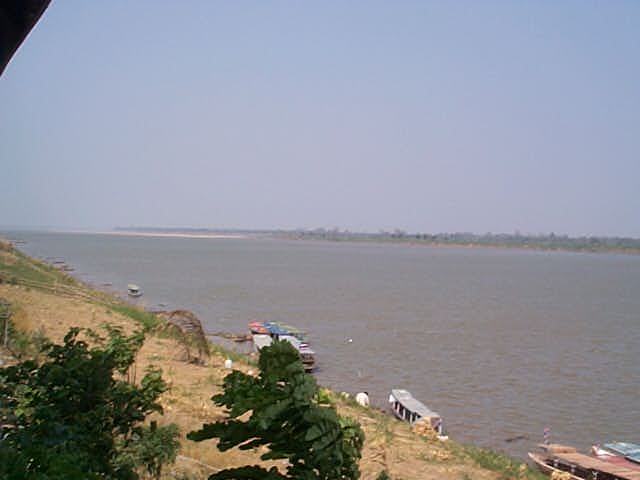
The Mekhong is a strange river. A river like any other, but full of marvels. It runs from the roof of the world, the Himalayans, cutting through gorges, cities, towns, paddy fields and forests. Sometimes it is wide, other where it can be dry and shallow, some places deep, churning, rocky. It is periodically lined by sandy beaches. The Nong Khai beach is rich with gold flecks. The river is peaceful, but many times carried the currents of war and illicit trafficking. Associated with it are myths of water dragons and mysterious floating fireballs. Rare white fresh water dolphins, giant catfishes share the waters with armed patrol boats and many other different kinds of exotic vessels. I would say that thanks to the river's fickle nature no major cities has yet clogged its shores.

As I remember my journey down that great mythical trip. In my mind's eye, I see myself standing on the balcony of a temple on top of a hill in the middle of an ancient 11th century capital of a lost kingdom.

As my fingers skim this slight keyboard of my white ibook with its blue screen, seeing these incredible words magically constructing themselves, I experience a surreal mosaic of time, space, and senses. The past, present, and future merged me into a certain space of my mind downloading itself into some obscure server in that infinite space of bits and bytes. My skin, bones, nose, ears, and eyes have been sent through a wondrous time machine, re-gathering itself to stand at that moment four years ago, on that other side of the world, disorienting from a spot on the concrete grid that is Toronto.

I stood in a palpitating moment of peace allowing a calm breeze to carry away the hazy heatwaves of humidity, cooling off my sweat, regaining my breath and regular heartbeat from the climb up the steps of that temple in the middle of that capital of the lost KIngdom of Laos, Luang Prabang. That same breeze had carried up a faraway melody of children's laughter from the foot of that hill. Its ringing melody was ocassionally drowned out by the staccato of street cars sounds and motor-cycle-powered boats gunning off the nearby banks of the Mekhong.

I am pulled back from the dream of that faraway ancient riverbank by the similarity of the thoughts that I am reminded of at that moment with those that this 21st century blogging tribeswoman has been thinking about on the edge of an information superhighway. The thoughts I wondered were: "Will this superway one day connect the diverse people who flash in and out along its banks? As it once connected the ice-age caveman to the rainforest hunter and food gatherers to delta rice growers to outrigger travelling seamen, will the modernizing dwellers along its banks overcome the artificial borders they have drawn in the spaces of their minds over the river's generous flow and allow its people to freely travel and thrive in multi-culturality again once more? So too, I wonder about the information superhighway that is the internet, will it unite its cutting edge techies of the E-age or will the segregration of peoples we have put in our minds simply transpose itself to this growing cyberspace cyberculture?"


Discuss

Friday, March 19, 2004

Tales of a modern tribal woman

A "non-literate/aural" in an obsolescing, electrically accelerated visual/linear world.

The merry-go-round disorient. I was born off the edge of Chaos. When I look back at that edge I feel that it was closer to near-death-static than to the alive, paradoxically orderly, complex edge of which I presently float in. Sakolnakorn is a town far away from the center of Thai politics, history, and economy. Time stands still in this town. Change happened so slowly and so little during the past 20 years that I hardly perceive it when I visit my mother, a true native tribal member of this changeless town. It was a place of birth, not the place that I grew up in. I have no town-mates I knew from kindergarden, no intimate pals I knew from the local high school alumni. Even as in a simple town life, a large part of the town are my distant cousins, aunts and uncles, I hardly know them.

My life is a constant reorientation. My family and I pack and re-pack our belongings nearly every two years. Even if we stayed in one city, there was always a reason to move to a new house. As I started to become aware of my identity during adolescence, I had these nagging feelings that I was somehow strangely out of place. As a youngster, because you grow up with the environment, there is an illusion that the neighborhood you play in is yours. My father's work took us to Lebanon when I was five. Being an Asian in Beirut during the late 60s and mid 70s was definitely not the norm. When we mentioned that we were from Thailand, very few people knew where it was. Yet when I was going through Grades 2 to 8 in a school where most kids came from different places and soon left for different places, I realized that, well, since I was one of the few class members who had been there since Grade two, I had somehow earned a status that opened me to groups of "non-others" that otherwise wouldn't have allowed me access. When I returned to Thailand as a quite disoriented teenager, I suffered the culture shock of going back to a culture that was mine but which I didn't have a clue about. I couldn't even speak Thai. So came the years of trying to belong. Maybe it would be more appropriate to call the period - the years of creating a belongingness in non-locality.

My Psyche gave me preliminary warnings of the ordeals she demanded as her due for passing through the dark nights of her world with an inflammed, congested gall bladder that was maybe unnecessarily removed. I obliviously throdded through her gates. Her breathe of wakening only hit me full in my face when I started falling apart internally at cocktails parties under my well-learnt mask of Thai politeness, graciousness, and the facade of a politically correct career woman, in the middle of a soon to be cut short career as a Thai diplomat. (I still carry the symtoms of vertigo whenever I engage with groups larger than about 12.) I was then in my early 30s, divorced and a single mother of a 3 years old boy who was starting to show symtoms of language confusion in an English-speaking Asian city-state that emulated a Western model of development.

So started my journeys of self-uncovering. Through this merry-go-round of disorientation I found the name of my tribe, by reading Marshall McLuhan. He named this new village, the Global Village, and so I recognized that I was in essence a non-literate, aural woman in an obsolescing, electrically accelerated visual/linear world.


Hopefully there will be more tales to come from this whimsical modern tribal woman.

Discuss

Sunday, February 15, 2004

Dilemma of a Reality Creator

For some time now, I've been probing the effects of a newly adopted belief: "The world is a conscious, participative, and intelligent universe". Through various sources I've constructed a personal ephemeral picture of a reality that is plasticy and fluid, a reality that constantly creates, deconstructs and recreates itself, a picture of multiple realities existing and interacting in porous co-existing multiple dimensions. I teased myself with questions concerning the laws and forces of such a world. I asked myself, "If all living entities are conscious and possess creative powers where together they create a ground for the physical reality that we feel, sense and experience, what would be the moral laws for co-existence in this reality? (I saw "living entities" being animals, plants, even inanimate objects, such as, the paper we write on, the computer we use, houses we live in, and ideas that we create, such as movies, political thought, and concepts of nation-state...what if they were all "alive" and each created their own realities? How would each of these realities connect, impact upon and interact with each other, and by what laws?)

What has been useful for me has been the application of observation to my own experiences when I feel that I am in such a moment of having created an alternative reality for myself. I have, for example, noticed that with each new level of perspective adopted, I am able to perceive a new reality upon the same kind of situation that I wouldn't have perceived with the old belief.

A example of this play, of experimenting with how 'what I choose to believe in' coloring my perception of reality, can be recounted through my most recent recreation of reality during my visit to Montreal and Quebec City. Always a new environment gives new input. What was unique about this experience was how within the structure of a dominant English-speaking majority of a nation-state,Canada, there exist as well, this strong culture of French-speaking people.

I found myself oscillating between the different realities, the very obvious outside realities of the French versus the English, between my outside and inner realities of being a person who constantly moves from one location to another nearly every two years, being confused several times about where my sense of identity belonged to. During this trip, we visited some old friends who had immigrated to Montreal from Singapore, a place in my past where we had originally met each other. So there was this extra pull of my old self then (working and not yet securely established in a family situation) and my other self of now (not working but quite established within a cross-cultural family). Then there was also the teasing question within my mind about the differences between the environment of a "developed" economy such as Canada, with all its complications of high taxes, employment situations, etc. with the intriguing contradiction of my background coming from a developing country where the economic situation was relatively lower in dollar sense, but much higher in many ways in the quality of life in non-monetary value sense. All through these provoking exploration of realities, I was of course, reconstructing my direct present-moment reality by redefining many values and beliefs I had previously just inherited from what the status quo "told", or you could say, "taught" me through "formal education".

One of the high point of this tour was when we visited the star shaped citadel on the "cliff" hanging over St. Lawrence river in Quebec City. This military structure was started by the French to help them fight against the British in the 17th century then was reconstructed as a fort by the British in the early 19th century to protect Canada against the invasion of the Americans. To me it was more like a symbol of power of the English-speaking nation-state imposed over the more dominant French-speaking people of Quebec, which quite frankly felt like a different country.

So many more questions came out as a result of my playful probing of reality and belief system. Here are some of them: In face of oscillating realities, what is a healthy operational mode? When we switch from one language to another in the process of translations (because I was operating in a four language mode during this trip), what happens when some meaning is lost in the translating? I saw the citadel in a way as a physical translation of culture and environment as well. This experential experience of my trip to Quebec really cannot be communicated through any form of written or spoken language. It can only be experienced, so culture is, in effect, truly a transformer of experience, and possibly a better translator than language itself? How do I resist from being completely converted by the consensus ground, and be more consistent with my own unique interpretation of reality that I accumulate through the actual events that I experience?

When I extrapolate some possible answers to the above line of questioning I found some intriguing answers through more questions such as, what if I am able to give up some sense of individuality, give up accustomed sense of national identity in exchange for a more universal group belongingness not restricted by imaginary borders?

The problem with all this reality reconstruction is, of course, that one could easily go off tangent. So it seems that there is some value in some form of consensus reality, isn't there? When a person can create, and edit his reality, there are so many alternatives possible. This seems to raise temptations to use judgment as selection criteria but isn't there a trap somewhere in judging? Because you have to decide on what is good and what is bad, based upon values and beliefs one is not so sure of anymore? Does that mean that impartiality and the recognition in the impermanent nature of all processes will become the most valuable cognition to have in a world of virtual reality?

Discuss

Friday, February 6, 2004

Cause of writer's block

Too many ideas and not knowing how to organize and put it all down. The excuse of waiting for a finished product actually stops the writing. I'm glad I got over my self-imposed block of wanting to write a summary of my presentation. Learning to live with the less than perfect seems to be part of my path.

Discuss