Another reminiscence from modern tribal woman:
It was February 2000. A cousin from Mexico sent us an email about his dream of traveling down the three greatest rivers of the world, the Amazon, the Nile, and the Mekhong. It dawned to us that we were sitting on the banks of his dream, the Mekhong. As it didn't seem likely that he would cross half the world to visit us any time soon, we decided to take the trip for him.
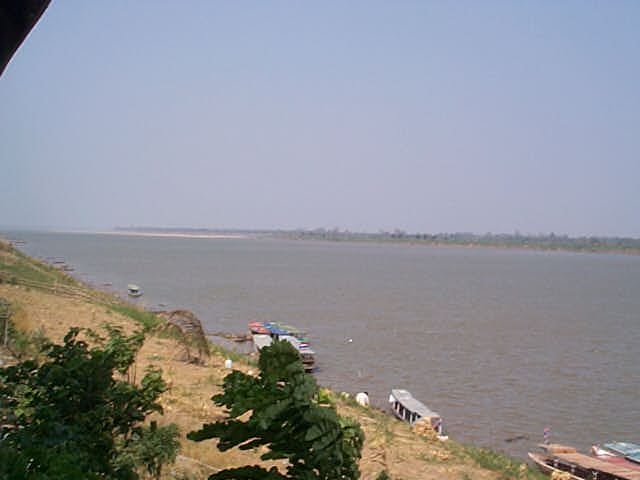
The Mekhong is a strange river. A river like any other, but full of marvels. It runs from the roof of the world, the Himalayans, cutting through gorges, cities, towns, paddy fields and forests. Sometimes it is wide, other where it can be dry and shallow, some places deep, churning, rocky. It is periodically lined by sandy beaches. The Nong Khai beach is rich with gold flecks. The river is peaceful, but many times carried the currents of war and illicit trafficking. Associated with it are myths of water dragons and mysterious floating fireballs. Rare white fresh water dolphins, giant catfishes share the waters with armed patrol boats and many other different kinds of exotic vessels. I would say that thanks to the river's fickle nature no major cities has yet clogged its shores.
As I remember my journey down that great mythical trip. In my mind's eye, I see myself standing on the balcony of a temple on top of a hill in the middle of an ancient 11th century capital of a lost kingdom.
As my fingers skim this slight keyboard of my white ibook with its blue screen, seeing these incredible words magically constructing themselves, I experience a surreal mosaic of time, space, and senses. The past, present, and future merged me into a certain space of my mind downloading itself into some obscure server in that infinite space of bits and bytes. My skin, bones, nose, ears, and eyes have been sent through a wondrous time machine, re-gathering itself to stand at that moment four years ago, on that other side of the world, disorienting from a spot on the concrete grid that is Toronto.
I stood in a palpitating moment of peace allowing a calm breeze to carry away the hazy heatwaves of humidity, cooling off my sweat, regaining my breath and regular heartbeat from the climb up the steps of that temple in the middle of that capital of the lost KIngdom of Laos, Luang Prabang. That same breeze had carried up a faraway melody of children's laughter from the foot of that hill. Its ringing melody was ocassionally drowned out by the staccato of street cars sounds and motor-cycle-powered boats gunning off the nearby banks of the Mekhong.
I am pulled back from the dream of that faraway ancient riverbank by the similarity of the thoughts that I am reminded of at that moment with those that this 21st century blogging tribeswoman has been thinking about on the edge of an information superhighway. The thoughts I wondered were: "Will this superway one day connect the diverse people who flash in and out along its banks? As it once connected the ice-age caveman to the rainforest hunter and food gatherers to delta rice growers to outrigger travelling seamen, will the modernizing dwellers along its banks overcome the artificial borders they have drawn in the spaces of their minds over the river's generous flow and allow its people to freely travel and thrive in multi-culturality again once more? So too, I wonder about the information superhighway that is the internet, will it unite its cutting edge techies of the E-age or will the segregration of peoples we have put in our minds simply transpose itself to this growing cyberspace cyberculture?"
Discuss
Friday, March 26, 2004




Saturday, March 20, 2004
Great Thai Blog!
I enjoyed visiting this webpage: Thailandlife which is another Thai webpage that I find has the characteristics of a blog, but with the format of a webpage, an interactive one at that. Thai culture is quite different from the western conventional, therefore Thais may not find blogging in the conventional format attractive. But as with the two websites I've found, that certainly hasn't stopped them from being creative and inventing their own style of "blogging".
What is interesting about the above website is its network of webpages, created by amateur webmasters of Sriwittayapaknam School. The school itself is novel in its experiment of teaching Thai kids to learn English by teaching them how to use the internet.
Discuss
What is interesting about the above website is its network of webpages, created by amateur webmasters of Sriwittayapaknam School. The school itself is novel in its experiment of teaching Thai kids to learn English by teaching them how to use the internet.
Discuss
Friday, March 19, 2004
Tales of a modern tribal woman
A "non-literate/aural" in an obsolescing, electrically accelerated visual/linear world.
The merry-go-round disorient. I was born off the edge of Chaos. When I look back at that edge I feel that it was closer to near-death-static than to the alive, paradoxically orderly, complex edge of which I presently float in. Sakolnakorn is a town far away from the center of Thai politics, history, and economy. Time stands still in this town. Change happened so slowly and so little during the past 20 years that I hardly perceive it when I visit my mother, a true native tribal member of this changeless town. It was a place of birth, not the place that I grew up in. I have no town-mates I knew from kindergarden, no intimate pals I knew from the local high school alumni. Even as in a simple town life, a large part of the town are my distant cousins, aunts and uncles, I hardly know them.
My life is a constant reorientation. My family and I pack and re-pack our belongings nearly every two years. Even if we stayed in one city, there was always a reason to move to a new house. As I started to become aware of my identity during adolescence, I had these nagging feelings that I was somehow strangely out of place. As a youngster, because you grow up with the environment, there is an illusion that the neighborhood you play in is yours. My father's work took us to Lebanon when I was five. Being an Asian in Beirut during the late 60s and mid 70s was definitely not the norm. When we mentioned that we were from Thailand, very few people knew where it was. Yet when I was going through Grades 2 to 8 in a school where most kids came from different places and soon left for different places, I realized that, well, since I was one of the few class members who had been there since Grade two, I had somehow earned a status that opened me to groups of "non-others" that otherwise wouldn't have allowed me access. When I returned to Thailand as a quite disoriented teenager, I suffered the culture shock of going back to a culture that was mine but which I didn't have a clue about. I couldn't even speak Thai. So came the years of trying to belong. Maybe it would be more appropriate to call the period - the years of creating a belongingness in non-locality.
My Psyche gave me preliminary warnings of the ordeals she demanded as her due for passing through the dark nights of her world with an inflammed, congested gall bladder that was maybe unnecessarily removed. I obliviously throdded through her gates. Her breathe of wakening only hit me full in my face when I started falling apart internally at cocktails parties under my well-learnt mask of Thai politeness, graciousness, and the facade of a politically correct career woman, in the middle of a soon to be cut short career as a Thai diplomat. (I still carry the symtoms of vertigo whenever I engage with groups larger than about 12.) I was then in my early 30s, divorced and a single mother of a 3 years old boy who was starting to show symtoms of language confusion in an English-speaking Asian city-state that emulated a Western model of development.
So started my journeys of self-uncovering. Through this merry-go-round of disorientation I found the name of my tribe, by reading Marshall McLuhan. He named this new village, the Global Village, and so I recognized that I was in essence a non-literate, aural woman in an obsolescing, electrically accelerated visual/linear world.
Hopefully there will be more tales to come from this whimsical modern tribal woman.
Discuss
The merry-go-round disorient. I was born off the edge of Chaos. When I look back at that edge I feel that it was closer to near-death-static than to the alive, paradoxically orderly, complex edge of which I presently float in. Sakolnakorn is a town far away from the center of Thai politics, history, and economy. Time stands still in this town. Change happened so slowly and so little during the past 20 years that I hardly perceive it when I visit my mother, a true native tribal member of this changeless town. It was a place of birth, not the place that I grew up in. I have no town-mates I knew from kindergarden, no intimate pals I knew from the local high school alumni. Even as in a simple town life, a large part of the town are my distant cousins, aunts and uncles, I hardly know them.
My life is a constant reorientation. My family and I pack and re-pack our belongings nearly every two years. Even if we stayed in one city, there was always a reason to move to a new house. As I started to become aware of my identity during adolescence, I had these nagging feelings that I was somehow strangely out of place. As a youngster, because you grow up with the environment, there is an illusion that the neighborhood you play in is yours. My father's work took us to Lebanon when I was five. Being an Asian in Beirut during the late 60s and mid 70s was definitely not the norm. When we mentioned that we were from Thailand, very few people knew where it was. Yet when I was going through Grades 2 to 8 in a school where most kids came from different places and soon left for different places, I realized that, well, since I was one of the few class members who had been there since Grade two, I had somehow earned a status that opened me to groups of "non-others" that otherwise wouldn't have allowed me access. When I returned to Thailand as a quite disoriented teenager, I suffered the culture shock of going back to a culture that was mine but which I didn't have a clue about. I couldn't even speak Thai. So came the years of trying to belong. Maybe it would be more appropriate to call the period - the years of creating a belongingness in non-locality.

My Psyche gave me preliminary warnings of the ordeals she demanded as her due for passing through the dark nights of her world with an inflammed, congested gall bladder that was maybe unnecessarily removed. I obliviously throdded through her gates. Her breathe of wakening only hit me full in my face when I started falling apart internally at cocktails parties under my well-learnt mask of Thai politeness, graciousness, and the facade of a politically correct career woman, in the middle of a soon to be cut short career as a Thai diplomat. (I still carry the symtoms of vertigo whenever I engage with groups larger than about 12.) I was then in my early 30s, divorced and a single mother of a 3 years old boy who was starting to show symtoms of language confusion in an English-speaking Asian city-state that emulated a Western model of development.
So started my journeys of self-uncovering. Through this merry-go-round of disorientation I found the name of my tribe, by reading Marshall McLuhan. He named this new village, the Global Village, and so I recognized that I was in essence a non-literate, aural woman in an obsolescing, electrically accelerated visual/linear world.
Hopefully there will be more tales to come from this whimsical modern tribal woman.
Discuss
Thursday, March 18, 2004
Somewhat a Thai "blog"
Since I've started blogging, I've been searching the internet to find what can be classified as "Thai blogs". Found many interesting things, but nothing close to what I was personally looking for until I had to do searches about Thai media ownership and discovered Busakorn's page. I find her style interesting because it is a webpage but has a weblog feel to it, and of course because she discusses media and being Thai. There was even a comment page added to it but she has control of what she wants to show.
Discuss
Discuss
Tuesday, February 17, 2004
A definition of globalism
Reading Mark Federman's document The Global Soul and the Global Village" (pdf), I attempt to extract a definition of the proposed concept of "globalism".
According to Mark who succeeds the work of Derrick de Kerckhove and Marshall McLuhan, globalism is different from the globalization of transnational enterprises. It is comforting to know that a global village is not anarchic but then one has to swallow its disturbing characteristic of non-uniformity, non-tranquility, discontinuity and division.
I find it interesting that the concept is an "-ism" and not "-ity". The "-ism" requires an action to be taken by the subject carrying that "-ism". Some common "-ism" I could recall of were "Buddhism, communism, nationalism". "-ity" seems to be a quality formed and perceived from an outside perspective, such as nationality which is given to you by the government or because you happen to be born in a certain geographical location.
This concept of globalism is described by Mark as a "a new modernity", a sort of post-postmodernism in which we are creating a new ground from the preceding ground of the postmodern that had shaken us from the even more conventional ground that was tied to geographic locale.
Mark refers to Pico Iyer's "Global Soul" and the challenge we face in forming this new identity. Here, I disagree with the perception that there is "no ground for cultural context or meaning". I think that the ground has simply shifted from nationalistic, border-confined ground to a larger more holistic ground of an Earth that is connected.

The most evoking symbol of this new ground would be the image of Earth seen as a precious, vulnerable, blue and white gem floating in space that was gifted to us through the camera lens of the Apollo astronauts. I think this new ground is one of teeming diversity, of a fully alive (and conscious?) bioshpere, where disunity, discontinuity and division can co-exist creatively as in an open complex living system where chaos is avoided through having entropy exported into the extra-dimensional scape of media, and entertainment or "play" of cyberspace.
This calls for an identification (or re-grounding) with a new cultural context that is acutally a larger geographical area. However, it is one that has more dimensional depth than just the physical, as well as one with emergent, ordered-chaotic diversity and non-unitary. I believe that once we have each personally experienced an understanding that no borders means proximity and realized that anything that affects you affects me immediately. This realization will flip Iyer's perception of "all rights and no responsibility" to one of self-chosen limited rights and voluntary undertaking of more responsibility than was ever expected at nationalistic level. This would have emerged from deep within a sense of self and identify that has experienced the world's connectivity and all its effects. This is the point where I agree with how Mark describes the nature of this new modernity as one in which we are experiencing as "experiential, as opposed to prescribed, pre-scripted and doctrinaire".
Discuss
According to Mark who succeeds the work of Derrick de Kerckhove and Marshall McLuhan, globalism is different from the globalization of transnational enterprises. It is comforting to know that a global village is not anarchic but then one has to swallow its disturbing characteristic of non-uniformity, non-tranquility, discontinuity and division.
I find it interesting that the concept is an "-ism" and not "-ity". The "-ism" requires an action to be taken by the subject carrying that "-ism". Some common "-ism" I could recall of were "Buddhism, communism, nationalism". "-ity" seems to be a quality formed and perceived from an outside perspective, such as nationality which is given to you by the government or because you happen to be born in a certain geographical location.
This concept of globalism is described by Mark as a "a new modernity", a sort of post-postmodernism in which we are creating a new ground from the preceding ground of the postmodern that had shaken us from the even more conventional ground that was tied to geographic locale.
Mark refers to Pico Iyer's "Global Soul" and the challenge we face in forming this new identity. Here, I disagree with the perception that there is "no ground for cultural context or meaning". I think that the ground has simply shifted from nationalistic, border-confined ground to a larger more holistic ground of an Earth that is connected.
The most evoking symbol of this new ground would be the image of Earth seen as a precious, vulnerable, blue and white gem floating in space that was gifted to us through the camera lens of the Apollo astronauts. I think this new ground is one of teeming diversity, of a fully alive (and conscious?) bioshpere, where disunity, discontinuity and division can co-exist creatively as in an open complex living system where chaos is avoided through having entropy exported into the extra-dimensional scape of media, and entertainment or "play" of cyberspace.
This calls for an identification (or re-grounding) with a new cultural context that is acutally a larger geographical area. However, it is one that has more dimensional depth than just the physical, as well as one with emergent, ordered-chaotic diversity and non-unitary. I believe that once we have each personally experienced an understanding that no borders means proximity and realized that anything that affects you affects me immediately. This realization will flip Iyer's perception of "all rights and no responsibility" to one of self-chosen limited rights and voluntary undertaking of more responsibility than was ever expected at nationalistic level. This would have emerged from deep within a sense of self and identify that has experienced the world's connectivity and all its effects. This is the point where I agree with how Mark describes the nature of this new modernity as one in which we are experiencing as "experiential, as opposed to prescribed, pre-scripted and doctrinaire".
Discuss
Subscribe to:
Posts (Atom)